


Root Microbiome Boosters Market Size to Surge to USD 686.4 Million by 2036
Root Microbiome Boosters Market Nutrient Efficiency and Root-Zone Performance Drive Agricultural Adoption
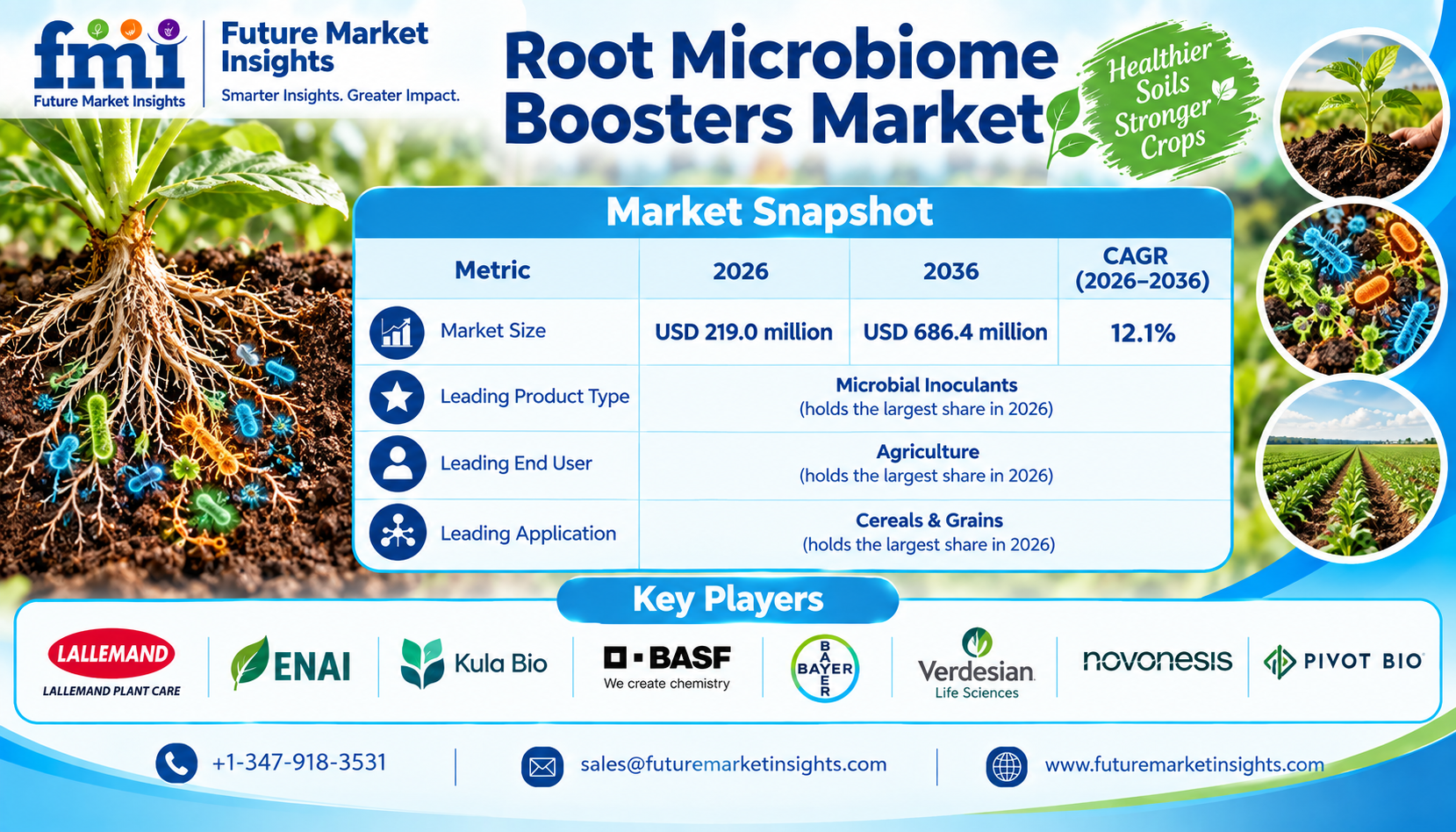
The global Root Microbiome Boosters Market is projected to grow from USD 219.0 million in 2026 to USD 686.4 million by 2036, advancing at a 12.1% CAGR during the forecast period, according to the latest research from Future Market Insights (FMI).
The market is supported by growing interest in improving nutrient efficiency without requiring farmers to replace established planting or fertility programs. Rising fertilizer costs are creating additional interest in microbial products that may improve nutrient access or nitrogen availability when field evidence demonstrates a measurable per-acre benefit.
Commercial adoption, however, depends heavily on the ability of suppliers to demonstrate consistent microbial performance under local soil, crop, and management conditions. Variability in soil response can lengthen qualification cycles as growers seek region-specific evidence before expanding microbial inputs across larger acreage.
Get Detailed Market Forecasts, Competitive Benchmarking, and Pricing Trends: https://www.futuremarketinsights.com/reports/sample/rep-gb-35346
Single-strain products are estimated to account for 41.7% of product type demand in 2026. Their simpler organism characterization can reduce validation complexity and provide manufacturers with a more straightforward proposition when establishing product performance across agricultural applications.
By crop type, cereals and grains are forecast to represent 41.6% of demand in 2026. Broad-acre crops provide opportunities for repeated per-acre performance testing, allowing growers and suppliers to evaluate the economic contribution of microbial inputs across larger production systems.
By application method, soil application is estimated to capture 48.7% of demand in 2026. Direct placement into the root-zone environment can be integrated with familiar field practices and equipment, supporting adoption where growers seek to introduce microbial products without substantially changing existing application workflows.
Analyst Perspective
"Root microbiome boosters earn repeat use only after viable organisms perform under the farm’s existing fertility and planting program. Commercial differentiation therefore depends on crop-specific field evidence plus handling instructions that preserve organism viability from storage through root-zone placement." — Nandini Roy Choudhury, Principal Consultant, Future Market Insights
Nutrient Efficiency Creates Commercial Demand
The increasing cost of conventional crop inputs is creating a commercial case for products designed to improve nutrient efficiency while complementing existing fertilizer and planting programs.
Farmers are increasingly interested in agricultural inputs that can demonstrate measurable benefits without requiring major changes to established production systems. Microbial nitrogen and nutrient-access products can therefore gain consideration when field trials demonstrate a reliable economic benefit on a per-acre basis.
The United States provides an important example of the commercial qualification challenge. Soil composition, crop management, organic carbon levels, and conservation practices can influence microbial establishment and community behavior. Consequently, suppliers may need location-specific field evidence before growers expand microbial products across wider acreage.
For manufacturers, demonstrating viable organism performance under practical farm conditions remains essential. Product handling, storage, application timing, and root-zone placement can all influence whether the expected microbial activity is achieved after commercialization.
Single-Strain Products Support Commercial Qualification
Single-strain products are expected to maintain a significant position in the market, representing 41.7% of product type demand in 2026.
Their relatively straightforward organism characterization can simplify validation requirements and provide manufacturers with a defined biological mechanism to evaluate during field testing.
However, commercial performance still depends on whether the selected organism remains viable and establishes effectively under different soil and crop conditions.
Suppliers therefore need to connect product specifications with practical application guidance. Maintaining organism viability from storage through field application becomes particularly important when microbial products are distributed across different climates, transportation conditions, and farm management systems.
Cereals and Grains Expand the Addressable Market
Cereals and grains are projected to account for 41.6% of crop-type demand in 2026, supported by the scale of broad-acre agricultural production and the opportunity to conduct repeated per-acre performance validation.
Large-scale cereal and grain production can provide a practical testing environment for microbial products because growers can compare treatment performance across substantial acreage and established fertility programs.
For suppliers, crop-specific evidence can help demonstrate whether root microbiome boosters provide sufficient nutrient-efficiency benefits to justify repeated use.
Commercial success therefore depends not only on microbial formulation but also on demonstrating performance under the soil, climate, fertility, and management conditions relevant to each crop-growing region.
Soil Application Remains the Leading Application Method
Soil application is estimated to represent 48.7% of application demand in 2026.
Direct placement into the soil and root-zone environment provides a familiar pathway for introducing microbial products into established agricultural programs. Existing field equipment and application practices can reduce the operational changes required for adoption.
The approach also places the microbial input close to the biological environment where root interactions occur. However, successful establishment remains dependent on soil conditions and the ability of the microorganisms to remain viable following handling and application.
Manufacturers therefore need to provide clear application instructions covering storage, handling, timing, dosage, and field placement.
Variable Soil Response Remains a Commercial Challenge
One of the principal commercial considerations for root microbiome boosters is the variability of microbial performance across soil environments.
Differences in soil organic carbon, conservation practices, nutrient availability, moisture, crop management, and existing microbial communities can influence microbial establishment and activity.
This variability can extend commercial qualification because growers may require local field evidence before committing to wider acreage deployment.
For manufacturers and distributors, this creates a need for robust regional trials and crop-specific performance data. Products that can demonstrate repeatable results under defined agricultural conditions may be better positioned to move from experimental trials into routine farm programs.
Regional Qualification Requirements Shape Market Development
Commercial qualification differs across major agricultural markets despite the common focus on root-zone microbial performance.
In the United States, suppliers may need localized field evidence because soil and management conditions can materially influence microbial establishment. Research involving agricultural sites across multiple U.S. locations has highlighted the relationship between microbial communities and factors including soil organic carbon and conservation management.
European markets introduce additional documentation and product-classification considerations. Germany and the United Kingdom can therefore require formal classification and documentation steps before products achieve broader channel adoption.
These differences increase the importance of regional regulatory planning, field validation, and technical documentation for manufacturers seeking international expansion.
Fertilizer Economics Support Trial Opportunities
High fertilizer costs provide an additional reason for growers to evaluate products designed to improve nutrient access or nitrogen efficiency.
According to the information cited in the FMI analysis, USDA Economic Research Service reported in March 2025 that fertilizer represented 33% to 44% of corn operating costs since 2020.
This cost exposure can create a trial opportunity for microbial inputs when suppliers can demonstrate measurable economic benefits without requiring growers to completely redesign existing fertility programs.
The commercial proposition therefore depends on evidence rather than biological claims alone. Growers need to understand whether a microbial treatment can deliver a sufficiently consistent per-acre benefit to justify product cost, application effort, and qualification time.
Competitive Landscape
The Root Microbiome Boosters Market includes agricultural biotechnology companies, microbial-input specialists, crop-science companies, and biological-product manufacturers.
Key companies identified by FMI include Lallemand Plant Care, ENAI, Kula Bio, BASF, Bayer Crop Science, Verdesian Life Sciences, Novonesis, and Pivot Bio.
Competition centers on microbial viability, crop-specific performance, nutrient-efficiency outcomes, formulation stability, application convenience, field evidence, and the ability to demonstrate repeatable results across different agricultural environments.
Suppliers are also competing through technical support and application guidance. Because microbial performance can vary with soil and management conditions, field-validation capabilities and regional agronomic knowledge remain important elements of commercial differentiation.
Market Outlook
The Root Microbiome Boosters Market is expected to expand as farmers and agricultural businesses evaluate biological products as complementary tools for nutrient-efficiency programs.
With the market projected to reach USD 686.4 million by 2036, suppliers will increasingly need to demonstrate measurable field performance rather than relying solely on broad biological positioning.
Single-strain products, cereal and grain applications, and soil-based delivery are expected to represent important areas of demand in 2026. At the same time, regional qualification requirements and variable soil response will continue to influence adoption timelines.
For manufacturers, the commercial opportunity lies in combining viable microbial formulations with crop-specific evidence, practical handling instructions, and economics that fit existing farm fertility and planting programs.
Read the Full Root Microbiome Boosters Market Report Future Market Insights – https://www.futuremarketinsights.com/reports/root-microbiome-boosters-market
Report Scope
FMI's Root Microbiome Boosters Market study covers market demand across key agricultural applications, examining product type, crop type, application method, regional markets, and competitive dynamics.
The study analyzes commercial adoption of root microbiome products, with particular attention to microbial viability, nutrient efficiency, field validation, application practices, and regional qualification requirements.
Explore the FMI research methodology: https://www.futuremarketinsights.com/methodology
Explore More Related Studies Published by FMI
Kombucha Market https://www.futuremarketinsights.com/reports/kombucha-market
Marine By-Products Market https://www.futuremarketinsights.com/reports/marine-by-products-market
Fat Filled Milk Powder Market https://www.futuremarketinsights.com/reports/fat-filled-milk-powder-market
Cultured Meat Market https://www.futuremarketinsights.com/reports/cultured-meat-market
About Future Market Insights (FMI)
Future Market Insights (FMI) delivers actionable, decision-focused market intelligence designed to support strategic business and investment decisions.
The company provides:
- In-depth pricing and cost benchmarking analysis
- Demand forecasting based on real industry inputs
- Procurement and buyer behavior insights
- Supply chain and trade flow intelligence
- Technology and application trend analysis across industries
FMI follows a bottom-up research methodology, combining insights from industry experts, procurement leaders, manufacturers, and technical professionals to provide practical market intelligence.
For Press & Corporate Inquiries
Rahul Singh
AVP – Marketing and Growth Strategy
Future Market Insights, Inc.
For Sales: sales@futuremarketinsights.com
For Media: Rahul.singh@futuremarketinsights.com
Web: https://www.futuremarketinsights.com/

 English
 Arabic
 French
 Spanish
 Portuguese
 Deutsch
 Turkish
 Dutch
Dutch
 Italiano
 Russian
 Romaian
 Portuguese (Brazil)