


Why 3D Rendering Has Become Essential for Modern Architecture Projects
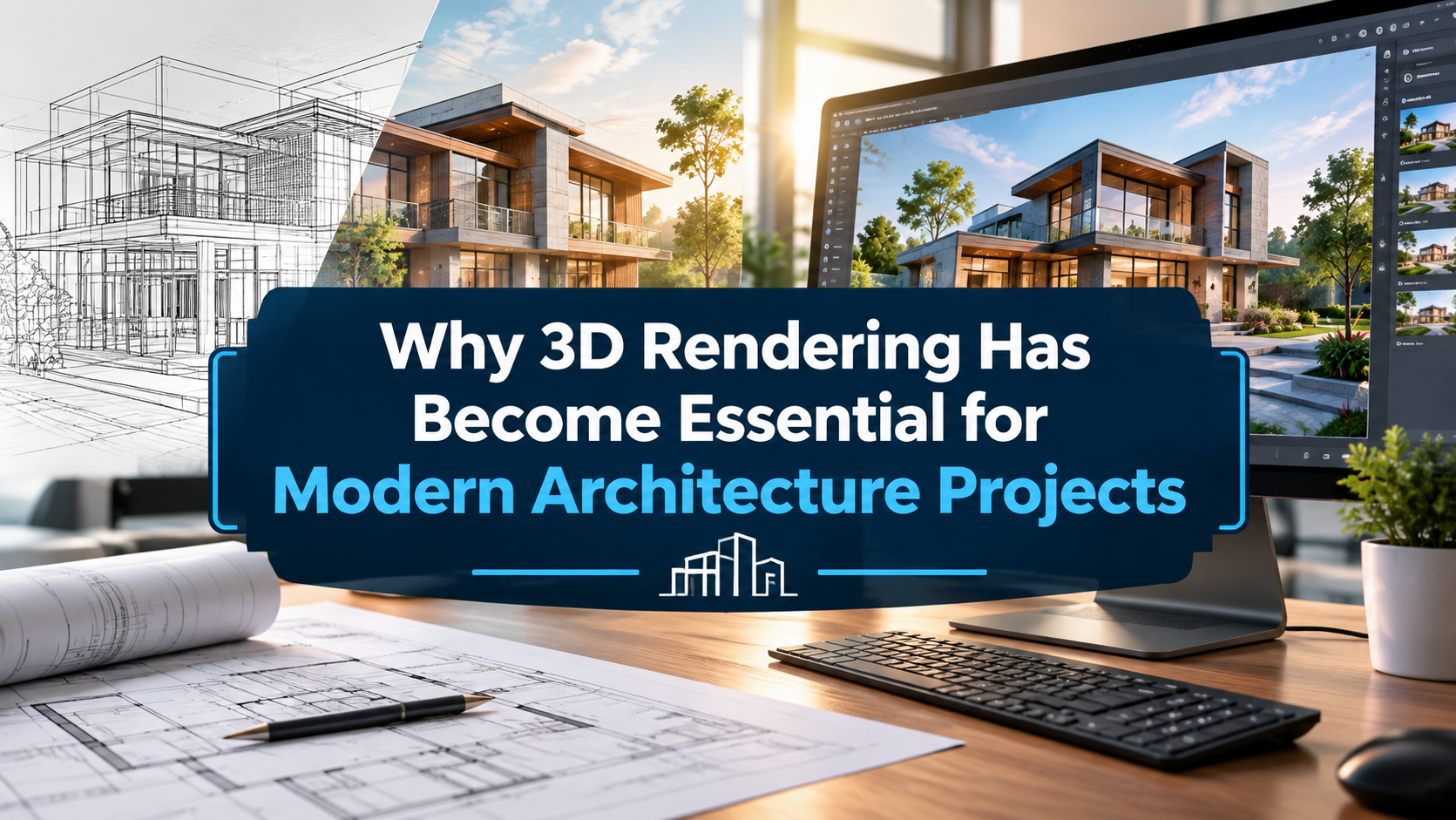
Not long ago, a set of blueprints and a hand-drawn elevation were enough to sell a design. Clients trusted the process, contractors filled in the gaps, and everyone hoped the final building matched what was in their heads. That approach doesn't hold up anymore. Today's clients, investors, and buyers expect to see a project before a single brick is laid and that shift is exactly why architectural 3D rendering has moved from a "nice extra" to a near-standard part of the design process.
What 3D Rendering Actually Solves
At its core, 3D rendering takes a flat design, a floor plan, an elevation, a CAD model and turns it into a photorealistic image or animation of the finished space. It sounds simple, but the impact on a project is significant.
Bridging the Gap Between Idea and Understanding
Most clients aren't trained to read architectural drawings. A wall section or a top-down floor plan means little to someone who isn't in the industry. A rendered image, on the other hand, needs no translation. Lighting, materials, proportions, and finishes are all visible at a glance, which means fewer misunderstandings and far less back-and-forth trying to explain what a drawing "actually means."
Catching Design Problems Before Construction Starts
It's one thing to see a floor plan on paper and another to walk through a rendered version of that same space. Awkward sightlines, cramped transitions, or a room that reads smaller than intended tend to show up clearly in a 3D render while they're still cheap and easy to fix, rather than after construction has already begun.
Making Marketing and Sales Materials Actually Convert
For developers and real estate teams, renderings aren't just a design tool, they're a sales tool. A polished, photorealistic image of a property does far more to secure pre-sales or attract investors than a technical drawing ever could. Firms offering professional 3D rendering services typically build this dual purpose into their process, producing visuals that work equally well in a client meeting and in a marketing brochure.
The Different Types of Architectural Visualization
Rendering isn't a single service; it covers a range of outputs depending on what a project needs.
Exterior Renderings
Exterior renders show how a building sits within its surroundings: landscaping, lighting conditions, neighboring structures, and the overall street presence of the design. These are often the first image a client or investor ever sees of a project, so they tend to get the most attention and polish.
Interior Renderings
Interior renders focus on how a space will actually feel to move through finishes, furniture layout, natural light, and material choices. This is especially valuable for residential and hospitality projects, where the interior experience often matters more to a buyer than the building's exterior.
Walkthroughs and Animations
Static images tell part of the story, but a walkthrough animation lets a viewer move through a space the way they would in real life. These are particularly effective for larger commercial or mixed-use developments, where a single image can't capture how the different areas of a building connect.
3D Floor Plans and Site Visualizations
For projects still in the planning or approval stage, 3D floor plans and site visualizations help stakeholders understand layout and scale without needing to interpret a technical drawing. They're also useful during permitting and approval processes, where clarity can speed up decision-making.
Who Actually Benefits From Rendering Services
Architects and Designers
Renderings give architects a way to test and present design decisions before they're locked in, and to communicate their vision clearly to clients who don't read blueprints.
Real Estate Developers
For developers, renderings drive pre-sales, support fundraising, and give marketing teams high-quality visuals long before a project is physically built.
Interior Designers
Interior-focused renders let designers show furniture placement, material palettes, and lighting choices in a way that's far easier for clients to evaluate than a mood board alone.
Builders and Contractors
Detailed renderings can also help contractors visualize complex design elements ahead of time, reducing costly misinterpretations during construction.
Choosing a Rendering Partner
Not every rendering studio delivers the same level of quality or turnaround. When evaluating a provider, it's worth looking at a few things:
-
Portfolio depth: do their past projects match the style and scale of your work?
-
Turnaround time: can they realistically meet your project deadlines?
-
Do they cover interior, exterior, animation, and drafting, or only one narrow offering?
-
Communication process: how many revision rounds are included, and how are changes handled?
Studios that specialize specifically in architectural visualization, rather than general 3D graphics, tend to understand the technical and presentation needs of architecture and real estate projects more intuitively.
Final Thoughts
Architectural visualization has shifted from a luxury add-on to a practical necessity, especially in a market where clients expect to see a finished project long before it exists. Whether the goal is refining a design, securing approvals, or closing a sale, working with an experienced provider of 3D rendering services can make the difference between a project that's hard to explain and one that sells itself.

 English
 Arabic
 Spanish
 Portuguese
 Deutsch
 Turkish
 Dutch
Dutch
 Italiano
 Russian
 Romaian
 Portuguese (Brazil)
 Greek
Greek