


Protein Bagels Market Poised to Touch USD 5.1 Billion Valuation by 2036
Protein Bagels Market as Protein-Enriched Bakery Products Gain Momentum
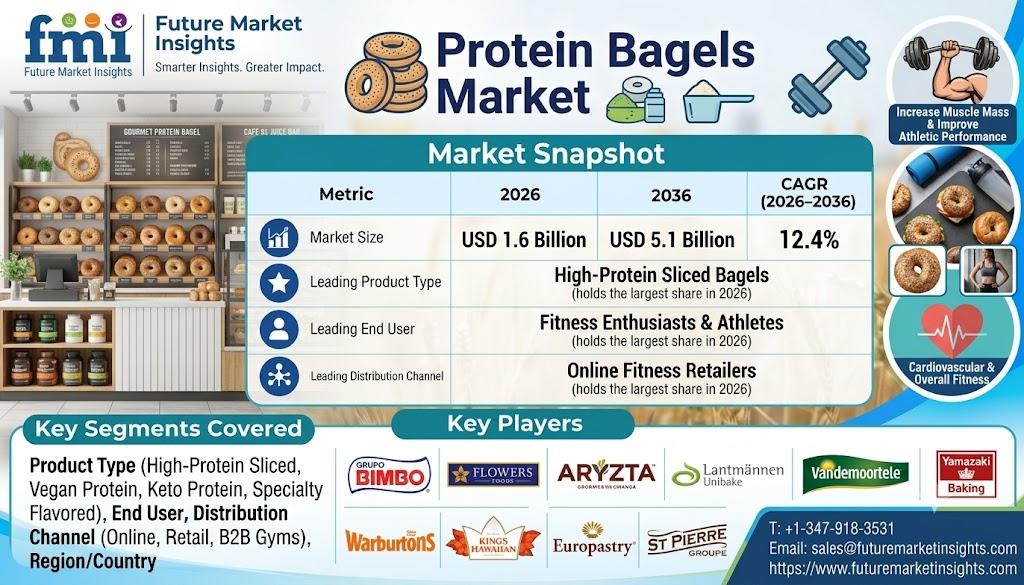
The global Protein Bagels Market is projected to grow from USD 1.6 billion in 2026 to USD 5.1 billion by 2036, advancing at a 12.4% CAGR during the forecast period, according to the latest research from Future Market Insights (FMI).
The market is benefiting from increasing consumer interest in higher-protein foods that can fit into familiar breakfast, snacking, and sandwich occasions. Protein bagels provide a convenient way to increase protein intake without requiring consumers to adopt unfamiliar food formats or separate supplementation routines.
Get Detailed Market Forecasts, Competitive Benchmarking, and Pricing Trends: https://www.futuremarketinsights.com/reports/sample/rep-gb-35272
Plain protein bagels are forecast to account for 23.0% of product type demand in 2026. Their broad compatibility with both sweet and savory toppings makes plain products suitable for breakfast, sandwiches, snacks, and multiple consumption occasions.
By claim nature, conventional products are estimated to capture 57.0% of demand in 2026. Conventional formulations benefit from established bakery processing systems, mainstream pricing structures, and fewer formulation constraints compared with products carrying specialized claims.
By format, fresh protein bagels are projected to represent 30.0% of demand in 2026. Fresh products benefit from immediate aroma, chew, and texture cues that consumers commonly associate with high-quality bagels.
Analyst Perspective
"Protein bagels earn shelf space when manufacturers treat protein content as a formulation constraint instead of a marketing layer. A durable offer preserves familiar chew and documents the nutrition claim while staying inside the channel's waste and pack economics." — Nandini Roy Choudhury, Principal Consultant, Future Market Insights
Protein-Enrichment Trends Create Commercial Demand
Commercial adoption increasingly depends on integrating meaningful protein content into a familiar bakery format without compromising the characteristic chew, texture, flavor, and appearance expected from bagels.
Consumer interest in protein-rich diets is creating a clear nutrition opportunity for bakery manufacturers. Protein bagels can enter established breakfast and sandwich routines, allowing consumers to increase protein intake without introducing a separate supplement or specialized food occasion.
However, protein enrichment can affect dough hydration, texture, flavor, and processing requirements. Manufacturers therefore need to balance protein concentration with the sensory characteristics that encourage repeat purchase.
Credible nutritional positioning is also becoming increasingly important. As packaged-food labeling requirements evolve across markets, manufacturers need reliable ingredient documentation and accurate nutrition information to support protein claims.
For suppliers, maintaining consistent protein content, familiar chew, acceptable flavor, portion economics, and production efficiency remains essential as protein bagels expand across retail and foodservice channels.
Conventional Formulations and Fresh Formats Support Mainstream Adoption
Conventional protein bagels maintain a significant position because manufacturers can integrate protein ingredients into established bakery systems while retaining familiar processing routes.
Conventional products can also support mainstream price points, allowing manufacturers to target consumers who are interested in additional protein without necessarily seeking specialized organic, clean-label, gluten-free, or other premium claims.
Fresh formats similarly benefit from the sensory characteristics associated with freshly produced bakery products. Aroma, chew, softness, and crust quality can influence purchase decisions, particularly when protein enrichment creates additional formulation challenges.
For manufacturers and distributors, maintaining product quality throughout storage and distribution remains important. Changes in moisture, texture, and protein-related formulation characteristics can affect the final eating experience and increase the risk of waste.
Familiar Breakfast and Sandwich Occasions Expand Household Consumption
One of the primary commercial opportunities for protein bagels is their ability to fit into established eating routines.
Unlike specialized protein products that may require consumers to adopt a new consumption habit, bagels are already associated with breakfast, sandwiches, snacks, and quick meals. Protein enrichment therefore allows manufacturers to add a nutritional proposition while retaining a familiar format.
Plain varieties can be paired with sweet or savory toppings, expanding their use across multiple dayparts. Cream cheese, eggs, vegetables, spreads, meat, and other toppings can be combined with protein bagels to create different meal and snack occasions.
Retail distribution can further broaden household consumption as supermarkets, grocery stores, convenience outlets, and bakery sections provide consumers with accessible protein-focused alternatives.
For manufacturers, packaging and portion formats that communicate protein content clearly while preserving freshness can help support repeat purchases.
Formulation Cost and Labeling Compliance Govern Commercial Performance
Although protein enrichment creates a strong market opportunity, formulation economics remain an important consideration.
Protein ingredients can increase manufacturing costs, while higher inclusion levels may require changes to hydration, mixing, fermentation, baking, and quality-control processes.
Manufacturers must therefore balance protein concentration with acceptable retail pricing and sensory performance. A product with a high protein claim may struggle to achieve repeat purchase if its texture, flavor, or price differs significantly from consumer expectations.
Labeling requirements represent another commercial consideration. Protein claims must be supported by accurate nutritional information and appropriate documentation, while requirements can vary between markets.
Manufacturers operating across multiple countries may therefore need market-specific labeling, ingredient declarations, nutritional testing, and claim verification.
Companies that can maintain credible protein content while controlling formulation costs and preserving familiar bagel characteristics are better positioned to expand across retail and foodservice channels.
Higher-Protein Snacking Creates New Consumption Opportunities
Protein bagels can extend beyond traditional breakfast occasions into afternoon snacks, post-workout meals, lunch sandwiches, and convenient on-the-go consumption.
Their familiar shape and preparation flexibility allow consumers to combine protein bagels with a broad range of toppings and fillings, creating opportunities across multiple consumption occasions.
Individual portions and convenient packaged formats can further support household and on-the-go consumption while allowing manufacturers to communicate protein content directly on packaging.
The expansion of protein-focused bakery products also creates opportunities to compete with protein breads, wraps, breakfast products, snack bars, and other functional bakery alternatives.
For protein bagel manufacturers, the commercial opportunity depends on delivering a meaningful nutrition proposition without sacrificing the recognizable chew and flavor expected from traditional bagels.
Regional Growth Reflects Protein Demand and Bakery Distribution
Market adoption varies across major economies as consumer interest in protein, bakery consumption patterns, retail infrastructure, labeling requirements, and foodservice development differ by country.
Growing consumer attention toward protein intake is creating opportunities for bakery manufacturers to incorporate nutritional positioning into established food formats.
Retail bakery networks provide manufacturers with opportunities to introduce protein bagels through supermarkets, grocery stores, convenience channels, and specialty bakery outlets, while foodservice operators can incorporate them into breakfast and sandwich menus.
However, local labeling regulations and differences in permitted nutrition claims require manufacturers to adapt packaging and communication strategies by market.
As distribution expands, suppliers that can combine reliable protein content, familiar sensory performance, competitive pricing, and compliant labeling can address a wider range of commercial channels.
Competitive Landscape
The Protein Bagels Market features global bakery companies, specialty bread manufacturers, prepared-food suppliers, and established foodservice-oriented brands.
Key companies identified by FMI include Grupo Bimbo, Flowers Foods, Aryzta, Lantmännen Unibake, Vandemoortele, Yamazaki Baking, Warburtons, King's Hawaiian, Europastry, and St Pierre Groupe.
Competition centers on protein content, taste, texture, formulation efficiency, price positioning, packaging, nutritional transparency, distribution reach, and the ability to preserve familiar bagel characteristics.
The market remains closely connected to broader trends in protein-focused food consumption, as manufacturers seek to incorporate higher protein levels into everyday bakery products rather than relying exclusively on specialized nutrition products.
For established bakery companies, existing manufacturing infrastructure and distribution networks can provide opportunities to introduce protein bagels across mainstream retail and foodservice channels.
To explore how FMI Custom Research can support your strategic priorities, please connect with our team at – sales@futuremarketinsights.com
About Future Market Insights (FMI)
Future Market Insights (FMI) delivers actionable, decision-focused market intelligence designed to support strategic business and investment decisions.
The company provides:
- In-depth pricing and cost benchmarking analysis
- Demand forecasting based on real industry inputs
- Procurement and buyer behavior insights
- Supply chain and trade flow intelligence
- Technology and application trend analysis across industries
FMI follows a bottom-up research methodology, combining insights from industry experts, procurement leaders, manufacturers, and technical professionals to provide practical market intelligence.
For Press & Corporate Inquiries
Rahul Singh AVP – Marketing and Growth Strategy
Future Market Insights, Inc.
Web: https://www.futuremarketinsights.com

 English
 Arabic
 French
 Spanish
 Portuguese
 Deutsch
 Turkish
 Italiano
 Russian
 Romaian
 Portuguese (Brazil)
 Greek
Greek