


B-Cell Depletion Therapy Market Competitive Landscape Driven by Biologic Drug Innovation
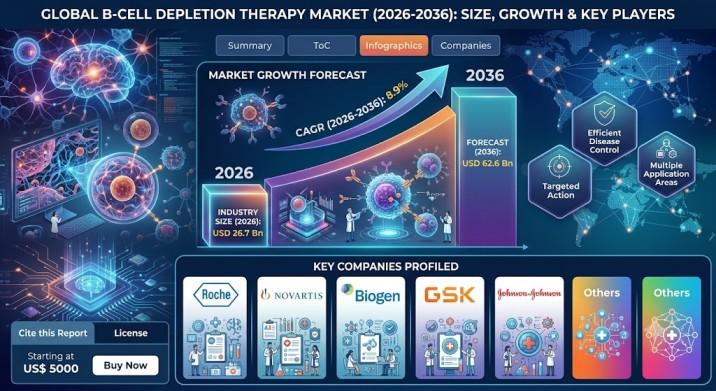
NEWARK, Del. — The global B-Cell Depletion Therapy Market is projected to increase from USD 26.7 billion in 2026 to USD 62.6 billion by 2036, expanding at a CAGR of 8.9% during 2026–2036, according to Future Market Insights. Market expansion is being supported by the rising prevalence of autoimmune and hematologic conditions, broader adoption of next-generation B-cell therapies, increasing hospital infusion capacity, specialty pharmacy networks, expanded indications, and the integration of B-cell depletion therapies into treatment guidelines.
The report states that demand is increasingly shaped by clinical evidence, expanded indication approvals, and guideline integration. Clinical trials demonstrating sustained remission, improved quality of life, and manageable safety profiles are supporting broader use in earlier disease stages and additional autoimmune and hematologic conditions.
👉 Get Detailed Market Forecasts, Competitive Benchmarking, and Pricing Trends:
https://www.futuremarketinsights.com/reports/sample/rep-gb-30366
Global Segment Leaders
· Product Type — Anti-CD20 monoclonal antibodies: 70% share. Established clinical efficacy across multiple B-cell-mediated conditions, predictable depletion kinetics, standardized dosing protocols, extensive outcome data, and reimbursement familiarity support the segment's leading position.
· Application — Autoimmune diseases: 60% share. Durable benefits in conditions driven by aberrant antibody production and immune activation, together with chronic disease management and repeat treatment cycles, support the segment's leading demand position.
· End User — Hospital infusion centers: 55% share. B-cell depletion therapies require intravenous administration, patient monitoring, specialized handling, and adherence to immunotherapy protocols, supporting demand through hospital-based infusion infrastructure.
Country-Level Performance
|
Country |
CAGR |
Key Growth Driver |
|
India |
11.2% |
Increasing autoimmune disease prevalence, adoption of biologic therapies, rising patient awareness, healthcare infrastructure expansion, and recurring therapy cycles. |
|
China |
11.0% |
Expansion of hospitals, specialty clinics, and autoimmune treatment programs, alongside rising healthcare infrastructure, patient awareness, and recurring therapy cycles. |
|
Brazil |
10.5% |
Increasing awareness of autoimmune conditions, expansion of specialty care programs, government healthcare initiatives, and recurring treatment schedules. |
|
USA |
10.0% |
Increasing adoption of monoclonal antibodies and biologic therapies, regulatory approvals, established healthcare infrastructure, and recurring treatment cycles. |
|
Germany |
8.2% |
Regulatory standards, autoimmune treatment protocols, specialty care infrastructure, and recurring therapy cycles. |
Note: The fetched FMI page provides the above country-level CAGR figures and country-specific growth explanations but does not attribute those country drivers to separate external organizations or provide organization-specific statistics such as dated reports from ACM, government agencies, or other named sources. The drivers above therefore reproduce the report's own country analysis rather than adding external sources.
Regional Context
The faster-growing countries identified on the report page are India, China, Brazil, and the USA, with CAGRs ranging from 10.0% to 11.2%. India is supported by increasing autoimmune disease prevalence, biologic therapy adoption, patient awareness, and expanding healthcare infrastructure. China is benefiting from hospital modernization, specialty care expansion, healthcare infrastructure development, and recurring treatment cycles. Brazil's growth is linked to increasing awareness, specialty care programs, government healthcare initiatives, and recurring treatment schedules, while the USA benefits from established healthcare infrastructure, biologic therapy adoption, regulatory approvals, and recurring treatment cycles.
Germany represents the slower-growth country among the five countries for which FMI publishes CAGR figures on the page, at 8.2%. Its market is described as being supported by mature healthcare systems, regulatory standards, autoimmune treatment protocols, specialty centers, and consistent procurement associated with recurring therapy cycles.
The full report covers Asia Pacific, Europe, North America, Latin America, and the Middle East & Africa, with country-level coverage extending across China, Japan, South Korea, India, Australia & New Zealand, ASEAN, Germany, the United Kingdom, France, Italy, Spain, Nordic, BENELUX, the United States, Canada, Mexico, Brazil, Chile, Saudi Arabia, Turkey, South Africa, and other regional markets.
👉 Access the Complete Report in PDF Format:
https://www.futuremarketinsights.com/reports/brochure/rep-gb-30366
Competitive Landscape
The key companies profiled in the B-Cell Depletion Therapy Market are Roche, Novartis, Biogen, GSK, and Johnson & Johnson, alongside other participants. FMI states that Roche focuses on lifecycle extension strategies including formulation improvements, dosing flexibility, and broad label maintenance. Novartis and Biogen emphasize selective indication targeting and clinical trial strategies for specific patient subgroups. GSK and Johnson & Johnson emphasize administration models that can reduce the burden on infusion centers, support outpatient delivery, or lower long-term monitoring requirements. The report also notes investment in real-world evidence, safety registries, and post-marketing studies as companies address payer and clinician confidence amid biosimilar competition.
The fetched report page does not contain a separately identified “Key Developments” section or dated company-development entries. Accordingly, no month/year-specific company development has been added to avoid introducing information that is not present on the FMI page.
About Future Market Insights
Future Market Insights (FMI) is a leading provider of market research and consulting services, offering syndicated and customized research across industries including healthcare, pharmaceuticals, and medical devices.
Access Full Report: https://www.futuremarketinsights.com/reports/b-cell-depletion-therapy-market
Related Reports:
· https://sites.google.com/view/healthcarewellnessinsights/genome-engineering-organ-transplant-market
About Future Market Insights (FMI)
Future Market Insights (FMI) is a global market intelligence and consulting firm providing comprehensive market research, competitive intelligence, and strategic business insights across industries. The firm delivers detailed forecasts, technology analysis, and data-driven recommendations that support informed decision-making for manufacturers, investors, distributors, and policymakers worldwide.
For Press & Corporate Inquiries
Rahul Singh
AVP – Marketing and Growth Strategy
Future Market Insights, Inc.
+91 8600020075
For Sales – sales@futuremarketinsights.com
For Media – Rahul.singh@futuremarketinsights.com
For Web – https://www.futuremarketinsights.com

 English
 Arabic
 French
 Spanish
 Portuguese
 Deutsch
 Turkish
 Dutch
Dutch
 Italiano
 Romaian
 Portuguese (Brazil)
 Greek
Greek