


Kidney Transplant Market Development Supported by Advances in Immunosuppressive Care
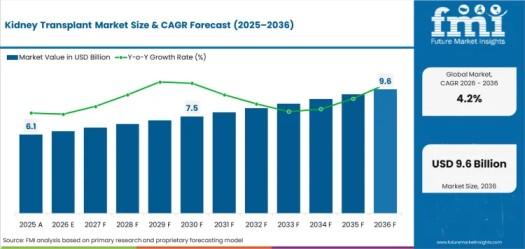
NEWARK, Del. — The global Kidney Transplant Market is projected to increase from USD 6.39 billion in 2026 to USD 9.64 billion by 2036, expanding at a 4.2% CAGR from 2026 to 2036. The market was valued at approximately USD 6.18 billion in 2025. Growth is being supported by expanding transplant-program capacity, greater recognition of transplantation as a preferred treatment for end-stage renal disease compared with long-term dialysis, expansion of living-donor programs, advances in immunosuppression, and organ-preservation technologies. FMI's source bibliography includes the European Commission's 2024 EU Directive on Standards of Quality and Safety of Human Organs Intended for Transplantation, reflecting the regulatory standards surrounding organ transplantation.
Get Detailed Market Forecasts, Competitive Benchmarking, and Pricing Trends: https://www.futuremarketinsights.com/reports/sample/rep-gb-16754
FMI Principal Consultant Anurag Sharma says, “The kidney transplant market is shaped by organ availability constraints more than pharmaceutical or surgical innovation.” He adds that investment in ex vivo organ perfusion technology, immunosuppression regimen optimization, and living-donor program support is creating opportunities across the transplant care continuum as healthcare systems prioritize transplantation over long-term dialysis for eligible end-stage renal disease patients.
Global Segment Leaders
- Transplant Type — Living-Donor Kidney Transplant: 58.9% share in 2026. Living donation leads because of higher organ availability, superior long-term graft-survival outcomes, shorter waiting times, shorter cold ischemia time, and elective scheduling advantages.
- Age Group — Adult: 76.4% share in 2026. Adults represent the largest age-group segment, reflecting the primary end-stage renal disease population served by kidney transplantation.
- End User — Hospitals: 52.7% share in 2026. Hospitals lead because they provide the core surgical infrastructure and serve the primary end-stage renal disease population requiring transplantation.
- Procedure Type — Open Kidney Transplant: 54.8% share. Open transplantation remains the established surgical approach for recipient nephrectomy and allograft implantation across transplant centers.
- Donor Type — No leading share disclosed. FMI segments this category into living donors and deceased donors, with further classifications for related, unrelated altruistic, brain-dead, and cardiac-death donors, but does not publish a leading percentage share on the accessible page.
- Post-Transplant Care — No leading share disclosed. FMI covers acute rejection management, infection management, and long-term monitoring, but does not provide a leading percentage share for this category on the page.
Country-Level Performance
|
Country |
CAGR |
Key Growth Driver |
|
India |
3.3% |
The Transplantation of Human Organs Act (THOA) provides the regulatory framework, while the National Organ and Tissue Transplant Organisation (NOTTO) coordinates deceased-donor programs; expanding transplant capacity at corporate hospitals and government medical colleges is increasing living-donor transplant volumes. |
|
USA |
3.2% |
UNOS coordinates organ allocation, while Medicare ESRD coverage provides transplant and immunosuppression reimbursement for eligible patients; the USA also performs the highest volume of kidney transplants globally. |
|
China |
3.1% |
The China Organ Transplant Response System (COTRS) improves transparency and matching efficiency, while the voluntary citizen donation system expands deceased-donor availability. |
|
UK |
2.9% |
NHS Blood and Transplant coordinates national organ procurement and allocation, while opt-out organ-donation legislation in England and Wales is expected to increase deceased-donor availability. |
|
South Korea |
2.8% |
The accessible FMI page publishes the 2.8% CAGR but does not provide a separate South Korea country-analysis section with a specific supporting statistic or organization. |
|
France |
2.7% |
The Agence de la Biomédecine coordinates organ procurement under a presumed-consent framework, while universal health insurance covers transplant procedures and immunosuppression therapy. |
|
Australia-New Zealand |
2.7% |
The accessible FMI page publishes the 2.7% CAGR but does not provide a separate Australia-New Zealand country-analysis section with a specific supporting statistic or organization. |
|
Italy |
2.6% |
The accessible FMI page publishes the 2.6% CAGR but does not provide a separate Italy country-analysis section with a specific supporting statistic or organization. |
|
Germany |
2.4% |
Eurotransplant organ sharing supports allocation, while legislative efforts to increase donation willingness address the persistent organ-donor shortage constraining transplant volumes. |
|
Japan |
2.3% |
The accessible FMI page publishes the 2.3% CAGR but does not provide a separate Japan country-analysis section with a specific supporting statistic or organization. |
FMI states that the broader study covers 30+ countries.
Regional Context
Faster-growing markets: India and the USA record the highest published country CAGRs at 3.3% and 3.2%, respectively. India's market is supported by expanding transplant-center capacity, living-donor programs, the THOA regulatory framework, and NOTTO's role in deceased-donor procurement. The USA benefits from the world's highest kidney-transplant volume, UNOS-coordinated organ allocation, established living-donor evaluation programs, and Medicare ESRD coverage for transplantation and immunosuppression.
Intermediate-growth markets: China and the UK record CAGRs of 3.1% and 2.9%. China's voluntary citizen-based donation system and COTRS allocation platform are improving deceased-donor availability and allocation efficiency. In the UK, NHS Blood and Transplant coordinates organ procurement and allocation, while opt-out donation legislation is expected to gradually increase deceased-donor availability.
Moderate-growth markets: South Korea, France, Australia-New Zealand, and Italy record CAGRs between 2.6% and 2.8%. FMI provides detailed country reasoning for France, where presumed consent, Agence de la Biomédecine coordination, established transplant centers, and universal health insurance support transplant activity; the accessible page does not provide equivalent detailed country analysis for South Korea, Australia-New Zealand, or Italy.
Slower-growth markets: Germany and Japan record the lowest two published CAGRs at 2.4% and 2.3%. Germany's growth is constrained by a persistent organ-donor shortage despite established surgical capabilities, while Eurotransplant allocation and legislative efforts to increase donation willingness address the supply gap. The accessible FMI page does not provide a separate Japan-specific growth-driver analysis.
The full report covers North America, Latin America, Europe, East Asia, South Asia and Pacific, and the Middle East & Africa, with 30+ countries included in its geographic scope.
Access the Full Kidney Transplant Market Report: https://www.futuremarketinsights.com/reports/kidney-transplant-market
Competitive Landscape
Key companies profiled in the Kidney Transplant Market include Novartis AG, Sanofi S.A., Pfizer Inc., Veloxis Pharmaceuticals, Inc., AbbVie Inc., Astellas Pharma Inc., F. Hoffmann-La Roche Ltd., Bristol-Myers Squibb Company, Medtronic plc, TransMedics Group, Inc., BioMérieux SA, OrganOx Limited, XVIVO Perfusion AB, and Terumo Corporation. FMI identifies Novartis as having a strong competitive position based on technical capability, existing relationships, and portfolio breadth. Sanofi, Pfizer, and Veloxis compete through specialized capabilities and targeted approaches, while other companies are establishing positions through regional specialization or niche applications.
In 2025, Novartis AG continued to strengthen its kidney-transplant therapeutics position through Certican (everolimus) and Myfortic (mycophenolic acid), focusing on long-term immunosuppression management, reduced calcineurin-inhibitor toxicity, and graft-survival outcomes. Also in 2025, Sanofi S.A. maintained its presence through Thymoglobulin (anti-thymocyte globulin), an induction therapy used in kidney transplantation, while supporting clinical programs and supply-chain stability, including in emerging markets such as India.
About Future Market Insights
Future Market Insights (FMI) is a leading provider of market research and consulting services, offering syndicated and customized research across industries including healthcare, pharmaceuticals, and medical devices.
Related Reports:
· The global liver transplantation market is expected to reach approximately USD 1.60 billion in 2025 and expand to nearly USD 3.00 billion by 2035, registering a CAGR of 6.5% over the forecast period.
· The bone marrow transplant market is estimated at USD 11.4 billion in 2026 and is forecast to reach USD 14.9 billion by 2036 at a 2.7% CAGR.
· The Senior In-Home Care Services Market is projected to reach USD 2695.7 million by 2035, registering a compound annual growth rate (CAGR) of 6.6% over the forecast period.
About Future Market Insights (FMI)
Future Market Insights (FMI) is a global market intelligence and consulting firm providing comprehensive market research, competitive intelligence, and strategic business insights across industries. The firm delivers detailed forecasts, technology analysis, and data-driven recommendations that support informed decision-making for manufacturers, investors, distributors, and policymakers worldwide.
For Press & Corporate Inquiries
Rahul Singh
AVP – Marketing and Growth Strategy
Future Market Insights, Inc.
+91 8600020075
For Sales – sales@futuremarketinsights.com
For Media – Rahul.singh@futuremarketinsights.com
For Web – https://www.futuremarketinsights.com

 English
 Arabic
 Spanish
 Portuguese
 Deutsch
 Turkish
 Dutch
Dutch
 Italiano
 Russian
 Romaian
 Portuguese (Brazil)
 Greek
Greek