


Non-silver Antimicrobial Wound Dressing Market Projected at $3.1 Bn
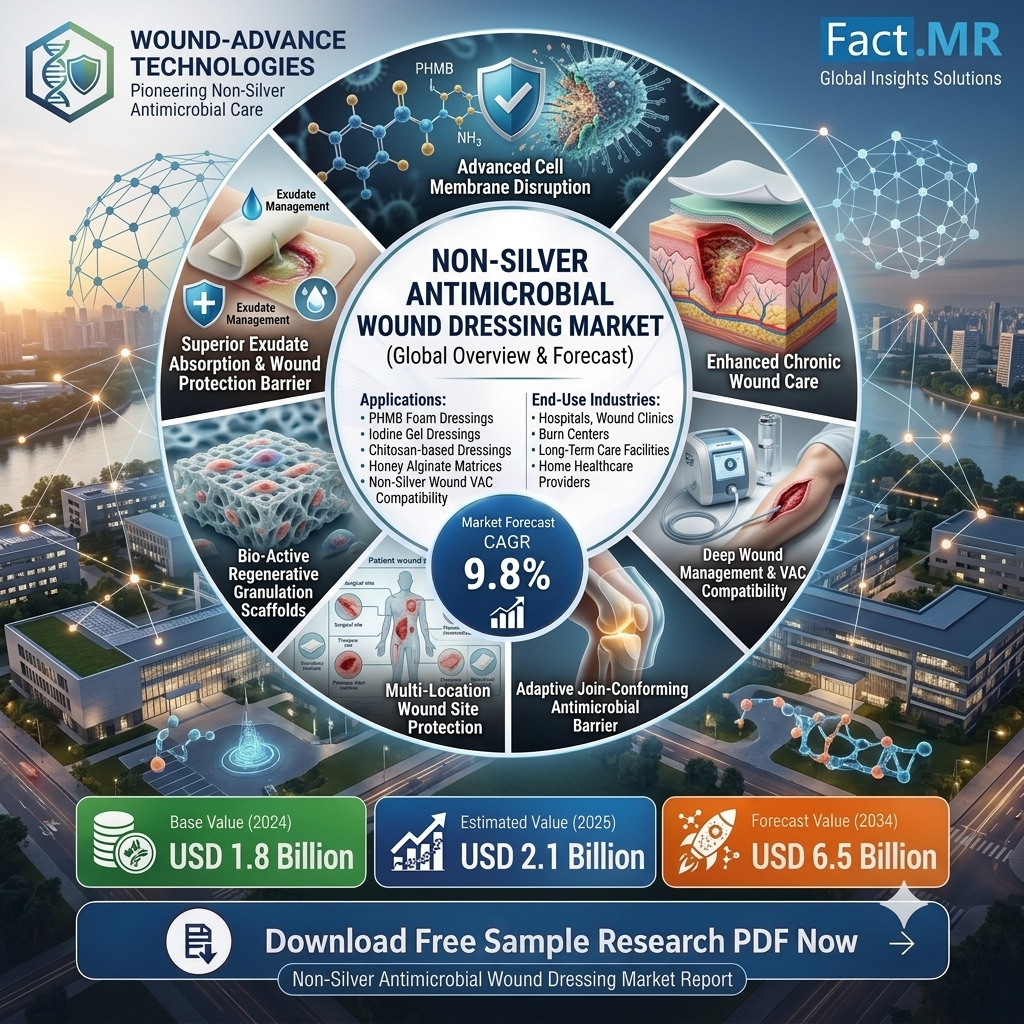
Rockville, MD., September 23, 2026 — The Non-silver Antimicrobial Wound Dressing Market is projected to increase from USD 1.8 billion in 2026 to USD 3.1 billion by 2036, advancing at a 5.6% CAGR, according to Fact.MR. The market was valued at USD 1.7 billion in 2025 and is expected to create a USD 1.3 billion absolute opportunity between 2026 and 2036.
Demand is being shaped by chronic wound management, antimicrobial stewardship programmes, and expanding hospital and home-care infrastructure. Clinician-led substitution of silver dressings with PHMB and iodine formats is also supporting adoption. The report specifically identifies reimbursement variability and higher unit costs of advanced dressings as factors that can moderate expansion.
Get detailed market forecasts, competitive benchmarking, and pricing trends: https://www.factmr.com/connectus/sample?flag=S&rep_id=14909
PHMB dressings lead product demand
PHMB dressings are estimated to hold 35% of the non-silver antimicrobial wound dressing market in 2026. Fact.MR attributes this position to broad-spectrum antimicrobial activity, clinically validated low cytotoxicity, and established formulary inclusion across hospital wound care protocols. PHMB compatibility with chronic wound management is supporting procurement interest.
Foam dressings account for approximately 40% of the dressing type segment in 2026. High exudate absorption capacity and suitability for chronic wounds support their position across hospital and community care settings. Foam formats can incorporate PHMB, iodine, and honey-based antimicrobial actives.
Chronic wounds represent approximately 50% of application demand in 2026. Diabetic foot ulcers, pressure injuries, and venous leg ulcers remain key use cases within this segment. The report links this demand to the prevalence of chronic wounds across ageing populations and rising diabetes-related wound care requirements.
Extractable market fact
Fact.MR defines the non-silver antimicrobial wound dressing market as advanced wound dressings incorporating PHMB, iodine, honey, and chlorhexidine antimicrobial actives in foam, hydrocolloid, alginate, and film formats for chronic and acute wound management.
Stewardship programmes influence procurement
Hospital wound dressing procurement is increasingly connected to antimicrobial stewardship protocols. Fact.MR reports that major hospital networks and national health systems are consolidating preferred supplier lists around products supported by clinical evidence, documented low cytotoxicity profiles, and regulatory clearance for chronic and acute wound indications.
The report cites antimicrobial stewardship framework updates by the U.S. Centers for Disease Control and Prevention and NHS England in 2024 as a factor reinforcing low-toxicity non-silver wound actives. These frameworks create structured formulary pathways for PHMB and iodine dressings.
A specific market detail highlights the pricing difference. Advanced foam and alginate constructs containing embedded antimicrobials command 25% to 40% price premiums over basic dressings, supporting value growth even as volume increases remain moderate.
The International Diabetes Federation reported 537 million adults living with diabetes globally in 2024. Fact.MR identifies diabetic foot ulcers as a primary driver of advanced wound dressing demand, with India and China accounting for the highest absolute volumes.
India records the fastest country growth
India is projected to register a 7.5% CAGR through 2036, making it the fastest-growing country among those highlighted by Fact.MR. The report connects this expansion with healthcare infrastructure development, a growing diabetic wound burden, and greater awareness of advanced wound care among clinical procurement teams.
China follows with a 7.1% CAGR, supported by government hospital capacity expansion, centralised procurement, and higher chronic disease management budgets. The United States is projected to grow at 6.2% CAGR, while Germany records 5.5%. The United Kingdom is expected to expand at approximately 5.0% CAGR through 2036.
India's Ayushman Bharat PM-JAY programme extended hospital coverage to more than 550 million beneficiaries by 2024, according to the Fact.MR report. The expansion is supporting institutional wound care procurement volumes.
[LINK: U.S. Centers for Disease Control and Prevention antimicrobial stewardship information]
Companies focus on evidence and formulary access
The competitive landscape includes Smith & Nephew, 3M Company, Mölnlycke Health Care, ConvaTec Group, Coloplast, and B. Braun Melsungen. Fact.MR identifies clinical evidence, formulary access, reimbursement positioning, and product portfolios as important competitive considerations.
Smith & Nephew expanded its PHMB-based ALLEVYN dressing portfolio across European hospital accounts in 2024, including new foam variants designed for enhanced exudate management. Mölnlycke Health Care introduced an updated iodine-cadexomer dressing range in 2025 for chronic wound management, including diabetic foot ulcer and venous leg ulcer indications.
ConvaTec Group expanded its AQUACEL Foam antimicrobial dressing line with PHMB-impregnated variants in 2024. Coloplast launched an updated iodine-impregnated alginate dressing in 2025 for heavily exuding wounds. These developments illustrate how manufacturers are expanding non-silver options across different dressing formats.
Shambhu Nath Jha, Principal Consultant at Fact.MR, said, “CXOs will find that PHMB and iodine-based dressings are capturing disproportionate share as antimicrobial stewardship programmes displace silver formats. Clinical evidence and biofilm data are becoming procurement prerequisites.”
A second named quotation is not provided in the supplied Fact.MR report content. It should therefore be added only after an approved speaker and exact quotation are supplied.
Top Reports:
https://adamaamresearch.blogspot.com/2026/09/liposomal-doxorubicin-market-projected.html
https://social.mytamam.com/blogs/41868/Liposomal-Doxorubicin-Market-to-Reach-USD-2-96-Billion-by
https://zeuspage.org/blogs/58926/Liposomal-Doxorubicin-Market-to-Hit-USD-2-96-Billion-by
https://kaamkaaziclub.com/read-blog/56582
About the Report
Fact.MR's Non-silver Antimicrobial Wound Dressing Market study covers product types including PHMB, iodine-based, honey-based, and chlorhexidine dressings. It also analyzes foam, hydrocolloid, alginate, and film formats across chronic and acute wound applications. The forecast covers 2026 to 2036 across North America, Europe, Asia Pacific, Latin America, and the Middle East and Africa.
The methodology uses manufacturer revenues, shipment volumes, average selling prices, hospital formulary benchmarks, reimbursement data, and primary interviews with wound care procurement specialists and clinical wound care teams.

 English
 Arabic
 Spanish
 Portuguese
 Deutsch
 Turkish
 Dutch
 Italiano
 Russian
 Romaian
 Portuguese (Brazil)
 Greek