


Antifoaming Agents Market Growth Accelerates Across Asia
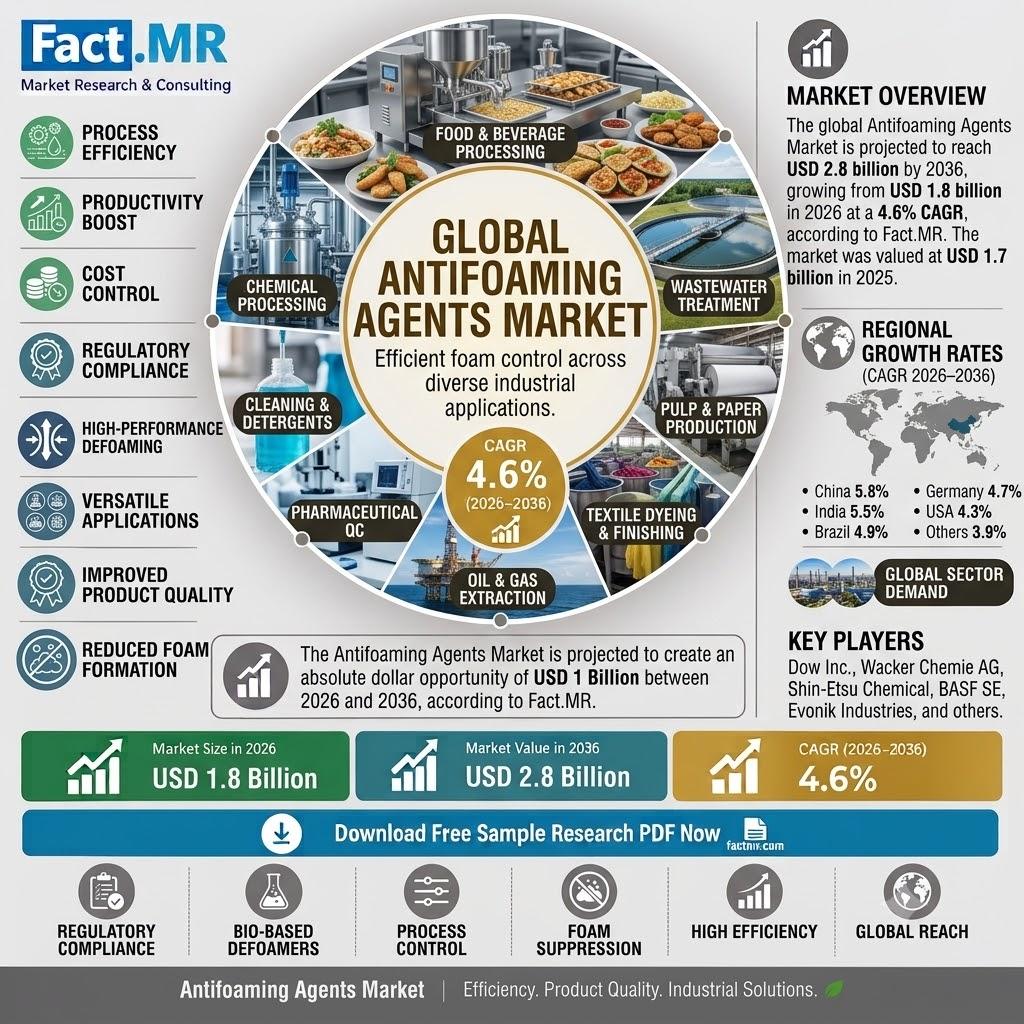
Silicone-based agents hold 48.3% share as food, industrial, and water-treatment demand supports a 4.6% CAGR through 2036.
September 23, 2026 — The global Antifoaming Agents Market is projected to grow from USD 1.8 billion in 2026 to USD 2.8 billion by 2036, advancing at a 4.6% CAGR, according to Fact.MR analysis. The market was valued at approximately USD 1.7 billion in 2025 and is expected to create an absolute dollar opportunity of USD 1.0 billion between 2026 and 2036.
The growth outlook is tied to foam-control requirements across food and beverage processing, wastewater treatment, pulp and paper manufacturing, textile production, and oil and gas operations. Food and beverage applications account for 29.6% of market share, while silicone-based antifoaming agents represent 48.3% of the product segment in 2026.
Get detailed market forecasts, competitive benchmarking, and pricing trends: https://www.factmr.com/connectus/sample?flag=S&rep_id=1520
Demand expands across industrial processing
Food and beverage manufacturers use antifoaming agents during fermentation, cooking, bottling, and clean-in-place operations. Fact.MR identifies uncontrolled foam as a factor that can reduce yield and throughput in these processes.
Wastewater treatment is another established demand channel. Aeration and biological treatment stages can generate foam, requiring continuous dosing to maintain treatment efficiency and prevent foam overflow.
Pulp and paper manufacturers use antifoaming agents during pulp washing, stock preparation, and paper-machine wet-end operations. Foam can entrain air and affect sheet quality, making process control a direct application requirement.
Textile dyeing and finishing operations also require defoaming because surfactants in dye baths can generate foam. Fact.MR notes that excessive foam can contribute to uneven dye penetration and fabric defects.
Oil and gas production uses antifoaming agents in drilling mud, gas-liquid separation, and crude oil processing. In these settings, foam formation can reduce equipment efficiency and increase safety risk.
Silicone products retain market leadership
Silicone-based antifoaming agents account for 48.3% of the product segment in 2026. Fact.MR attributes this position to mature industrial usage patterns, broad application compatibility, and the ability to meet key end-use requirements.
Shambhu Nath Jha, Principal Consultant at Fact.MR, said, “The antifoaming agents market is a process chemical category where demand is distributed across multiple industrial sectors.”
That diversification matters to suppliers because no single application exceeds 30% of total consumption, according to the Fact.MR analysis. Demand weakness in one industrial segment can therefore be offset by stability in other areas.
The report also identifies food-grade and non-silicone alternatives as an emerging development area. Vegetable-oil and lecithin-based defoamers are described as food-grade, silicone-free, and eligible for organic and clean-label processing certifications.
Bio-based formulations gain attention
Product development is increasingly focused on antifoaming agents compatible with food processing and clean-label requirements. Vegetable oils and plant-derived surfactants are being used in formulations designed for food-contact and environmentally sensitive applications.
Fact.MR describes a market split between high-performance silicone systems serving industrial applications and bio-based alternatives targeting food processing and other applications where regulatory or consumer requirements favor natural-origin process aids.
Specialty and high-performance grades can command pricing premiums, while emerging-market industrial expansion creates additional demand opportunities. At the same time, feedstock cost volatility and regulatory compliance across jurisdictions remain constraints for manufacturers and downstream buyers.
Shambhu Nath Jha further noted, “Silicone-based defoamers dominate because they offer the broadest operating temperature range and lowest effective dosage.”
China and India record faster growth
China is projected to register a 5.8% CAGR through 2036, while India is projected to expand at a 5.5% CAGR. Brazil follows at 4.9%, Germany at 4.7%, and the USA at 4.3%, based on Fact.MR's proprietary forecasting model and primary research.
In China, expanding industrial demand and application diversification are identified as key market factors. India's outlook is linked to industrial growth, food processing, wastewater treatment, and changing end-use requirements.
An insider-level detail from the Fact.MR assessment is that the research methodology includes 20+ primary interviews across manufacturers, providers, end users, and partners. The study also benchmarks 40+ company portfolios and draws on 100+ secondary sources across more than 25 countries.
Top Trending Reports :
https://sohomoy.com/blogs/55554/Ceramic-Membrane-Market-Growth-Accelerates-in-Water-Treatment
Competitive activity continues
The competitive landscape includes Dow Inc., Wacker Chemie AG, Shin-Etsu Chemical Co. Ltd., BASF SE, Evonik Industries AG, Momentive Performance Materials, Bluestar Silicones, Ashland, MÜNZING Chemie GmbH, and Kemira Oyj.
Recent developments provide examples of product and capacity activity. WACKER Chemie AG expanded specialty silicone production capacity in Japan and South Korea in January 2025. BASF SE listed FoamStar® ED 2524 as a high-efficiency aqueous-emulsion defoamer for coating applications in July 2025. Evonik Industries AG launched TEGO® Foamex 8420 in March 2025 for waterborne overprint varnishes and inks.
About Fact.MR
Fact.MR is a market research and consulting firm providing syndicated and custom research across global industries. Its Antifoaming Agents Market study covers product type, functionality, application, composition, form, regional demand, competitive activity, and forecasts from 2026 to 2036. The research uses secondary research, primary interviews, forecast modelling, cross-validation, procurement-cycle analysis, and sensitivity testing.

 English
 Arabic
 French
 Spanish
 Portuguese
 Deutsch
 Turkish
 Dutch
Dutch
 Italiano
 Russian
 Romaian
 Portuguese (Brazil)