


Paper Box Market Reaches New Scale Through E Commerce And Sustainable Packaging
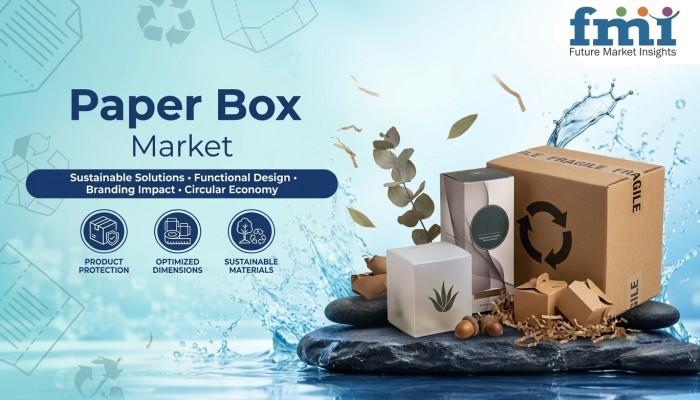
The global Paper Box Market is projected to reach USD 100.9 billion by 2036, rising from USD 67.59 billion in 2026 at a 4.10% CAGR, according to Future Market Insights (FMI). Growth is being shaped by e-commerce fulfillment, plastic substitution, warehouse automation, and rising demand for recyclable packaging across food, healthcare, and consumer goods applications.
The market is moving beyond basic shipping containers toward engineered formats designed for automated handling, right-sized fulfillment, consistent dimensional performance, and recycled content requirements.
Automation Is Changing Box Specifications
Slotted boxes are expected to account for 33.80% of the market in 2026. Their standardized flap configuration and compatibility with automated case-forming and sealing systems support continued adoption across logistics and manufacturing operations.
Warehouse and fulfillment automation is also raising procurement expectations. Boxes must maintain stable dimensions, scoring accuracy, and structural performance to operate reliably on high-speed packing and sorting lines.
Smurfit Westrock's expansion of production capacity at its Lee County, Mississippi facility is among the developments covered in FMI's competitive analysis, reflecting ongoing investment in regional corrugated packaging capacity.
Get detailed market forecasts, competitive benchmarking, and pricing trends:
https://www.futuremarketinsights.com/reports/sample/rep-gb-14642
Recycled Fiber Becomes a Central Procurement Consideration
Recycled material is projected to represent 57.40% of material demand in 2026. Sustainability commitments from retailers and brand owners are increasing the focus on recovered fiber, while circular economy policies are encouraging substitution away from plastic-based protective packaging.
Recycled grades also create operational considerations for converters. Shorter fiber characteristics, localized collection gaps, and fluctuations in recovered paper costs can affect input availability and production economics.
FMI's analysis notes that closed-loop recovery systems and retailer backhaul programs can help stabilize recovered-fiber supply. Converters with access to integrated paper and board resources may therefore have greater flexibility when input markets tighten.
Single Wall Board Leads Standard Packaging Applications
Single wall board is forecast to hold a 52.70% share in 2026. Its strength-to-weight balance makes it suitable for standard consumer goods and shipping applications where compression performance and freight efficiency must be balanced.
Liner paperboard is also expected to remain significant, accounting for 61.30% of the market in 2026. Consistent surfaces support flexographic printing and help brand owners maintain graphical quality across retail and transport packaging.
These requirements are encouraging investment in precision converting, moisture control, die-cutting, inline printing, and barrier technologies that can improve performance without compromising recyclability.
Regional Growth Centers on India and Asia Pacific
Asia Pacific remains a major growth region as manufacturing activity, retail formalization, export packaging, and domestic logistics infrastructure support paper box consumption.
India is projected to record the fastest growth among the countries covered, with a 5.30% CAGR from 2026 to 2036. China follows with a projected 4.40% CAGR, while Japan is expected to expand at 2.90%.
In North America, the United States is projected to grow at 3.10% CAGR. Fulfillment automation and right-sized packaging are key considerations for suppliers serving e-commerce and distribution networks.
European markets are experiencing a different demand pattern. Plastic reduction measures and fiber-based packaging requirements are influencing packaging specifications, while consolidation and regional capacity investments continue to shape the competitive environment.
Regional Supply Security Becomes a Commercial Differentiator
Nandini Roy Choudhury, analyst at Future Market Insights, highlights the market's shift toward regional supply security, recycled fiber access, and automation-ready design.
“Converters with integrated paperboard supply and high-precision cutting lines will hold stronger pricing control,” Sutaria notes. He adds that brand owners are likely to favor suppliers capable of delivering stable dimensions, verified recycled content, and shorter lead times.
The competitive landscape includes DS Smith plc, Robinson Plc, Huhtamäki Oyj, Smurfit Kappa Group Plc, Stora Enso Oyj, WestRock Company, Mayr-Melnhof Karton AG, International Paper, Packaging Corporation of America, and Pratt Industries.
Recent developments covered by FMI include International Paper's January 2026 announcement concerning the planned separation of its EMEA Packaging operations, Smurfit Westrock's North American capacity expansion, and Mondi's April 2025 acquisition of Schumacher Packaging's Western European assets.
What the Market Means for Packaging Buyers
The next phase of paper box demand will place greater emphasis on dimensional consistency, recycled-content verification, supply reliability, and regional production capacity.
For procurement teams, the relevant question is increasingly whether a box supplier can support automated operations while maintaining consistent specifications and reliable lead times. For converters, investment decisions are increasingly connected to right-sizing, precision converting, recycled fiber access, and regional service coverage.
FMI's Paper Box Market research covers product, material, board type, grade type, end use, and regional markets across 40+ countries. The study covers slotted, folder, telescope, and die cut boxes; recycled and virgin materials; single wall, double wall, single face, and triple wall boards; and liner and fluting medium grades.
Related Report Links:
FMI Custom Research: Strategic Intelligence for Confident Decision-Making
In today's rapidly evolving business environment, leadership teams need more than market data—they need clear, actionable intelligence tailored to their strategic objectives. FMI's Custom Research solutions are designed around the specific business questions organizations need answered, enabling executives to evaluate growth opportunities, validate investments, assess competitive dynamics, and reduce uncertainty before making critical decisions. By combining deep industry expertise, primary research, and proprietary market intelligence, FMI delivers insights that help organizations move from assumptions to evidence-based strategies with greater speed and confidence.
Business Impact
FMI helps organizations transform market complexity into strategic clarity, enabling leadership teams to identify growth opportunities faster, optimize resource allocation, strengthen competitive positioning, and make high-stakes business decisions with confidence.
To explore how FMI Custom Research can support your strategic priorities, please connect with our team at - sales@futuremarketinsights.com
About Future Market Insights (FMI)
Future Market Insights, Inc. (FMI) is an ESOMAR-certified, ISO 9001:2015 market research and consulting organization, trusted by Fortune 500 clients and global enterprises. With operations in the U.S., UK, India, and Dubai, FMI provides data-backed insights and strategic intelligence across 30+ industries and 1200 markets worldwide.

 English
 Arabic
 French
 Spanish
 Deutsch
 Turkish
 Dutch
Dutch
 Italiano
 Russian
 Romaian
 Portuguese (Brazil)
 Greek
Greek