


Edible Salt: A Simple Guide to Salt Types, Textures, and Uses
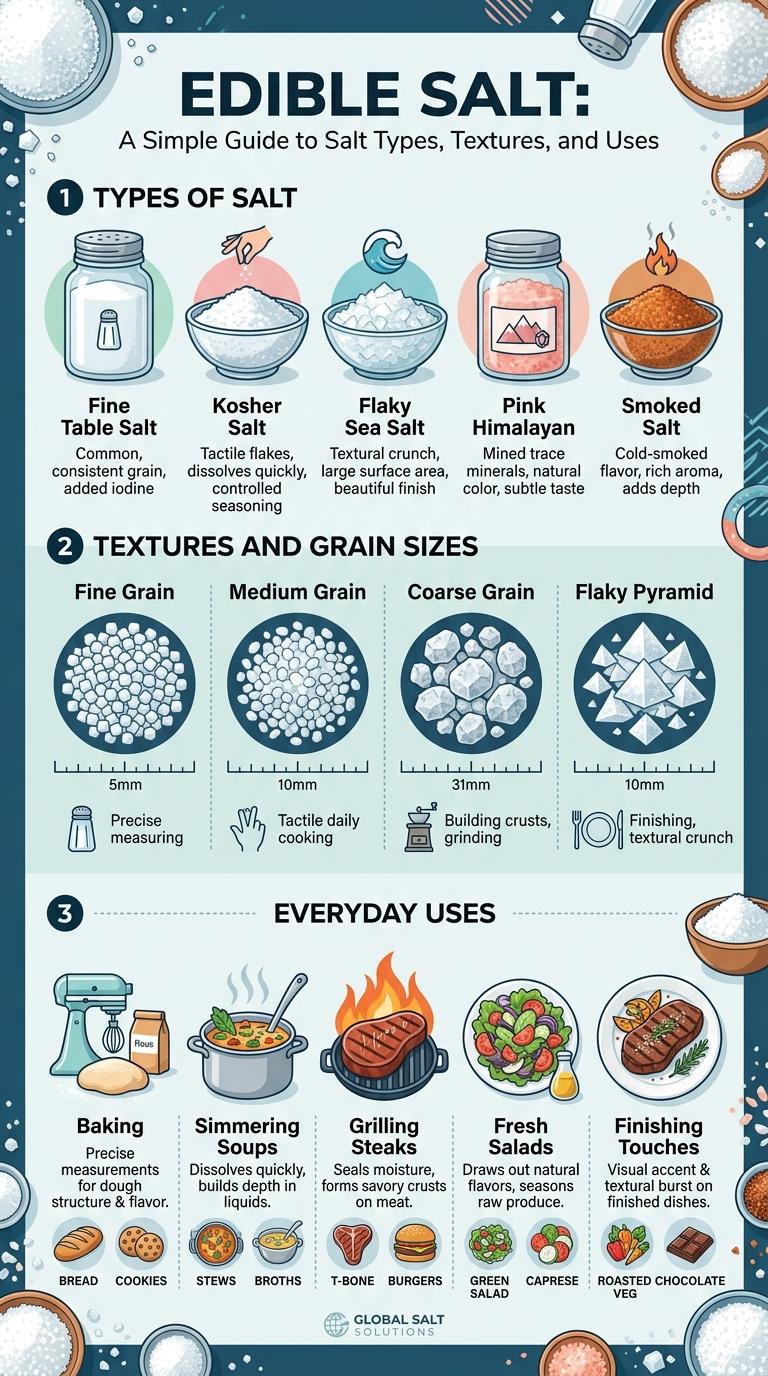
Salt is a basic kitchen ingredient found in almost every home. It adds flavor, improves recipes, and can provide different textures in food. With so many varieties available, choosing the right edible salt can sometimes feel confusing.
From refined table salt to Himalayan varieties, each type has its own crystal size and practical uses.
What Is Edible Salt?
Edible salt is produced and prepared for human consumption. Most edible salts are mainly sodium chloride. Some varieties may also contain naturally occurring minerals or added ingredients.
Salt can come from seawater or underground deposits. It may then be cleaned, dried, crushed, or ground into different crystal sizes.
Always check the package to make sure the salt is food grade before using it in cooking.
Regular Table Salt
Regular table salt is one of the most common salts used for everyday meals. Its small crystals dissolve easily and make measuring simple.
It can be added to soups, vegetables, rice, pasta, sauces, eggs, meat, and many other dishes.
Its consistent texture also makes it useful for baking recipes that require accurate measurements.
Refined Table Salt
Refined table salt goes through processing to create clean and consistent crystals. It is widely used in home kitchens and commercial food preparation.
Some products may contain iodine or anti-caking ingredients. These details are usually listed on the package.
Refined salt is a practical choice when you want a uniform texture for everyday cooking.
Extra Fine Salt
Extra Fine Salt has very small crystals that mix quickly with other ingredients. It can be useful in baking, seasoning, sauces, and homemade food.
Because the crystals are small, they spread easily throughout a recipe. This makes extra-fine varieties useful when even distribution is important.
Extra Fine Himalayan Salt
Extra Fine Himalayan Salt is finely ground Himalayan salt with a light pink appearance.
It can be used in cooking, baking, soups, salads, sauces, and seasoning when the product is labeled for food use.
Its fine texture also allows it to dissolve easily in liquids.
Fine Pink Salt
Fine pink salt contains small crystals and has a naturally pink appearance. It can be sprinkled over vegetables, eggs, salads, potatoes, and cooked meals.
The color comes from minerals present in the salt deposit. However, pink salt is still a source of sodium, so it should be used appropriately as part of a balanced diet.
Choosing the BEST HIMALAYAN SALT
When looking for the BEST HIMALAYAN SALT, consider your intended use rather than color alone.
A fine variety may work well for everyday seasoning and baking. A coarse variety can be useful with a grinder or for adding texture to finished foods.
Before buying, check:
- Crystal size
- Food-grade labeling
- Packaging
- Intended use
- Ingredients
- Storage instructions
The best option for your kitchen depends on how you plan to use the salt.
Coarse Pink Himalayan Salt
Coarse Pink Himalayan Salt has larger crystals than fine salt. It is commonly used in grinders and can also be used as a finishing salt.
A coarse salt grinder allows you to crush the crystals as needed. This gives you more control over the texture and amount of salt added to food.
Rock Salt
Rock salt consists of larger salt crystals and can have several applications. However, not every rock salt product is intended for eating.
If you are buying rock salt for cooking, always choose a product specifically labeled as food grade.
The same rule applies when comparing different types of rock salt. Product labeling is important because salt sold for industrial or other purposes should not be used as food.
Crystal Salt Chunks
Crystal Salt Chunks are larger pieces of salt that can be crushed or ground when a smaller texture is needed.
Food-grade chunks may be useful for people who prefer controlling the final crystal size themselves.
Keep them in a dry container to protect their texture from moisture.
Crystal Salt Granules
Crystal Salt Granules are generally smaller than large salt chunks but larger than many fine salt varieties.
They can be used for seasoning and cooking, depending on their size and the product's intended purpose.
Their texture can make them useful when you want a little more crystal presence in a recipe.
Salt Lumps
Salt Lumps are compact pieces of salt that can be broken, crushed, or ground when necessary.
Food-grade salt lumps should be stored in a dry place. Before using them, check that the product is specifically intended for culinary purposes.
Himalayan Salt Chunks
Himalayan Salt Chunks are larger pieces of Himalayan salt. They can be crushed into smaller crystals or used with an appropriate grinder.
Some cooks prefer chunks because they can decide how fine they want the salt to become.
As always, choose a food-grade product when the salt is intended for consumption.
Coarse Salt for Different Uses
People often search for coarse salt for baking, but fine salt is usually easier to distribute evenly in many baking recipes. If a recipe specifically calls for coarse salt, follow the recipe's instructions.
For grinding, a best coarse salt for grinder should have crystals that fit the grinder properly.
Terms such as extra coarse solar salt and extra coarse water softener salt usually refer to products made for non-food applications. These should not be confused with culinary salt.
Fine Salt vs. Coarse Salt
The biggest difference between fine and coarse salt is crystal size.
Fine salt dissolves quickly and mixes easily into recipes. Coarse salt has larger crystals and can provide more texture.
For everyday cooking, either can be useful depending on the recipe. Always consider the salt's intended purpose and follow the recommended measurements.
How to Store Edible Salt
Salt should be protected from moisture. Humidity can cause crystals to clump together and become harder to use.
Keep Extra Fine Salt, fine pink salt, and table salt in sealed containers.
Larger varieties such as Crystal Salt Chunks and Himalayan Salt Chunks should also be stored somewhere dry and clean.
Frequently Asked Questions
What is edible salt?
Edible salt is salt that has been produced, processed, and labeled for human consumption.
Is all rock salt edible?
No. Some rock salt is produced for non-food purposes. Always check the label before using it in food.
What is pink himalayan salt coarse?
Pink himalayan salt coarse refers to Himalayan salt with larger crystals. It is often used in grinders or as a finishing salt.
Can coarse salt be used in a grinder?
Yes, if the crystals are suitable for the grinder. A coarse salt grinder can help break larger crystals into smaller pieces.
What is extra coarse solar salt?
Extra coarse solar salt is generally associated with non-food applications such as water treatment. It should not be used as edible salt unless the product is specifically labeled for human consumption.
Conclusion
There are many types of edible salt, including regular table salt, refined table salt, Extra Fine Salt, Extra Fine Himalayan Salt, fine pink salt, BEST HIMALAYAN SALT, Coarse Pink Himalayan Salt, Crystal Salt Chunks, Crystal Salt Granules, rock salt, Salt Lumps, and Himalayan Salt Chunks.
Understanding crystal size and intended use makes it easier to select the right salt. Always choose food-grade products for cooking and keep them stored in a dry place.

 English
 Arabic
 French
 Spanish
 Portuguese
 Deutsch
 Turkish
 Dutch
Dutch
 Russian
 Romaian
 Portuguese (Brazil)
 Greek
Greek