


Household Refrigerators and Freezers Market Growth Driven by Smart Appliances
The refrigerator has moved far beyond its traditional role as a basic food-storage appliance. Consumers now expect better organization, precise temperature control, lower energy consumption, smart connectivity, and designs that fit changing kitchen layouts. This shift is creating new opportunities across the global Household Refrigerators and Freezers Market, particularly as disposable incomes rise and consumers gain access to a wider range of appliances through online retail.
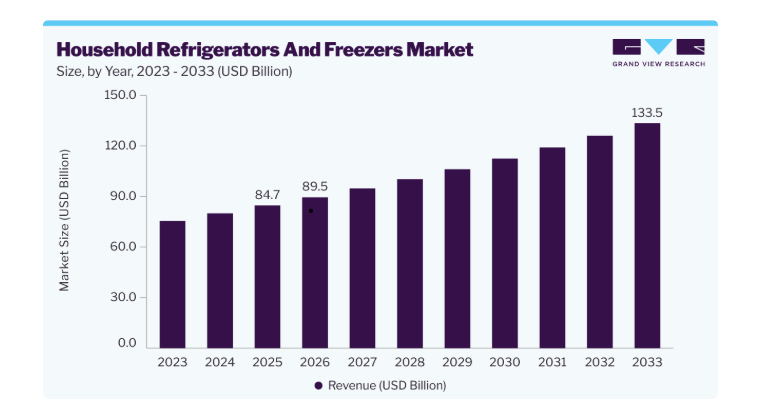
The global market was valued at USD 84.7 billion in 2025 and is projected to reach USD 133.5 billion by 2033, expanding at a 5.7% CAGR from 2026 to 2033. Asia Pacific held the largest revenue share of more than 36.0% in 2025, while North America is expected to register the fastest CAGR during the forecast period.
Why Are Consumers Moving Toward Smarter Refrigeration?
Changing lifestyles are influencing what consumers expect from household appliances. Nuclear families, compact urban homes, modular kitchens, and greater consumption of packaged and frozen foods are creating demand for refrigerators that combine storage flexibility with intelligent functionality.
Modern products increasingly incorporate AI-enabled sensors, IoT connectivity, digital temperature controls, advanced cooling systems, and energy-saving functions. These features allow consumers to monitor temperatures, manage storage conditions, and operate appliances more efficiently.
The January 2026 launch of Haier Appliances India's Frost Free 5252 Series illustrates this direction. The product was designed around smart storage, 360° cooling, and modern aesthetics, reflecting how manufacturers are combining technology with everyday convenience.
Download a free sample report or claim your copy of this full market intelligence report
How Is Kitchen Design Changing Refrigerator Demand?
Kitchen architecture is becoming an increasingly important factor in appliance purchasing. Freestanding refrigerators continue to dominate because they are flexible, easier to relocate, and available in a broad range of configurations. The segment held more than 57.0% of market revenue in 2025.
Built-in models, however, are gaining momentum as modular and premium kitchen designs become more common. These appliances can integrate more closely with cabinetry, create a streamlined appearance, and make better use of limited kitchen space.
This creates an interesting contrast: freestanding models lead through flexibility, while built-in appliances are gaining through design integration.
What Does Refrigerator Capacity Tell Us About Consumer Needs?
Capacity is closely connected to household size, purchasing habits, and food-storage requirements. The 16 to 30 cu. Ft. segment accounted for more than 48.0% of revenue in 2025, reflecting its suitability for typical household requirements. Families purchasing groceries in larger quantities or storing a mixture of fresh, frozen, and packaged foods increasingly need sufficient internal space.
Larger-than-30-cu.-Ft. refrigerators are also gaining attention. Manufacturers are addressing the energy challenge associated with larger appliances by incorporating automatic energy-saving functions and compressor-management technologies.
As nuclear households become more common, mid-capacity refrigerators can offer a balance between storage requirements, physical footprint, and energy consumption.
Why Do Double-Door Refrigerators Still Lead?
Double-door refrigerators held more than 69.0% of the global market in 2025, supported by their combination of storage capacity, compartmentalization, and convenience.
Separate refrigerator and freezer sections allow consumers to organize food more efficiently while frost-free cooling reduces the need for manual defrosting. Adjustable shelves, door bins, temperature controls, and dedicated compartments further increase their practicality.
But the double-door category itself is changing.
French-door models are expected to record strong growth because they provide wider refrigerator compartments, flexible shelf arrangements, and bottom-mounted freezer configurations. Their design also allows consumers to access frequently used refrigerated items without repeatedly opening the larger freezer compartment.
How Are Energy Regulations Influencing Product Innovation?
Energy efficiency is becoming a major product-development priority.
Refrigerators operate continuously, making electricity consumption an important consideration for households as well as regulators. Manufacturers are therefore improving compressors, insulation, cooling systems, and automatic energy-management functions.
Regulatory initiatives are reinforcing this shift. In Europe, energy labeling requirements help consumers compare appliance efficiency while encouraging manufacturers to improve product performance. The result is a market where energy efficiency is no longer simply an additional feature. It is becoming an important part of product design and purchasing decisions.
What Role Is E-Commerce Playing in Market Expansion?
Online retail has changed how consumers discover and compare household appliances. Customers can now compare capacities, door configurations, energy ratings, smart features, prices, reviews, and financing options before visiting a physical store—or complete the purchase entirely online.
This wider product accessibility is particularly relevant in emerging markets where consumers are gaining purchasing power and manufacturers are expanding digital distribution.
At the same time, established companies continue to rely on physical retail, regional distributors, service networks, and after-sales support. The market is therefore developing through a combination of digital discovery and physical service infrastructure.
Which Regions Are Creating the Strongest Opportunities?
Asia Pacific remains the largest regional market, accounting for more than 36.0% of global revenue in 2025. China, India, and other developing economies are benefiting from urbanization, rising household incomes, expanding electrification, and strong appliance manufacturing capabilities.
North America is expected to record the fastest CAGR. The U.S. remains a major market due to high appliance penetration, smart-home adoption, online retail accessibility, and demand for advanced household technologies.
Meanwhile, the Middle East and Africa are experiencing increasing demand as disposable incomes and consumer purchasing power improve. New partnerships, market expansion strategies, and product launches are supporting appliance availability across the region.
What Is Keeping Competition Intense?
Competition in the Household Refrigerators and Freezers Market increasingly revolves around technology, energy efficiency, design, distribution, and customer experience.
Companies are investing in AI sensors, IoT connectivity, digital controls, improved cooling systems, and energy-saving technologies to encourage consumers to upgrade existing appliances.
Strategic partnerships are also becoming important. In April 2026, AB Electrolux announced a partnership with Midea Group covering areas including food-preservation manufacturing and sales and the North American market.
Key companies profiled in the market include General Electric, Dover Corporation, AB Electrolux (publ), and Haier Group.
What Could Define the Next Phase of the Market?
The future of the Household Refrigerators and Freezers Market will be shaped by the convergence of convenience, connectivity, efficiency, and design.
Consumers are increasingly looking for appliances that fit modern kitchens while reducing energy consumption and simplifying food management. Manufacturers that combine larger and smarter storage, advanced cooling, efficient operation, and connected functionality will continue to influence product development.
As appliance ownership expands across emerging markets and replacement demand evolves in mature economies, refrigeration is becoming less about simply keeping food cold and more about creating a smarter, more efficient household environment.
About us:
Grand View Research, a market research and consulting company, provides syndicated research reports, customized research reports, and consulting services. Grand View Research database is used by the world's renowned academic institutions and Fortune 500 companies to understand the global and regional business environment. Our database features thousands of statistics and in-depth analysis on 46 industries in 25 major countries worldwide.

 English
 Arabic
 French
 Spanish
 Portuguese
 Deutsch
 Dutch
Dutch
 Italiano
 Russian
 Romaian
 Portuguese (Brazil)
 Greek
Greek