


Zonal Vehicle Control Unit Architectures Market Projected at $36.2 Bn
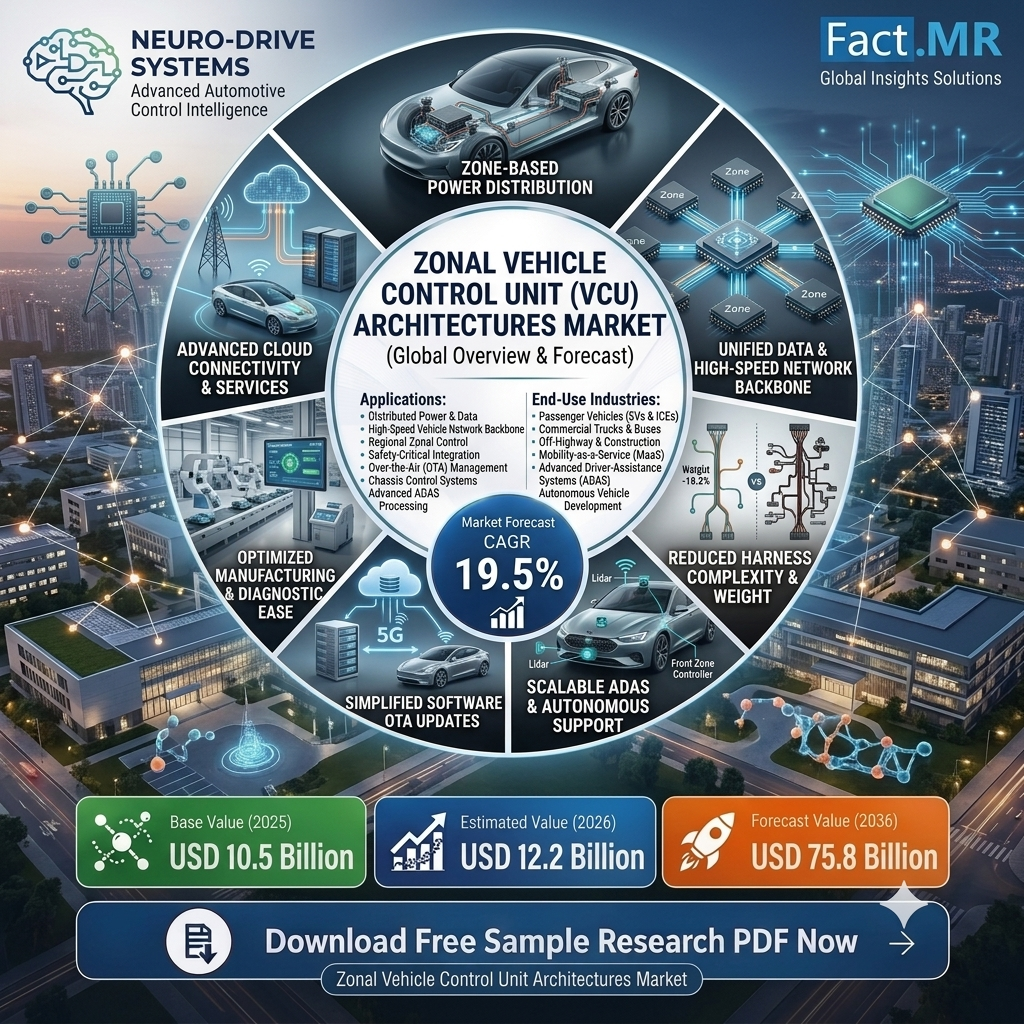
Rockville, MD., September 23, 2026 — The Zonal Vehicle Control Unit Architectures Market is projected to grow from USD 5.8 billion in 2026 to USD 36.2 billion by 2036, advancing at a 20.1% CAGR, according to Fact.MR. The market was valued at USD 4.4 billion in 2025 and is expected to create an absolute dollar opportunity of USD 30.4 billion between 2026 and 2036.
The expansion is linked to electric vehicle platform launches, software-defined vehicle programs, cybersecurity requirements, and the migration from distributed electronic control units toward centralized zonal frameworks. UNECE R155 and R156 became mandatory from July 2024, creating additional requirements for vehicle cybersecurity and software update management.
Get detailed market forecasts, competitive benchmarking, and technology insights: https://www.factmr.com/connectus/sample?flag=S&rep_id=14992
Hybrid domain-zonal architecture leads the transition
Hybrid domain-zonal architecture is projected to hold approximately 40% of the market in 2026. Fact.MR attributes its position to backward compatibility requirements as vehicle manufacturers migrate from legacy ECU networks. Hybrid configurations allow OEMs to move toward zonal control without replacing every existing architecture element at once.
Continental AG invested in high-performance computing zonal platforms in 2024. The company's platform supports hybrid domain-zonal deployment by integrating zone and domain control in one module. Aptiv introduced its updated Smart Vehicle Architecture in 2025, supporting modular zone controllers for hybrid and full-zonal systems, with production launches expected during 2026–2027.
Volkswagen Group provides another documented example. Volkswagen Group deployed its E3 1.2 architecture on the Premium Platform Electric, launched with the Audi Q6 e-tron in 2024. According to Fact.MR, the architecture reduces wiring by 30% while centralizing OTA updates across vehicle systems.
Extractable market fact
Zonal vehicle control unit architectures are hardware modules, embedded software platforms, and integration services that consolidate vehicle electronic and electrical functions by physical zone across passenger, commercial, and electric vehicles.
Hardware accounts for 45% share
Hardware, including ZCU modules and gateways, is estimated to account for approximately 45% of the market in 2026. Each zonal vehicle requires physical modules containing silicon, printed circuit boards, and connectors. Fact.MR states that hardware content per vehicle is higher in zonal systems than in legacy ECU architectures.
NXP Semiconductors launched its S32Z and S32E processors in 2024. These processors support zonal control with Ethernet and safety integration, and NXP reported more than 50 OEM design wins. AUTOSAR Adaptive Platform Release 23-11 was also published in 2024, supporting service-oriented zonal architectures. Robert Bosch and Continental AG confirmed compliance with the platform.
Magna International expanded ZCU integration services in 2025 by adding dedicated teams in North America and Europe. Fact.MR reports that Magna International's electronics integration revenue increased 12% in 2024, providing a specific indicator of growing deployment requirements.
Body and comfort electronics remains an early application
Body and comfort electronics is projected to account for approximately 30% of application demand in 2026. OEMs are prioritizing zonal consolidation in lower-complexity vehicle zones before extending the architecture into ADAS and powertrain systems.
Demand is also supported by EV architecture programs. Fact.MR reports that BYD, NIO, and Li Auto adopted zonal architectures across platforms introduced during 2024–2025. China produced more than 9.5 million electric vehicles in 2024, creating a large installed base for ZCU deployment.
General Motors and Ford are deploying zonal architectures across their Ultium and VIP platforms, respectively. The report links these programs with software-defined features and incremental software revenue opportunities.
China records the highest country CAGR
China is projected to record a 21.8% CAGR from 2026 to 2036, followed by India at 20.5% and South Korea at 20.2%. The United States is projected at 19.6%, Germany at 18.9%, and Japan at 17.5%.
India's growth is associated with cost-optimized ZCU adoption and domestic electronics manufacturing supported by Production Linked Incentive schemes. Fact.MR states that Tata Motors is integrating zonal architectures across EV platforms, while Maruti Suzuki is evaluating zonal transitions for future programs.
South Korea's market is shaped by platform standardization. Hyundai Motor Group is deploying a unified zonal architecture across Hyundai, Kia, and Genesis platforms, while Hyundai Mobis serves as the primary system integrator.
Early platform decisions shape supplier positioning
The competitive landscape includes Robert Bosch GmbH, Continental AG, Aptiv PLC, Magna International Inc., Denso Corporation, NXP Semiconductors N.V., Qualcomm Incorporated, and Infineon Technologies AG.
Fact.MR identifies early OEM design-win capture as an important competitive factor. Suppliers aligned with OEM architecture roadmaps before platform-freeze timelines, typically 24 to 36 months before production, can secure longer program visibility.
Shambhu Nath Jha, Principal Consultant at Fact.MR, said, “CXOs will find that the ZCU market increasingly rewards early platform commitment. OEMs that secure silicon and middleware partnerships ahead of 2027 will establish stronger architectural control.”
The report also identifies AUTOSAR Adaptive compliance, silicon partnerships, software platforms, gateway integration, wiring reduction, and OTA enablement as important areas in supplier positioning.
Top Reports:
https://adamaamresearch.blogspot.com/2026/09/high-speed-blowers-market-growth.html
https://social.mytamam.com/blogs/41885/High-Speed-Blowers-Market-to-Reach-USD-1-93-Billion
https://zeuspage.org/blogs/58979/High-Speed-Blowers-Market-to-Hit-USD-1-93-Billion
https://kaamkaaziclub.com/read-blog/56629
About the Report
Fact.MR's Zonal Vehicle Control Unit Architectures Market study covers hybrid domain-zonal architecture, full zonal architecture, and legacy domain controllers. It also examines hardware, software platforms, services and integration across body and comfort electronics, ADAS and safety, infotainment and cockpit, and powertrain coordination. The forecast covers 2026 to 2036 across North America, Europe, Asia Pacific, Latin America, and the Middle East and Africa.

 English
 Arabic
 French
 Spanish
 Portuguese
 Deutsch
 Turkish
 Dutch
Dutch
 Italiano
 Romaian
 Portuguese (Brazil)
 Greek
Greek