


Denim Tears: The Streetwear Brand Using Fashion to Tell the Untold Stories
Denim Tears: The Streetwear Brand Using Fashion to Tell the Untold Stories of Black America
Introduction:
Tremaine Emory didn't set out to build just another streetwear label. When he launched Denim Tears in 2019—exactly 400 years after the first enslaved Africans arrived on American shores—he was making a deliberate statement. This wasn't about hype. It wasn't about chasing trends. It was about using the very fabric that built America's wealth to tell a story that too often gets buried.
Walk into any Denim Tear stockist and you'll notice something different. The hoodies are soft. The denim is heavy and considered. But the graphics? They stop you cold. A cotton wreath, rendered in muted earth tones, carries the weight of centuries. That's the point. Emory has created something rare in contemporary fashion: a brand where every stitch carries intention, where every collection functions as a chapter in an ongoing education.
The Origins of Denim Tears: Tremaine Emory's Vision
From Jamaica, Queens to the Global Stage
Tremaine Emory's path to founding Denim Tears wasn't linear. Born in Atlanta, Georgia in 1981 and raised in Jamaica, Queens, he cut his teeth in the fashion industry through a series of retail jobs and advisory roles. Before Denim Tears, Emory worked with Marc Jacobs, Stüssy, Yeezy, and GOOD Music. He co-founded the creative collective No Vacancy Inn with Ade "Acyde" Odunlami and Brock Korsan, building a reputation as a cultural connector long before he had his own label.
His collaborators read like a who's who of contemporary culture: Virgil Abloh, Frank Ocean, André 3000, Theaster Gates, Hank Willis Thomas. This network wasn't just about clout. It was about building a platform. When Denim Tears launched, Emory already had the relationships and the credibility to make people pay attention to what he had to say.
The Name That Carries Weight
The name "Denim Tears" isn't decorative. It references the denim aprons worn by Emory's grandmother and countless Black women like her—garments that symbolized labor, servitude, and survival. It's a name that acknowledges pain while refusing to be defined solely by it. Emory has described the brand as "African-American sportswear," a term that grounds it in a specific cultural context while giving it room to evolve.
The Cotton Wreath: Understanding Denim Tears' Most Powerful Symbol
What the Cotton Wreath Actually Means
The cotton wreath is Denim Tears' most recognizable motif, and it's impossible to understand the brand without understanding it. Cotton was the backbone of the American slave trade. The labor of enslaved Black Americans cultivating cotton generated enormous wealth for a society that denied their humanity. The wreath format—a circular arrangement typically associated with mourning or celebration—transforms this reference into something simultaneously elegiac and defiant.
Emory has spoken about being inspired partially by artist Kara Walker's work, which often confronts the brutal history of slavery directly. The cotton wreath functions similarly: it's not subtle, but it's also not didactic. It sits on a hoodie or a trucker jacket, inviting questions rather than demanding them.
From Hoodies to High Art
What started as a graphic on sweatshirts has become something much larger. The cotton wreath has appeared on Swarovski-crystal-encrusted cashmere sweatsuits retailing for as much as $2,800. It's been reinterpreted in jacquard weaves, paisley patterns, and monogram forms. It's part of the permanent collections at The Metropolitan Museum of Art's Costume Institute alongside works by Levi's and Ralph Lauren.
This journey—from streetwear graphic to museum acquisition—speaks to something Emory has understood from the beginning: fashion's power isn't just in its visibility, but in its ability to carry meaning into spaces that might otherwise resist it. When a cotton wreath hoodie sits in a museum case, the conversation it sparks is different from the one it sparks on the street. Both matter.
Beyond the Wreath: Denim Tears' Cultural Collaborations
Levi's: Reclaiming the Fabric of America
Denim Tears' collaborations with Levi's have been particularly significant. The first season featured the cotton wreath alongside wide-brimmed plantation hats, "replicated and recontextualized after those worn in the fields during the assiduous cotton-picking process." Season two explored the Gullah Geechee people, who were forced to dye fabrics with indigo during enslavement. Season three examined Black biker culture through the lens of Martin Dixon's book Brooklyn Kings: New York City's Black Bikers.
These aren't random themes. Each collection builds on the last, creating a cumulative narrative about Black American history that most people never learned in school. The collaborations with Levi's—arguably the most American of all denim brands—carry particular weight. Denim is the fabric of America, and Denim Tears is insisting that the full story of that fabric be told.
Dior, Converse, and the Art of Institutional Disruption
In 2022, Kim Jones invited Emory to guest-design a capsule collection for Dior Homme titled "Dior Tears." Presented in Cairo, the collection drew from Black Ivy League students of the 1950s and 1960s, paying tribute to James Baldwin and Miles Davis. It was a moment where a historically European luxury house handed creative control to a Black American designer with something to say—and let him say it.
The Converse collaboration took a different turn. Featuring a Pan-African flag reworked through the lens of David Hammons' African-American Flag, the release became associated with the 2020 racial justice protests. Emory delayed the launch, pressuring Converse's parent company Nike to demonstrate genuine support for the movement. The collaboration ended up meaning more than a shoe—it became a statement about what brands owe their communities.
The Business of Meaning: How Denim Tears Built a Movement
Growth Without Compromise
Denim Tears has generated "tens of millions" in annual revenue and doubled sales every year since its founding—all without investors and with limited retail distribution. The brand's products sell for an average of 31 percent above retail on resale platforms like StockX. Sales grew 290 percent in 2024 compared to 2023.
These numbers matter because they prove something important: you don't have to water down your message to build a successful business. Emory has never positioned Denim Tears as a compromise between commerce and conscience. The brand's commercial success is inseparable from its cultural clarity.
Expanding the Footprint
Denim Tears Clothing operates flagship stores called African Diaspora Goods in New York and Atlanta. A Tokyo location is planned for 2026, with eventual plans for stores in Chicago, Houston, Philadelphia, Portland, and Los Angeles. The brand sells through Dover Street Market via a concession model—a partnership that gives it visibility without sacrificing control.
This careful expansion reflects Emory's philosophy. He's not chasing growth for its own sake. He's building infrastructure for a project that he believes needs to reach more people. The stores aren't just retail spaces; they're community hubs designed by Theaster Gates, an artist whose work engages deeply with Black space and memory.
Recent Collections: Lauryn Hill, André Leon Talley, and the Stories Still Untold
SS26: Family, Lineage, and the Return of Denim
Denim Tears' Spring/Summer 2026 collection marked the return of the brand's full denim program, and the campaign featured Ms. Lauryn Hill with her children Zion, Selah, Joshua (YG Marley), John, Sara, and Micah. Photographed by Liam MacRae, the images center lineage and closeness—themes that run through everything Denim Tears does.
The collection introduced the Jacquard Cotton Wreath, a textured interpretation of the brand's signature motif applied across trucker jackets, baggy jeans, bucket hats, denim caps, and tote bags. Heavyweight 14 oz denim returned in Light Wash and Dirty Wash, alongside 13 oz Japanese Selvedge denim woven on traditional shuttle looms. Everything was cut, sewn, and washed in the United States.
FW26: Honoring André Leon Talley
The Fall/Winter 2026 collection, created in partnership with the André Leon Talley Estate, marked the first official apparel collaboration authorized by the late editor's estate. The 153-piece collection celebrates Talley's legacy as the first Black male Creative Director at Vogue and his commitment to championing Black designers when doing so was genuinely radical.
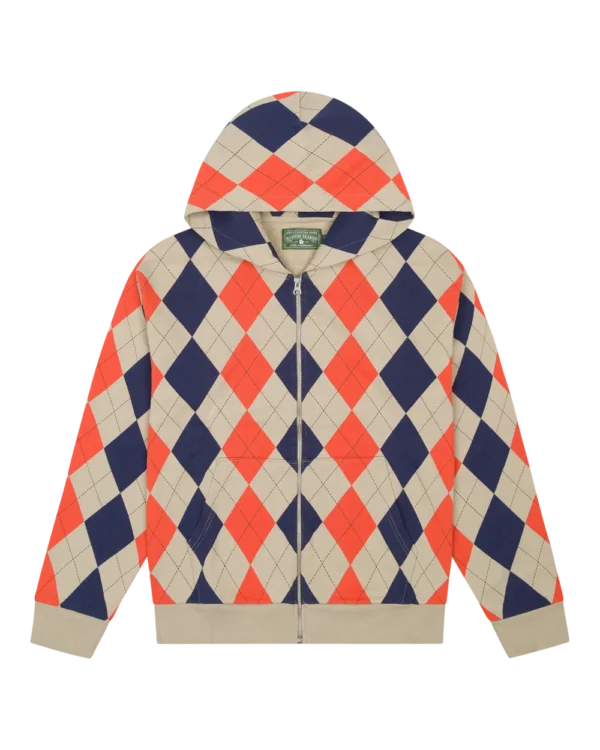
Emory described the collection as exploring "a specific part of André Leon Talley's style that had social implications within and beyond fashion." The lineup includes outerwear, varsity jackets, leather constructions, and reinterpretations of the Cotton Wreath in Paisley, Monogram, and Peace Wreath forms. The lookbook features Andre Walker, Edward Buchanan, and Ashantéa Austin—figures who embody the blend of diaspora clothing and traditional fashion that Talley championed. https://denimtearsclothing.com/
Top 10 FAQs About Denim Tears
1. What is Denim Tears known for?
Denim Tears is known for using clothing to tell the stories of the African diaspora, particularly its signature Cotton Wreath motif that references the history of slavery and cotton cultivation in America.
2. Who founded Denim Tears?
Denim Tears was founded in 2019 by Tremaine Emory, a multi-hyphenate creative who previously worked with Marc Jacobs, Stüssy, Yeezy, and Supreme.
3. What does the Cotton Wreath symbolize?
The Cotton Wreath symbolizes the central role of cotton in American slavery and honors the enslaved Black Americans whose labor built enormous wealth for a society that denied their humanity.
4. Where can I buy authentic Denim Tears?
Authentic Denim Tears can only be purchased through the official Denim Tears website, African Diaspora Goods flagship stores in New York and Atlanta, and Dover Street Market locations.
5. How much does Denim Tears cost?
Denim Tears pricing ranges from approximately $200 for hoodies to over $2,800 for Swarovski-crystal cashmere pieces, with most core items in the $150-$400 range.
6. What makes Denim Tears different from other streetwear brands?
Denim Tears approaches garment design as historical documentation and cultural argument rather than simply aesthetic production, with each collection functioning as an educational narrative.
7. Has Denim Tears collaborated with other brands?
Yes, Denim Tears has collaborated with Levi's, Dior, Converse, Stüssy, ASICS, Dr. Martens, UGG, and Marc Jacobs, among others.
8. Is Denim Tears in museums?
Yes, Denim Tears pieces are in the permanent collections at The Metropolitan Museum of Art's Costume Institute and have been exhibited at the SCAD Museum of Art.
9. What is Denim Tears' most recent collection?
The Fall/Winter 2026 collection, created in partnership with the André Leon Talley Estate, features 153 pieces releasing across five drops beginning August 14, 2026.
10. Why is Denim Tears important?
Denim Tears is important because it demonstrates that fashion can be both commercially successful and culturally meaningful, creating educational pathways between Black history and contemporary clothing.
Conclusion:
Denim Tears isn't trying to be everything to everyone. It's not chasing virality or trying to appeal to the broadest possible audience. It's doing something more difficult and more valuable: it's telling the truth, one garment at a time, and trusting that people will respond to that truth.
Tremaine Emory has said that if he didn't feel clothing was a more efficient way of spreading a message, he'd be making art instead. That's the key to understanding everything about this brand. The hoodies and denim jackets and trucker hats aren't the point—they're the delivery mechanism. The point is the story. The point is the history that textbooks left out, that monuments obscure, that everyday conversation avoids.
When you wear Denim Tears, you're not just wearing a piece of clothing. You're wearing a question. You're wearing an invitation to learn something you probably should have been taught. And in a culture that constantly encourages us to look away from uncomfortable truths, that's a genuinely radical act.

 English
 Arabic
 French
 Spanish
 Portuguese
 Turkish
 Dutch
Dutch
 Italiano
 Russian
 Romaian
 Portuguese (Brazil)
 Greek
Greek