


Eco-Friendly Materials and Recycled Fabrics Surge in Modern Baby Stroller Manufacturing
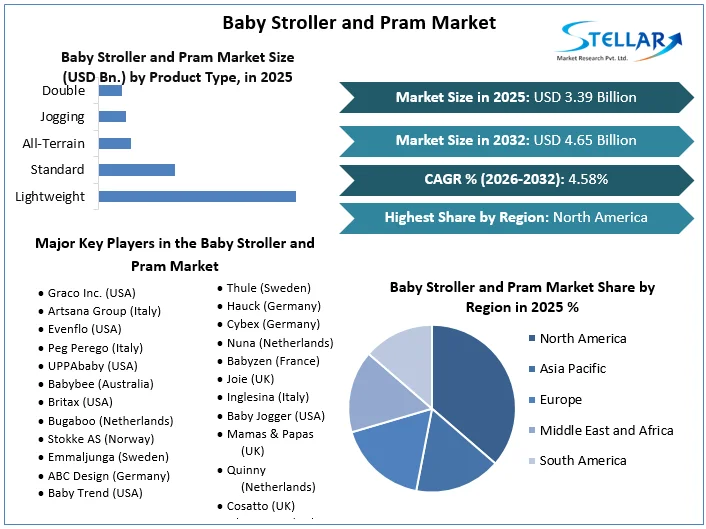
The Baby Stroller and Pram Market is experiencing dynamic transformation, according to a comprehensive industry study released by Stellar Market Research. Valued at USD 3.39 billion in 2025, the global market is on an upward trajectory to hit USD 4.65 billion by 2032, expanding at a compound annual growth rate (CAGR) of 4.58%. This market is strategically vital as urbanization, rising disposable incomes, and heightened parental expectations for infant safety and ergonomic convenience reshape the global juvenile products landscape.
Modern parenting is undergoing a fundamental lifestyle shift, driven by compact urban living, busy schedules, and an intense focus on health and wellness. Today’s urban parents are moving away from traditional, bulky baby carriers, demanding instead agile, multi-functional, and aesthetically pleasing transit solutions. This evolution has opened significant growth avenues for manufacturers investing in smart technologies, eco-friendly materials, and ultra-portable engineering. As dual-income households expand across emerging economies, the market transition toward premium, feature-rich travel systems and AI-integrated strollers represents a lucrative frontier for global brands and investors alike.
Key Findings from the Report
-
Market Valuation: The global baby stroller and pram market reached USD 3.39 billion in 2025 and is projected to scale to USD 4.65 billion by 2032.
-
Growth Rate: The industry is poised to register a steady CAGR of 4.58% throughout the 2026–2032 forecast period.
-
Dominant Segment: The lightweight stroller segment held the largest market share in 2025, favored by space-conscious urban families and fitness-oriented parents.
-
Fastest-Growing Region: Asia-Pacific is registering the fastest growth, propelled by expanding middle-class demographics and rising retail penetration in China and India.
-
Key Import Dynamics: The United States served as China’s largest export destination for baby carriages at approximately USD 500 million, followed by Germany at USD 130 million.
-
Technological Integration: Smart features such as GPS tracking, automated folding mechanisms, temperature sensors, and AI-assisted safety braking are rapidly redefining premium product tiers.
-
Investment Relevance: Heightened consumer spending on child safety and wellness is driving robust corporate collaborations, strategic partnerships, and cross-border distribution agreements among key players.
For further information, click the following link:https://www.stellarmr.com/report/req_sample/Baby-Stroller-and-Pram-Market/2172
Market Drivers and Restraints
-
Driver 1: Rapid Urbanization and Busy Lifestyles: The proliferation of high-density urban housing demands compact, easily maneuverable, and foldable juvenile transit systems, driving continuous product upgrades.
-
Driver 2: Integration of Smart Technologies and AI: The introduction of cutting-edge features—such as Glüxkind’s AI-driven Ella stroller with hands-free modes and collision alerts—transforms standard childcare items into smart, connected devices.
-
Driver 3: Rising Disposable Incomes and Premiumization: Parents are increasingly willing to allocate higher budgets for premium, ergonomic designs that protect infant health and reduce parental physical strain.
-
Restraint 1: Strict Regulatory and Safety Compliance: Stringent standards such as ASTM F833 in the United States and EN 1888 in Europe demand rigorous testing, high R&D investments, and complex compliance protocols.
-
Restraint 2: High Retail Pricing and Economic Pressures: Increased manufacturing and compliance expenses elevate final retail price points, potentially limiting accessibility for budget-conscious demographics.
Technology, Regulation, and Sustainability Trends
The industry is experiencing a massive wave of operational transformation anchored in digital connectivity and eco-conscious manufacturing. Manufacturers are heavily integrating IoT capabilities into strollers to offer real-time health and environment monitoring. On the regulatory front, compliance with CPSC and CEN standards remains mandatory to mitigate injury risks—highlighted by historical CPSC data noting thousands of annual stroller-related incidents. Concurrently, sustainability is shifting from a niche preference to a core requirement; eco-friendly brands are capturing conscious consumer segments by utilizing recycled fabrics, non-toxic coatings, and biodegradable plastics.
Regional Insights
-
Asia-Pacific (Leading Growth): Emerging as the fastest-growing market, APAC is fueled by massive urbanization waves across China and India, burgeoning middle-class populations, and expanding modern retail channels.
-
North America (Established Hub): The U.S. continues to represent a mature, high-value market driven by high consumer spending on premium juvenile goods, strict safety standard enforcement, and widespread fitness-stroller adoption.
-
Europe: Characterized by high regulatory adherence (EN 1888 standards) and strong consumer preference for sustainable, durable, and modular multi-functional travel systems, with Germany acting as a major commercial import and distribution center.
Recent Industry Developments
-
Glüxkind (2024): Launched advanced AI-powered smart strollers featuring automated braking and hands-free assistance modes, significantly enhancing urban infant safety and parent convenience.
-
Stokke (2023): Expanded its flagship ergonomic lineup with heightened seating positions designed to minimize parental back strain and foster closer parent-child interaction during transit.
-
Evenflo (2023): Unveiled lightweight, modular travel systems engineered specifically for compact urban living and seamless automobile-to-stroller transitions.
-
Artsana Group / Chicco (2024): Partnered with global digital retail distributors to optimize supply chain efficiency and expand direct-to-consumer digital reach across European markets.
-
Graco Inc. (2025): Rolled out a sustainable product line featuring recycled frame components and organic, chemical-free textiles to capture the growing eco-conscious consumer base.
Competitive Landscape
The global competitive arena features prominent industry leaders such as Graco Inc., Chicco (Artsana Group), Evenflo, and Peg Perego. To maintain market advantage, major players are actively pursuing product differentiation strategies, including the rollout of lightweight aluminum frames, integration of IoT tracking systems, and aggressive multi-channel retail expansion. Strategic mergers, acquisitions, and regional distributor partnerships remain key tactics deployed by top-tier brands to penetrate emerging Asian and Latin American markets.
Analyst Commentary
"The baby stroller and pram market is transitioning from a traditional utility category into a sophisticated segment defined by smart mobility and ergonomic engineering," said a Senior Research Analyst at Stellar Market Research. "As urbanization accelerates and modern parents demand higher standards of safety and connectivity, brands that successfully integrate AI features, lightweight durability, and stringent regulatory compliance will capture disproportionate market share through the next decade."
Future Outlook
Through 2032, demand for baby strollers and prams will be heavily dictated by digital innovation, intelligent automation, and customized aesthetic choices. While stringent safety regulations will continue to raise entry barriers for smaller players, they will simultaneously drive quality standardization across global supply chains. Investments will increasingly flow toward smart-enabled manufacturing, IoT integration, and sustainable material sourcing, ensuring long-term resilience and steady market expansion.
For further information, click the following link:https://www.stellarmr.com/report/req_sample/Baby-Stroller-and-Pram-Market/2172
About Stellar Market Research
Stellar Market Research is a multifaceted market research and consulting company with professionals from several industries. Some of the industries we cover include medical devices, pharmaceutical manufacturers, science and engineering, electronic components, industrial equipment, technology and communication, cars and automobiles, chemical products and substances, general merchandise, beverages, personal care, and automated systems. To mention a few, we provide market-verified industry estimations, technical trend analysis, crucial market research, strategic advice, competition analysis, production and demand analysis, and client impact studies.
Address
Phase 3, Navale IT Zone, S.No. 51/2A/2, Office No. 202, 2nd floor, Near, Navale Brg, Narhe, Pune, Maharashtra 411041
Email
sales@stellarmr.com
Mobile
+91 9607365656

 English
 Arabic
 Spanish
 Portuguese
 Deutsch
 Turkish
 Dutch
Dutch
 Italiano
 Russian
 Romaian
 Portuguese (Brazil)
 Greek
Greek