


Gaucher Disease Drugs Market Growth, Global Trends, Size, Segmentation, Opportunities, Forecast Analysis By Fact.MR
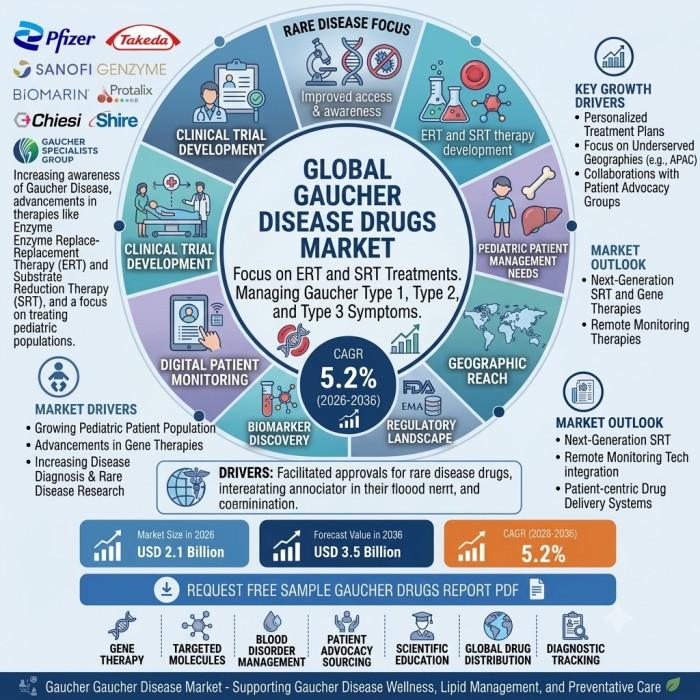
ROCKVILLE, MARYLAND , Sept 23, 2026 – The Gaucher disease drugs market reached USD 2.4 billion in 2025 and is projected to stand at USD 2.5 billion in 2026. It is forecast to expand to USD 4.3 billion by 2036, recording a compound annual growth rate (CAGR) of 5.5% from 2026 to 2036.
This absolute opportunity of USD 1.8 billion by 2036 is concentrated in enzyme replacement therapy and Type 1 Gaucher disease, according to Fact.MR analysis of approved Gaucher-specific drugs used in documented treatment pathways. Coverage spans hospital pharmacies, specialty pharmacies, homecare, retail and online channels.
Get detailed market forecasts, competitive benchmarking, and pricing trends:
Key Findings
· Market size: USD 2.4 billion (2025), USD 2.5 billion (2026), USD 4.3 billion (2036).
· CAGR: 5.5% (2026–2036).
· Absolute opportunity: USD 1.8 billion by 2036, focused on enzyme replacement therapy and Type 1 disease.
· Leading product type share (2026): Enzyme Replacement Therapy at 58.0%.
· Leading application share (2026): Type 1 Gaucher Disease at 67.0%.
· Leading end-user share (2026): Hospitals at 42.0%.
Note: Source materials state both a 2025 base of USD 2.4 billion and a 2026 starting point of USD 2.5 billion; both figures are retained as reported.
Growth Drivers
Demand is supported by the following factors, ranked by qualitative relevance in the source analysis:
· Treatment eligibility and long-term persistence (high relevance; Germany and USA; current forecast period). Confirmed patients remain on therapy after specialist review and funding approval, converting diagnosis into recurring revenue.
· Specialist diagnosis and reimbursement review (high relevance; Germany, Canada and UK). Documented disease type and clinical need enable payer approval for repeat treatment.
· Hospital and specialty-pharmacy coordination (medium relevance; USA and Australia). Shared access tasks protect continuity from infusion start to ongoing supply.
Opportunities include neuronopathic therapy development (high relevance; USA and specialist rare-disease centers), oral therapy for selected patients after genotype and interaction review (medium; USA and Europe), and home-infusion support for stable patients (medium; USA, Canada and Australia).
Segment Analysis By Product Type
· Enzyme Replacement Therapy (ERT) is projected to hold 58.0% share in 2026. It leads through approved biologic products that replace deficient glucocerebrosidase activity and support systemic disease control. Specific agents referenced include imiglucerase and velaglucerase alfa.
· Substrate Reduction Therapy (SRT) follows, with agents including eliglustat and miglustat.
· Additional categories cover combination therapy, supportive care drugs (pain and bone disease management), and pipeline/emerging therapies (gene therapy and novel enzyme therapies).
By Technology / Route of Administration
· Intravenous administration (hospital infusion and home infusion) remains central for ERT.
· Oral routes (capsules and tablets) support selected SRT use after eligibility checks.
· Other routes include subcutaneous and combination administration pathways.
By Application
· Type 1 Gaucher Disease is anticipated to account for 67.0% share in 2026 as the largest treatable patient group. Drivers include anemia, thrombocytopenia and bone pain without primary central nervous system involvement.
· Type 3 and Type 2 Gaucher Disease form smaller segments; Type 3 includes pediatric and adult patients, while Type 2 focuses on symptomatic and palliative management.
· Hematological manifestations and bone complications are tracked as related sub-applications.
By End User
· Hospitals are forecast to hold 42.0% share in 2026. Diagnosis, treatment selection, infusion initiation and emergency readiness occur in tertiary and specialty settings.
· Specialty clinics, infusion centers, home healthcare and research institutes complete the end-user mix.
Country-Level Growth Comparison
|
Country |
CAGR (2026–2036) |
Commercial Condition |
|
Germany |
6.3% |
Specialist prescribing and structured benefit assessment |
|
Brazil |
5.9% |
Protocol-based specialist care and public-system authorization |
|
USA |
5.6% |
Parallel hospital, specialty-pharmacy and home-infusion channels |
|
Canada |
5.3% |
Provincial funding and specialist genetic care |
|
Australia |
5.0% |
Specialist medicine access and coordinated rare-disease services |
|
UK |
4.7% |
Nationally coordinated specialist services and formal access terms |
|
Japan |
4.1% |
Specialist centers and product-specific regulatory conditions |
Germany records the highest listed CAGR. Comparable rates still produce different entry conditions based on specialist capacity and funded access.
Competitive Landscape
The market separates enzyme replacement franchises, oral substrate reduction platforms and regional rare-disease companies. Competition hinges on indication breadth and supply continuity.
Key companies profiled:
· Sanofi
· Takeda Pharmaceutical Company Limited
· Pfizer Inc.
· ISU ABXIS Co., Ltd.
· CANbridge Pharmaceuticals Inc.
· Protalix BioTherapeutics
· Amicus Therapeutics
Sanofi and Takeda hold the clearest treatment relevance through established Gaucher products. Pfizer and Chiesi retain relevance via rare-disease portfolios. Regional players such as ISU ABXIS and CANbridge matter where local access and approved products shape sales.
Recent Developments
· May 16, 2025: CANbridge Pharmaceuticals Inc. announced marketing approval of Velaglucerase-beta for Injection (Gaurunning), a Class 1 new drug for treating Type I and III Gaucher Disease, in China.
· January 12, 2026: U.S. Food and Drug Administration search of Orphan Drug Designations and Approvals referenced imiglucerase.
· May 28, 2026: Sanofi’s venglustat was accepted for priority review in the US to treat type 3 Gaucher disease.
Restraints
· Lifetime cost and funded access control (high relevance; USA, UK, Canada and Australia). The primary restraint lies between specialist recommendation and repeat use; payers require proof of fit to approved pathways.
· Infusion staffing and site readiness (medium relevance; hospitals and homecare). Intravenous therapy adds scheduling and monitoring requirements; smaller sites face slower starts
{
"@context": "https://schema.org",
"@type": "BlogPosting",
"headline": "Gaucher Disease Drugs Market Growth, Global Trends, Size, Segmentation, Opportunities, Forecast Analysis By Fact.MR",
"description": "<div class="WordSection1">
<p class="MsoBodyText" style="margin:0in 4.3pt 0.0001pt 0.05pt;"><strong>ROCKVILLE, MARYLAND , Sept 23, 2026...",
"image": "https://np-social.sfo3.digitaloceanspaces.com/uploads/photos/2026/09/net_pals_7d56c1e8d47578a520f62321fa7f60fa.jpg",
"author": {
"@type": "Person",
"name": "Akshaygo",
"url": "https://net-pals.com/Akshaygo"
},
"publisher": {
"@type": "Organization",
"name": "Net Pals",
"url": "https://net-pals.com"
},
"datePublished": "2026-09-23 17:08:47",
"dateModified": "2026-09-23 17:08:47",
"mainEntityOfPage": {
"@type": "WebPage",
"@id": "https://net-pals.com/blogs/39428/Gaucher-Disease-Drugs-Market-Growth-Global-Trends-Size-Segmentation-Opportunities"
},
"url": "https://net-pals.com/blogs/39428/Gaucher-Disease-Drugs-Market-Growth-Global-Trends-Size-Segmentation-Opportunities",
"articleSection": "Health",
"keywords": "Gaucher_Disease_Drugs_Market",
"wordCount": "65535",
"commentCount": "",
"interactionStatistic": [{
"@type": "InteractionCounter",
"interactionType": "https://schema.org/CommentAction",
"userInteractionCount": ""
},
{
"@type": "InteractionCounter",
"interactionType": "https://schema.org/ViewAction",
"userInteractionCount": ""
}
]
}

 English
 Arabic
 Spanish
 Portuguese
 Deutsch
 Turkish
 Dutch
Dutch
 Italiano
 Russian
 Romaian
 Portuguese (Brazil)
 Greek
Greek