


Key Highlights of the NDCT Amendment Rules 2026: Transforming India’s Clinical Research Landscape
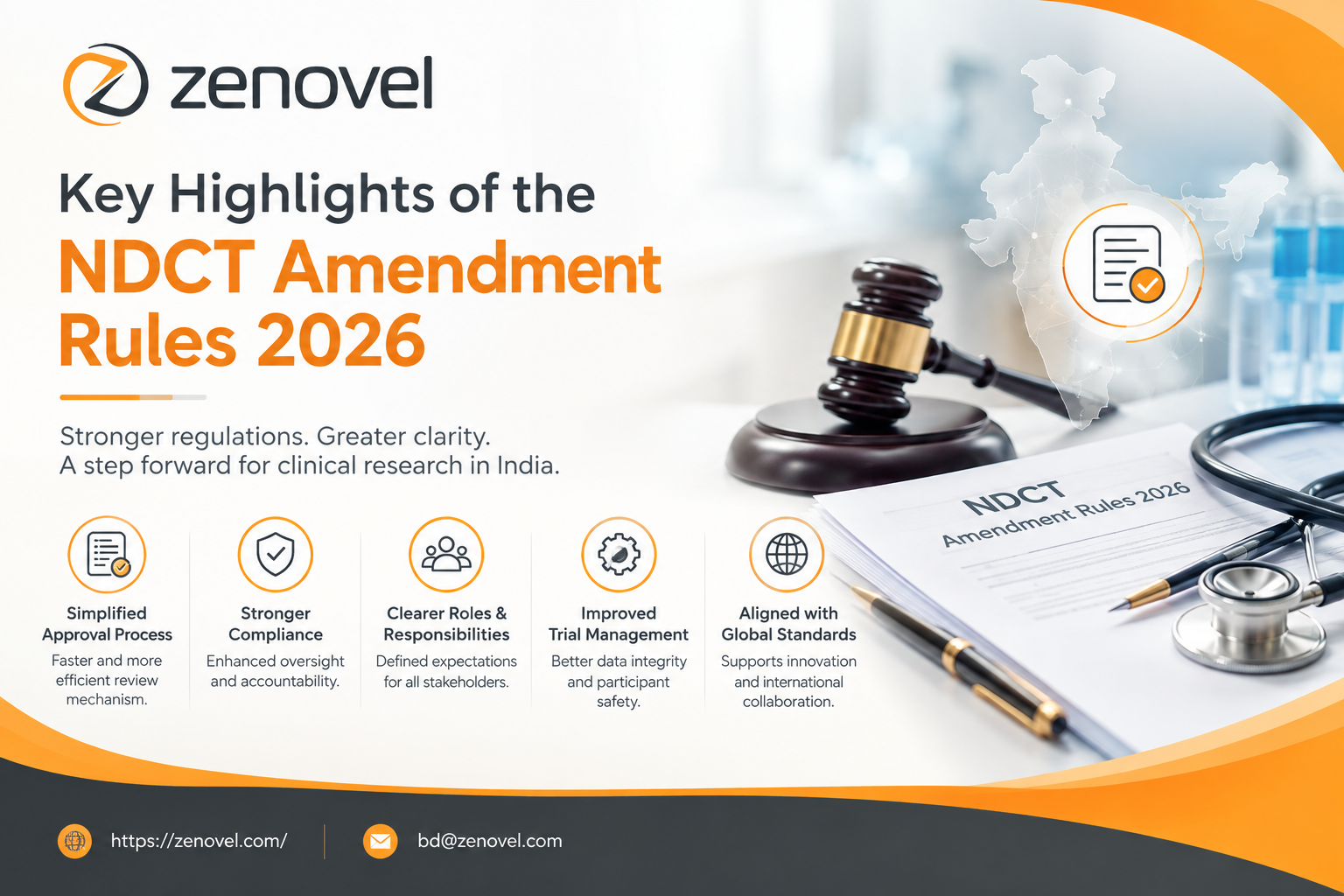
The clinical research and pharmaceutical sectors in India are undergoing a profound evolution. To streamline drug development, eliminate procedural bottlenecks, and align national standards with global frameworks, the Ministry of Health and Family Welfare (MoHFW) and the Central Drugs Standard Control Organization (CDSCO) introduced the landmark New Drugs and Clinical Trials (NDCT) Amendment Rules.
These updated rules represent a critical shift toward risk-based efficiency, digital integration, and faster regulatory pathways. For global pharmaceutical sponsors, contract research organizations (CROs), and biotech firms, understanding these changes is essential for optimizing clinical trial start-up timelines and regulatory strategies in India.
1. Introduction of the Prior Intimation Pathway (Replacing Traditional Test Licenses)
One of the most impactful reforms under the 2026 amendments is the modernization of the test license framework for non-commercial manufacturing.
-
The Prior Intimation Mechanism: For specified lower-risk categories, applicants can submit an online application via Form CT-10 through the CDSCO SUGAM portal.
-
Streamlined Execution: Instead of waiting for formal regulatory pre-approval, manufacturing for clinical trials, bioequivalence (BE) studies, or analytical testing can commence upon receiving acknowledgment of prior intimation.
-
High-Risk Exceptions: To maintain rigorous safety standards, high-risk categories—such as sex hormones, cytotoxic drugs, beta-lactam antibiotics, biologics containing live microorganisms, and narcotic/psychotropic substances—are strictly excluded from the prior intimation pathway and still require traditional prior approvals.
2. Compression of Statutory Review Timelines (90 to 45 Days)
To accelerate early-phase research and improve study start-up efficiency, the amendment formally standardizes and reduces statutory review periods.
-
Under revised provisions (such as Rules 53 and 60), the Central Licensing Authority (CLA) review window for applicable test licenses, investigational new drugs (INDs), and unapproved active pharmaceutical ingredients (APIs) has been cut from 90 working days down to 45 working days.
-
This predictable timeframe significantly compresses pre-trial preparation cycles, helping sponsors achieve faster "First Patient In" (FPI) milestones.
3. Enhanced Compliance and Rigorous Quality Obligations
While the 2026 amendments successfully reduce administrative red tape, they simultaneously place a heavier emphasis on accountability and Good Manufacturing Practices (GMP).
-
Strict Purpose Limitation: Materials manufactured under these pathways must be strictly restricted to clinical trials, BA/BE studies, or analytical testing, with zero tolerance for commercial distribution.
-
Documentation & Audits: Manufacturers must maintain flawless records, proper labeling, and robust audit trails.
-
Enforcement & Appeals: The rules clearly outline provisions for the suspension or cancellation of acknowledgments or permissions in cases of non-compliance, backed by a structured appeal process to the Central Government to ensure procedural fairness.
4. Deepening Digital Integration via the CDSCO Portal
The transition toward an end-to-end digitized framework (utilizing Forms CT-10, CT-12, CT-13, etc.) enhances end-to-end traceability and transparency. Digital tracking minimizes human interface delays, optimizes application tracking, and empowers regulatory authorities to execute risk-based monitoring more effectively.
Strategic Implications for Sponsors and CROs
The NDCT Amendment Rules 2026 solidify India’s position as a premier, highly agile destination for multi-regional clinical trials. However, navigating the intersection of accelerated timelines and strict compliance mandates requires meticulous planning. Sponsors must update their operational standard operating procedures (SOPs) and integrate the prior intimation pathways seamlessly into their global development frameworks.
To successfully interpret these regulatory updates, optimize your trial start-up pathways, and ensure absolute compliance with CDSCO and GCP standards, partner with the experts at Zenovel for specialized regulatory consulting and clinical research execution.

 English
 Arabic
 French
 Spanish
 Portuguese
 Deutsch
 Turkish
 Dutch
Dutch
 Italiano
 Russian
 Romaian
 Portuguese (Brazil)