


Carbon Accounting and Management Software: What Enterprises Need to Know About the Evolving Market
Organizations across industries are under increasing pressure to understand their carbon footprint, improve emissions visibility, meet sustainability objectives, and respond to evolving climate-related requirements. As carbon management becomes increasingly connected to business strategy, spreadsheets and disconnected reporting processes are no longer sufficient for many large enterprises.
This is driving demand for Enterprise Carbon Management Software that can bring emissions data, carbon accounting, reporting, scenario modeling, compliance, and decarbonization planning into a more connected environment.
QKS Group’s Enterprise Carbon Management Software market research examines emerging technology trends, market dynamics, competitive developments, and future market outlook. The research provides strategic insights for technology vendors while helping users understand vendor capabilities, competitive differentiation, and market positioning.
Download Sample Report Here: https://qksgroup.com/download-sample-form/spark-matrix-enterprise-carbon-management-software-ecm-q2-2025-8922
Why Enterprise Carbon Management Is Becoming a Business Priority
Carbon management has evolved beyond simply calculating an organization's emissions. Enterprises increasingly need to understand where emissions originate, how they change over time, which operations contribute the most, and what actions can reduce them.
Large organizations can have complex operational footprints spanning offices, manufacturing facilities, transportation networks, data centers, suppliers, and other parts of the value chain.
This makes carbon data management challenging.
Organizations may need to collect information from multiple systems and business units while maintaining consistency across emissions calculations and reporting processes.
Enterprise Carbon Management Software addresses this challenge by helping organizations centralize and manage carbon-related information across their operations.
What Is Enterprise Carbon Management Software?
Enterprise Carbon Management Software is designed to help organizations measure, manage, and reduce carbon emissions while supporting broader decarbonization and net-zero initiatives.
Core capabilities can include:
- Carbon accounting and emissions measurement
- Scope 1, Scope 2, and Scope 3 emissions management
- Emissions data collection
- Carbon reporting
- Sustainability dashboards
- Supplier and value-chain emissions tracking
- Decarbonization planning
- Scenario modeling
- Reduction target management
- Regulatory and standards-related reporting
- Carbon performance analytics
The value of these capabilities extends beyond reporting. By connecting carbon information with operational and business data, enterprises can gain better visibility into potential reduction opportunities.
Carbon Accounting Is Becoming More Data-Driven
One of the major areas of focus for organizations is carbon accounting.
Traditional carbon accounting processes can involve manually collecting activity data, applying emissions factors, consolidating spreadsheets, and preparing reports. These processes can become difficult to manage as an organization grows.
Modern carbon management platforms aim to streamline this process by connecting data sources and automating parts of emissions calculations and reporting.
This can help organizations establish more consistent processes for tracking emissions and identifying changes in their carbon footprint.
The increasing digitization of carbon accounting also creates opportunities to connect emissions information with procurement, finance, operations, facilities, supply chain, and enterprise resource planning systems.
Scope 3 Emissions Increase the Complexity
Managing direct operational emissions can already be challenging, but value-chain emissions create another layer of complexity.
Scope 3 emissions can involve suppliers, purchased goods and services, transportation, business travel, employee commuting, product use, and other value-chain activities.
For organizations with extensive supplier networks, collecting consistent emissions data can be difficult.
Enterprise Carbon Management Software can help organizations organize supplier-related information, improve data collection processes, and develop greater visibility into value-chain emissions.
This is particularly relevant as organizations increasingly connect carbon management with supply chain sustainability.
Check SPARK Plus Study Here: https://qksgroup.com/sparkplus?market-id=475&market-name=enterprise-carbon-management-software
From Carbon Reporting to Decarbonization Strategy
Carbon measurement is only one part of the sustainability journey.
Organizations also need to determine what actions can reduce emissions and how different strategies may affect their operations, costs, and long-term objectives.
This is where scenario modeling becomes important.
Carbon management platforms can help organizations examine potential scenarios, such as changes in energy sources, operational processes, transportation methods, facilities, or supplier strategies.
Scenario-based analysis can help sustainability and business teams understand potential pathways toward emissions reduction before committing to major initiatives.
Instead of viewing carbon data purely as a reporting requirement, organizations can use it as an input into strategic planning.
How Technology Supports Net Zero Goals
Net-zero strategies require organizations to establish measurable targets and continuously track progress.
Technology can support this process by helping enterprises:
- Establish emissions baselines
- Set reduction targets
- Track progress against targets
- Identify high-emission operations
- Model potential reduction scenarios
- Monitor emissions trends
- Improve data transparency
- Coordinate sustainability initiatives across business functions
A centralized platform can also make it easier for sustainability teams to communicate carbon performance with executives and other stakeholders.
Compliance and Carbon Management Are Becoming Connected
Another important factor driving investment in carbon management technology is the changing sustainability reporting environment.
Organizations operating across different regions may face varying requirements around emissions disclosure, sustainability reporting, climate-related information, and environmental performance.
Manually maintaining multiple reporting processes can increase complexity.
Enterprise Carbon Management Software can help organizations organize emissions data and create repeatable processes for reporting and compliance activities.
However, organizations should evaluate whether a platform's supported reporting capabilities align with their specific geographic, industry, and regulatory requirements.
What Should Enterprises Look for in Carbon Management Software?
Selecting a carbon management platform requires organizations to consider more than basic emissions calculation.
Key evaluation areas can include:
Data collection: Can the platform collect emissions-related data from relevant internal and external sources?
Carbon accounting: Does it support the organization's required emissions categories, scopes, methodologies, and calculation processes?
Supply chain visibility: Can it help capture and manage relevant supplier and value-chain emissions information?
Scenario modeling: Can sustainability teams model potential decarbonization pathways?
Analytics: Does the platform provide dashboards and insights that help decision-makers understand emissions performance?
Reporting: Can it support the organization's sustainability and carbon reporting requirements?
Integration: Can the platform connect with enterprise systems and existing sustainability technology?
Scalability: Can it support expanding emissions data requirements as the organization grows?
These criteria can help organizations align technology investments with both current sustainability requirements and longer-term decarbonization strategies.
Understanding the Enterprise Carbon Management Vendor Landscape
The Enterprise Carbon Management Software market includes technology providers with different approaches to carbon accounting, sustainability management, emissions intelligence, and decarbonization.
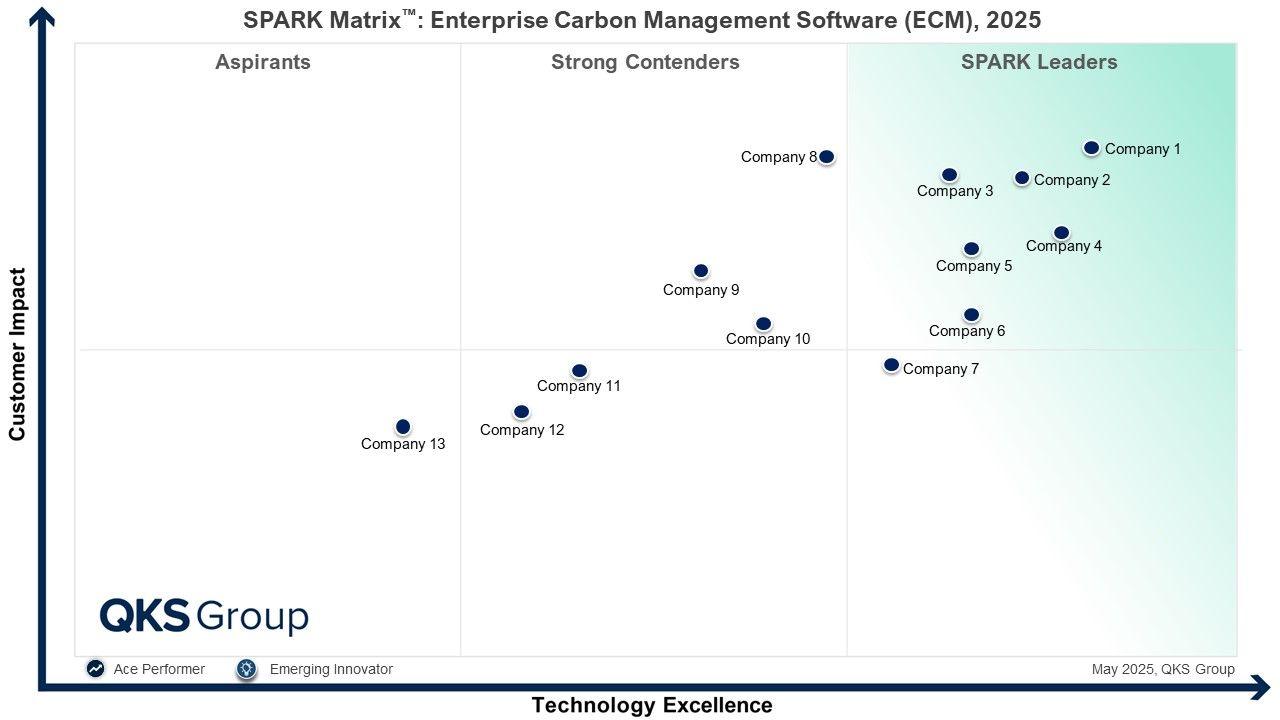
QKS Group's research provides detailed competition analysis and vendor evaluation through its proprietary SPARK Matrix™.
The research includes vendors such as Cority, UL Solutions, Sphera, Intelex, Wolters Kluwer, Persefoni, SINAI Technologies, Diligent, Salesforce, Watershed, Schneider Electric, Sweep, and FigBytes.
For technology buyers, this competitive perspective can provide useful context when examining vendor capabilities and differentiation. For technology providers, the research can help identify market expectations, technology trends, and competitive positioning opportunities.
The Future of Enterprise Carbon Management
The future of carbon management is moving from isolated emissions reporting toward integrated, data-driven sustainability management.
As organizations pursue decarbonization and net-zero objectives, they increasingly need technology that can connect carbon accounting, emissions intelligence, scenario modeling, supply chain data, compliance, and reduction planning.
Enterprise Carbon Management Software can provide the digital foundation for this transition by helping organizations turn fragmented emissions information into structured insights and actionable strategies.
Click Here For More Information: https://qksgroup.com/market-research/spark-matrix-enterprise-carbon-management-software-ecm-q2-2025-8922
QKS Group's SPARK Matrix™ provides market intelligence into the evolving Enterprise Carbon Management Software landscape, helping enterprises understand vendor capabilities while giving technology providers insights into competitive differentiation and emerging market expectations.
Explore the QKS Group Enterprise Carbon Management Software SPARK Matrix™ to understand the vendors and capabilities shaping the future of enterprise carbon management.

 English
 Arabic
 French
 Spanish
 Portuguese
 Turkish
 Dutch
Dutch
 Italiano
 Russian
 Romaian
 Portuguese (Brazil)
 Greek
Greek