


Medical Device and Medtech Enterprise Resource Planning Market Growth, Global Analysis and Forecast Analysis By Fact.MR
Rockville, Maryland — September 24, 2026 — The Medical Device and Medtech Enterprise Resource Planning Market reached USD 7.9 billion in 2025 and is valued at USD 8.9 billion in 2026. Demand is projected to increase to USD 27.8 billion by 2036, recording a 12.1% CAGR from 2026 to 2036.
Fact.MR defines the market as revenue from enterprise resource planning software and related implementation, consulting and support services purchased for medical device and medtech operations. Coverage connects manufacturing, inventory, procurement, finance, supplier control, quality and regulatory records within one governed enterprise environment. Stand-alone QMS, MES, CRM or PLM products are included only when sold as part of the defined ERP platform or module scope.
Get detailed market forecasts, competitive benchmarking, and pricing trends:
Key Findings
- Market valued at USD 8.9 billion in 2026; forecast to reach USD 27.8 billion by 2036 at 12.1% CAGR.
- Software projected to hold 69.0% share in 2026, with USD 18.9 billion absolute opportunity by 2036.
- Cloud-Based deployment anticipated to account for 74.0% share in 2026.
- Manufacturing & Production Management forecast to hold 31.0% share in 2026.
- Large Enterprises expected to represent 65.0% share in 2026.
- Medical Device Manufacturers projected to account for 48.0% share in 2026.
- South Korea leads listed country CAGRs at 13.17% from 2026 to 2036.
Shambhu Nath Jha, Principal Consultant at Fact.MR, states: “The buying decision is no longer about replacing finance software alone. Medical device manufacturers need one governed data spine for bills of material, production orders, supplier quality, lot and serial history, UDI records and regulatory evidence. Cloud adoption can reduce infrastructure work, but vendors still have to prove validation, access control and integration discipline. The strongest implementations will be phased around manufacturing and quality processes that auditors and plant teams use every day.”
Growth Drivers
- Regulatory and quality-system data convergence: FDA QMSR, ISO 13485-based controls, EUDAMED registration and national device requirements increase the value of governed product, supplier and quality data. High relevance in USA, Germany, UK and Japan.
- Lot, serial and supplier traceability: Manufacturers need to identify which supplier lot, work order, inspection result and shipment relate to a specific device. High relevance in USA, Canada, Australia and South Korea.
- Multi-site production and contract manufacturing control: A common ERP model helps compare capacity, inventory, purchase commitments and cost across owned plants and outsourced production. Medium relevance for global manufacturers and CMOs.
Opportunities include validated cloud ERP rollout (high relevance in USA, Canada, UK and Australia), ERP-QMS-MES-PLM integration (high relevance in Germany, Japan and South Korea), and mid-market medtech implementation templates (medium relevance for regional manufacturers and startups).
Segment Analysis by Component, Deployment, Application, Enterprise Size and End User
By Component Software leads with 69.0% share in 2026. Software carries the process model that links finance, procurement, inventory, production, quality and reporting. ERP Platforms provide the transactional core, while Regulatory Compliance Modules add controlled workflows, electronic records and audit support. Services remain essential for configuration, integration and user adoption, but the platform retains the recurring license and subscription value.
By Deployment Cloud-Based is anticipated to hold 74.0% share in 2026. Cloud deployment gives corporate teams a common release path across factories, distribution sites and acquired businesses. Public Cloud supports standardized processes and regular updates. Hybrid Cloud gives manufacturers more control over plant interfaces, sensitive workloads and regional requirements. On-Premise remains relevant where local production systems, validated customizations or data policies make a full cloud move impractical.
By Application Manufacturing & Production Management is forecast to represent 31.0% share in 2026. Production Planning and Manufacturing Execution determine whether materials, labor, tooling and approved instructions are available for each device build. These functions also connect output, scrap, rework and cost to lot or serial history.
By Enterprise Size Large Enterprises are expected to account for 65.0% share in 2026. Global Medical Device Manufacturers and Multinational MedTech Companies operate across multiple plants, legal entities, product classes and regulatory markets. They need consolidated financial control without losing plant-level traceability.
By End User Medical Device Manufacturers are projected to hold 48.0% share in 2026. Diagnostic Device Manufacturers and Surgical Device Manufacturers depend on controlled production records, supplier quality, lot and serial tracking and change management. Implant Manufacturers carry long traceability horizons.
Country-Level Growth Comparison
|
Country |
CAGR (2026-2036) |
Commercial Condition |
|
South Korea |
13.17% |
Medical-device GMP, digital-device controls and approval documentation under Ministry of Food and Drug Safety |
|
USA |
12.58% |
QMSR effective February 2, 2026, incorporating ISO 13485:2016; FDA risk-based computer software assurance guidance (February 2026) |
|
Canada |
12.19% |
MDSAP participation and medical-device licensing requirements |
|
UK |
11.93% |
Separate Great Britain (MHRA) and Northern Ireland (EUDAMED from May 28, 2026) registration paths |
|
Australia |
11.87% |
TGA manufacturer evidence requirements supporting ARTG inclusion |
|
Germany |
11.71% |
EUDAMED actor, UDI/device and certificate modules mandatory May 28, 2026 under EU MDR/IVDR |
|
Japan |
11.36% |
PMDA document-based and on-site QMS inspections for domestic and overseas sites |
Competitive Landscape
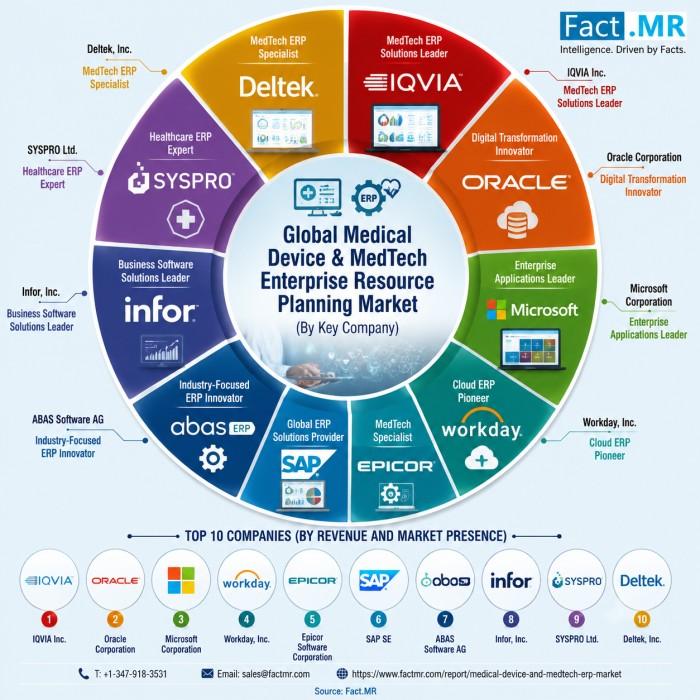
SAP SE accounts for 15.2% in 2026 among the named provider set. Its position reflects demand for an integrated enterprise core spanning finance, procurement, supply chain, production planning and quality management across large manufacturers.
Key companies include:
- SAP SE
- Oracle Corporation
- Microsoft Corporation
- Infor Inc.
- IFS AB
- QAD Inc.
- Epicor Software Corporation
- Aptean Inc.
- Deskera Holdings Ltd.
- Rootstock Software
Oracle Corporation addresses life-sciences ERP and supply-chain programs that include contract manufacturing and global network control. Microsoft Corporation, Infor Inc., IFS AB and Epicor Software Corporation compete through configurable manufacturing, finance and supply-chain suites. QAD Inc. and Rootstock Software have explicit medical-device positioning around traceability, supplier coordination and quality-ready processes. Aptean Inc. and Deskera Holdings Ltd. add alternatives for focused industry and mid-market requirements. Competition depends on validation approach, implementation depth, integration architecture, regional support and the ability to manage regulated upgrades without disrupting production.
Restraints
- Validation and data-migration workload: High relevance at regulated manufacturing sites. A technically successful migration can still fail an operational review if item, supplier, batch or quality history loses context.
- Legacy interfaces and master-data inconsistency: High relevance for large enterprises. Plants often use different part numbers, units, routings and quality codes.
- Cybersecurity, access and data-residency requirements: Medium relevance for cloud and hybrid deployments.
How to Choose: Buyer Decision Guide for Procurement and R&D Teams
1. Establish clean item, supplier, routing and quality master data before moving complex plants into a common ERP instance.
2. Apply risk-based computer software assurance to production and quality functions instead of testing every configuration with equal intensity (aligned with FDA February 2026 guidance).
3. Map interfaces with QMS, MES, PLM, CRM, warehouse systems and contract manufacturers before selecting a cloud, hybrid or on-premise architecture.
4. Prioritize vendors that package medtech-specific workflows for UDI, lot and serial traceability, supplier qualification, nonconformance, change control and device history records.
5. Evaluate validated workflows, access control and integration discipline as decisive buying tests, particularly for phased manufacturing and quality deployments.
6. Assess regional support and the ability to manage regulated upgrades without disrupting production, given country-specific requirements such as EUDAMED (May 28, 2026) and QMSR (February 2, 2026).
Unlock 360° insights for strategic decision making and investment planning:
Report Scope
The report covers commercial ERP licenses, subscriptions and defined implementation, consulting and support services for medical-device and medtech enterprise operations. Segmentation includes Component, Deployment, Application, Enterprise Size, End User and Region. Forecast period is 2026 to 2036. Analysis draws on 120+ sources, 35+ company portfolios, 25+ countries and more than 20 industry interviews.
Explore More Related Studies Published by Fact.MR Research
Erythropoietin (EPO) Drugs Market-
Laboratory Animal Medicine Market-
About Fact.MR
Fact.MR is a global market research and consulting firm, trusted by Fortune 500 companies and emerging businesses for reliable insights and strategic intelligence. With a presence across the U.S., UK, India, and Dubai, we deliver data-driven research and tailored consulting solutions across 30+ industries and 1,000+ markets. Backed by deep expertise and advanced analytics, Fact.MR helps organizations uncover opportunities, reduce risks, and make informed decisions for sustainable growth.
- Contact Us -
11140 Rockville Pike, Suite 400, Rockville,
MD 20852, United States
Tel: +1 (628) 251-1583 | sales@factmr.com
Flag: The quote attributed to analyst S.N. Jha is sourced directly from published commentary on the report page and requires standard PR media sign-off before official press wire dissemination.

 English
 Arabic
 French
 Spanish
 Portuguese
 Deutsch
 Turkish
 Dutch
Dutch
 Italiano
 Russian
 Portuguese (Brazil)
 Greek
Greek