


Hairy Cell Leukemia Treatment Market Trends: Targeted Therapies Shape Future Treatment Demand
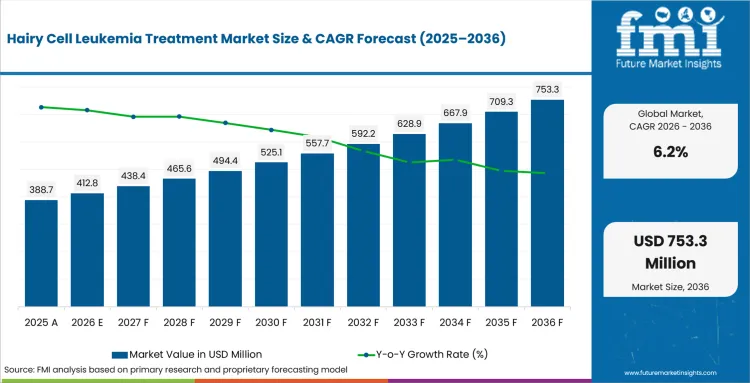
NEWARK, Del. — According to Future Market Insights (FMI), the global hairy cell leukemia treatment market is valued at USD 412.8 million in 2026 and is projected to reach USD 753.3 million by 2036, expanding at a 6.2% CAGR during the 2026–2036 forecast period. Established treatment guidelines and defined intervention criteria continue to support demand for therapies among patients with active disease. The National Cancer Institute updated its professional summary in February 2025 and retained cladribine, with or without rituximab, as standard care.
👉 Get Detailed Market Forecasts, Competitive Benchmarking, and Pricing Trends:
https://www.futuremarketinsights.com/reports/sample/rep-gb-34363
Treatment demand is concentrated within specialist hematology centers because symptomatic cytopenias, progressive splenomegaly, or recurrent infections establish the need for therapy rather than diagnosis alone. The Hairy Cell Leukemia Foundation's updated international consensus guidance, published in April 2026, distinguishes molecularly different patient groups and gives measurable residual disease a clearer role in response assessment.
Global Segment Leaders
- Chemotherapy — 49.0% share: Chemotherapy leads the treatment segment in 2026, supported by established purine-based courses and specialist monitoring pathways. FMI cites an August 2025 ClinicalTrials.gov update covering a 175-participant National Cancer Institute study of cladribine with immediate or delayed rituximab.
- Purine Analogs — 52.0% share: Purine analogs lead the drug-class segment, reflecting established response performance and familiar administration protocols. The European Medicines Agency retained cladribine for adult hairy cell leukemia in its April 2025 Litak information update.
- First-line Treatment — 61.0% share: First-line treatment represents the largest disease-stage segment because newly treated eligible patients make up the larger treatment flow. FMI notes that established regimens provide known outcome expectations for specialist teams.
- Hospitals — 46.0% share: Hospitals account for the largest end-user share because they combine diagnosis, infusion capacity, blood-count monitoring, pharmacy services, and management of treatment-related complications.
- Hospital Pharmacies — 55.0% share: Hospital pharmacies lead the distribution channel because key medicines require controlled ordering, preparation, scheduled administration, and coordination with specialist monitoring.
Country-Level Performance
|
Country |
CAGR |
Key Growth Driver |
|
Japan |
7.8% |
Concentrated hematology expertise and formal clinical guidance support treatment pathways for uncommon leukemia cases. The Japanese Society of Hematology updated its hematologic malignancy guideline portal in November 2025. |
|
Canada |
7.4% |
Provincial cancer programs and registry participation support coordinated treatment and outcome documentation. ClinicalTrials.gov updated the international patient registry in April 2025 and listed CancerCare Manitoba as a recruiting location. |
|
Germany |
7.0% |
Organized hematology networks and long-term registry infrastructure support specialist access. ClinicalTrials.gov updated the German CLL Study Group registry in December 2025, retaining hairy cell leukemia within its documentation program. |
|
Italy |
6.3% |
Public hospital hematology units and academic collaboration support rare-leukemia diagnosis and follow-up. A Bologna observational study posted in January 2025 includes patients at diagnosis and relapse. |
|
UK |
5.9% |
Specialist cancer centers operate defined systemic therapy protocols. A North East and North Cumbria NHS formulary update in July 2025 retained injectable cladribine for hairy cell leukemia. |
|
France |
5.5% |
Regional university hospitals and molecular laboratories support diagnosis across uncommon hematologic cancer pathways. Orphanet updated an IUCT Oncopole laboratory listing in December 2025 to include classic hairy cell leukemia within flow-cytometry testing. |
|
USA |
4.4% |
Established purine analog use and broad academic trial capacity support the market, including molecularly selected research in relapsed disease. ClinicalTrials.gov updated an encorafenib plus binimetinib study in June 2026 for relapsed or refractory BRAF V600-mutated disease. |
The seven profiled countries span a 3.4-percentage-point CAGR range, from 7.8% in Japan to 4.4% in the USA. FMI states that the forecast measures market growth rather than treatment quality or underlying disease burden.
Regional Context
East Asia and North America present different market conditions for hairy cell leukemia treatment. Japan's 7.8% CAGR is linked to concentrated specialist expertise and formal clinical guidance, while Canada's 7.4% growth is supported by provincial cancer programs and registry participation. The USA, despite its mature treatment base, is projected to grow at 4.4% as expansion is linked more closely to incremental pipeline activity and molecularly selected relapse treatment.
Europe includes Germany, Italy, the UK, and France among the profiled markets. Germany's 7.0% CAGR reflects organized hematology networks and registry infrastructure. Italy is projected at 6.3%, supported by public hospital research networks. The UK and France are forecast at 5.9% and 5.5%, respectively, with national evidence review, funding structures, molecular testing, and concentrated referral expertise influencing treatment access.
FMI's full report covers North America, Latin America, Europe, East Asia, South Asia, Oceania, and the Middle East and Africa, with country-level CAGR analysis disclosed for Japan, Canada, Germany, Italy, the UK, France, and the USA.
👉 Access the Complete Report in PDF Format:
https://www.futuremarketinsights.com/reports/brochure/rep-gb-34363
Drivers, Restraints and Opportunities
Durable responses from established purine analog regimens remain a key market driver. FMI notes that cladribine and rituximab studies continue to use measurable residual disease among response measures, supporting continued evaluation of treatment durability within specialist hematology pathways.
The small eligible patient population remains a central restraint. Limited patient numbers constrain clinical-trial recruitment and commercial scale outside concentrated referral networks. FMI also cites the NHS England January 2026 policy that did not support routine commissioning of vemurafenib plus rituximab for defined relapsed or refractory classic disease, illustrating how comparative and cost-effectiveness evidence can affect access to newer combinations.
Targeted combinations for relapsed disease represent an opportunity. A ClinicalTrials.gov study updated in April 2026 is evaluating low-dose vemurafenib with rituximab in hairy cell leukemia, while other development programs are examining molecularly selected approaches. Commercial relevance will depend on disease-specific evidence, response durability, and manageable safety.
Competitive Landscape
The competitive landscape includes Hospira, Inc., Lipomed GmbH, Fresenius Kabi USA, LLC, Hisun Pharmaceuticals USA, Inc., Genentech USA, Inc., AbbVie Inc., MacroGenics, Inc., and Servier. The market combines established purine analog suppliers with companies developing targeted or relapse-focused therapies.
Hospira, Lipomed, Fresenius Kabi, and Hisun participate in established purine analog supply through specialist treatment channels. Genentech and AbbVie are involved in venetoclax development and commercialization, with ClinicalTrials.gov updating a recruiting venetoclax study for relapsed hairy cell leukemia in May 2026. MacroGenics and Servier have development-stage programs addressing selected relapsed blood cancers and hairy cell leukemia.
Key Recent Developments
- July 2026: Hospira retained NIPENT's active hairy cell leukemia indication in an updated federal drug label, preserving a pentostatin treatment route for patients with active disease.
- January 2025: Hisun Pharmaceuticals USA retained cladribine's active hairy cell leukemia indication in an updated federal drug label, maintaining an intravenous purine analog route.
- May 2026: MacroGenics updated its recruiting phase 1 study of MGD024, retaining hairy cell leukemia among eligible relapsed blood cancers. The program evaluates a CD123 × CD3 bispecific DART molecule.
- April 2026: Servier completed its acquisition of Day One Biopharmaceuticals and gained control of the tovorafenib development portfolio. ClinicalTrials.gov subsequently updated a hairy cell leukemia study in June 2026 evaluating tovorafenib with rituximab across untreated and relapsed disease.
Access Full Report: https://www.futuremarketinsights.com/reports/hairy-cell-leukemia-treatment-market
Analyst Perspective
“Hairy cell leukemia creates value through long treatment-free intervals rather than repeated prescription volume across a broad patient base. Purine analogs retain first-line relevance because experienced centers understand their response profile and monitoring burden. Targeted combinations need disease-specific evidence in relapsed or molecularly selected patients, while commercial teams must preserve dependable medicine access across referral networks that treat very few cases each year.”
— Anurag Sharma, Principal Analyst, Future Market Insights
About Future Market Insights
Future Market Insights (FMI) is a leading provider of market research and consulting services, offering syndicated and customized research across industries including healthcare, pharmaceuticals, and biotechnology.
Related Reports:
· Kidney Transplant AlloSure dd-cfDNA Monitoring Market - https://www.futuremarketinsights.com/reports/kidney-transplant-allosure-dd-cfdna-monitoring-market
· Medical Technology Accelerator Market - https://www.futuremarketinsights.com/reports/medical-technology-accelerator-market
· Medical Technology Regulatory Modernization And Innovation Market - https://www.futuremarketinsights.com/reports/medical-technology-regulatory-modernization-and-innovation-pathways-market
About Future Market Insights (FMI)
Future Market Insights (FMI) is a global market intelligence and consulting firm providing comprehensive market research, competitive intelligence, and strategic business insights across industries. The firm delivers detailed forecasts, technology analysis, and data-driven recommendations that support informed decision-making for manufacturers, investors, distributors, and policymakers worldwide.
For Press & Corporate Inquiries
Rahul Singh
AVP – Marketing and Growth Strategy
Future Market Insights, Inc.
+91 8600020075
For Sales – sales@futuremarketinsights.com
For Media – Rahul.singh@futuremarketinsights.com
For Web – https://www.futuremarketinsights.com

 English
 French
 Spanish
 Portuguese
 Deutsch
 Turkish
 Dutch
Dutch
 Italiano
 Russian
 Romaian
 Portuguese (Brazil)
 Greek
Greek