


How to Launch a Roadside Assistance App Business in 2026
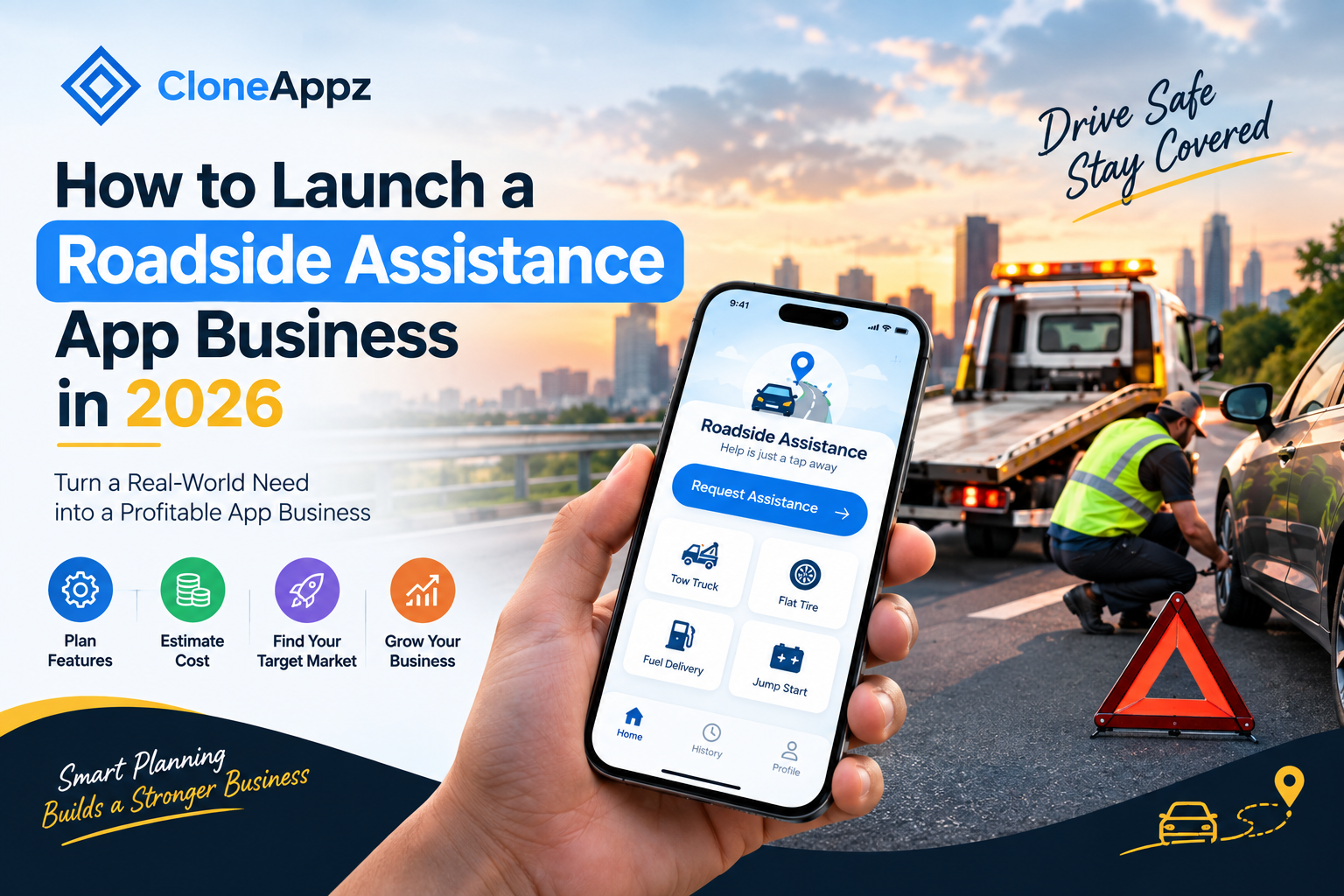
A vehicle breakdown rarely happens at a convenient time. A flat tire on a highway, a dead battery in a parking lot, or an empty fuel tank during a long trip can leave drivers looking for immediate help. Traditionally, people have depended on phone calls and local garages to solve these problems. Today, smartphones are changing that experience.
An on-demand roadside assistance app can connect drivers with towing companies, mechanics, tire specialists, battery technicians, and other service providers through a single digital platform. Customers can request help, share their location, track a service professional, and make payments without managing multiple phone calls.
For entrepreneurs, this creates an opportunity to build a location-based service marketplace around a real and recurring problem. However, launching successfully requires more than simply creating an application. The business needs a clear service model, reliable providers, suitable technology, and a customer experience designed for urgent situations.
This guide explains how to launch a roadside assistance app business in 2026, what features to include, how the platform can generate revenue, and how to approach Roadside Assistance App Development.
What Is a Roadside Assistance App Business?
A roadside assistance app business acts as a digital connection between vehicle owners who need help and professionals who can provide it.
Depending on the business model, customers may request services such as:
-
Emergency towing
-
Flat-tire replacement
-
Battery jump-start
-
Fuel delivery
-
Vehicle lockout assistance
-
Minor mechanical repairs
-
Accident recovery
-
Vehicle transportation
-
Mobile mechanic services
The platform can work as a direct service provider or as a marketplace where independent roadside professionals register and receive service requests.
A marketplace model can be particularly useful when the goal is to expand across multiple locations without maintaining a large in-house workforce.
Why Start a Roadside Assistance App Business in 2026?
Consumers are increasingly comfortable ordering services through mobile applications. When an emergency occurs, convenience becomes even more important.
Instead of searching online for a nearby towing company, a customer can open an app and request assistance using their current location.
A digital platform can help businesses manage:
-
Customer requests
-
Provider availability
-
Service locations
-
Pricing
-
Payments
-
Reviews
-
Service history
-
Customer communication
It can also create opportunities for partnerships with insurance companies, vehicle dealerships, rental companies, fleet operators, and automotive service businesses.
The key is to solve a specific problem efficiently rather than attempting to build a complicated application from day one.
Step 1: Choose Your Roadside Assistance Business Model
Before starting Roadside Assistance App Development, determine how the business will operate.
Direct Service Model
The company owns or manages its own service team. Customers request assistance through the application, and the company's employees complete the jobs.
Marketplace Model
Independent mechanics, towing companies, and roadside professionals join the platform. Customers request a service, and the system connects them with an appropriate provider.
Subscription Model
Customers pay a recurring membership fee in exchange for roadside assistance benefits.
Hybrid Model
A business can combine service fees, commissions, subscriptions, and corporate partnerships.
Your choice will influence the application's features, provider management system, pricing structure, and backend architecture.
Step 2: Identify Your Target Customers
A roadside assistance app does not have to target every vehicle owner initially.
You can focus on a specific audience, such as:
-
Individual car owners
-
Motorcycle riders
-
Commercial fleets
-
Rental companies
-
Delivery businesses
-
Corporate vehicle fleets
-
Used-car dealerships
-
Insurance customers
For example, a platform targeting delivery fleets may need fleet dashboards, multiple vehicle management, service history, and business billing.
A consumer-focused app may instead prioritize quick service requests, GPS tracking, digital payments, and emergency communication.
Defining the audience early makes the development process more focused.
Step 3: Build an MVP First
One of the common mistakes in app startups is trying to include every possible feature before launching.
A better approach is to build a Minimum Viable Product that handles the complete customer journey.
A roadside assistance MVP can include:
-
User registration
-
Vehicle profiles
-
Service categories
-
Location sharing
-
Service requests
-
Provider registration
-
Provider availability
-
Request acceptance
-
GPS navigation
-
Push notifications
-
Online payments
-
Ratings and reviews
-
Admin dashboard
Once the MVP starts receiving real users, additional features can be introduced based on actual customer needs.
Essential Features for a Roadside Assistance App
Customer App
The customer application should make requesting assistance as simple as possible.
Users should be able to select their problem, provide vehicle details, confirm their location, view estimated pricing, request assistance, and track the assigned provider.
Service Provider App
The provider application needs a different workflow.
Providers should be able to:
-
Create professional profiles
-
Add service categories
-
Set availability
-
Receive requests
-
Accept jobs
-
Navigate to customers
-
Update service status
-
View earnings
-
Manage completed jobs
Admin Dashboard
The administrator controls the entire marketplace through a centralized dashboard.
It can be used to manage:
-
Customers
-
Service providers
-
Service categories
-
Payments
-
Commissions
-
Complaints
-
Reviews
-
Promotions
-
Analytics
-
Service areas
GPS and Real-Time Tracking
Location technology is one of the most important components of a roadside assistance platform.
When a driver is stranded, manually explaining their location can be difficult. GPS can allow the customer to share their current position directly through the application.
After a provider accepts the request, real-time tracking can show their approximate location and estimated arrival time.
This can improve communication and reduce unnecessary calls between customers and service providers.
Use an Airtasker Clone Concept for Service Matching
An Airtasker Clone provides a useful example of how a service marketplace can connect people who need a task completed with professionals who can perform it.
For roadside assistance, the same concept can be adapted to automotive services.
Instead of general tasks, the marketplace can list:
-
Towing
-
Tire assistance
-
Battery services
-
Fuel delivery
-
Vehicle recovery
-
Mobile mechanics
The objective is not to duplicate another platform. The useful concept is the service marketplace structure: customers post requirements, qualified providers receive opportunities, and the platform manages the transaction.
What a Turo Clone App Can Teach Mobility Startups
A turo clone app is based around a vehicle-focused marketplace model. While a car-rental marketplace and roadside assistance platform have different purposes, both involve vehicles, locations, availability, customers, and digital transactions.
Roadside assistance businesses can learn from this type of marketplace architecture when designing:
-
Provider profiles
-
Availability management
-
Location-based discovery
-
Booking workflows
-
Reviews
-
Digital payments
-
Customer-provider communication
The final product should be designed around roadside assistance rather than simply copying a rental platform.
Add AI Where It Actually Helps
AI can be useful in roadside assistance, but it should solve practical problems.
For example, a customer could describe an issue in natural language:
“My car suddenly stopped and won't start again.”
An AI assistant could ask basic questions and help categorize the request before connecting the customer with an appropriate service provider.
Other possible applications include:
-
Automated customer support
-
Service categorization
-
FAQ automation
-
Provider support
-
Request prioritization
-
Fraud detection
-
Operational analytics
The growing popularity of conversational products such as a candy ai clone demonstrates how users are becoming familiar with AI-based interactions. In a roadside assistance product, however, AI should remain focused on helping users complete the service journey.
Personalization Through White-Label Technology
Not every business needs to build an entire technology stack from scratch.
A white-label solution can provide a ready-made foundation that businesses can customize with their own brand identity, workflows, services, pricing, and integrations.
For example, a White Label Mental Health App can be adapted for a specific healthcare business by customizing the technology around its particular service model. The same general white-label approach can be applied to roadside assistance.
A business can customize:
-
Logo and branding
-
Service categories
-
Pricing
-
Provider workflows
-
Payment methods
-
Notifications
-
Location coverage
-
Admin controls
This can help businesses move from concept to launch without creating every basic component from zero.
Location-Based Discovery Inspired by Zillow Clone Platforms
Location is also central to property platforms. A Zillow Clone, for example, can organize listings according to geographic location and help users find relevant options in a particular area.
A roadside assistance platform can use a similar location-driven principle for service discovery.
Instead of finding properties, the customer can find available roadside professionals based on:
-
Current location
-
Service type
-
Availability
-
Distance
-
Estimated arrival
-
Service coverage
-
Provider rating
This makes location data a central part of the customer experience.
How Will Your Roadside Assistance App Make Money?
A clear monetization strategy should be defined before development.
Commission
The platform can keep a percentage of each completed service.
Service Fee
Customers can pay a platform fee in addition to the provider's service charge.
Membership
Customers can purchase monthly or annual roadside assistance plans.
Provider Subscription
Service providers can pay for premium access, additional leads, or advanced business tools.
Business Partnerships
The platform can work with insurers, dealerships, rental companies, and fleet operators.
A hybrid revenue model can combine several of these options.
Roadside Assistance App Development Process
Once the business model is clear, development can follow a structured process.
1. Market Research
Study competitors, service gaps, customer expectations, and local pricing.
2. Business Planning
Define your audience, service categories, revenue model, operating areas, and provider strategy.
3. UI/UX Design
Create simple screens that allow users to request assistance quickly.
4. MVP Development
Develop customer, provider, and admin components with the core features.
5. API Integration
Integrate mapping, payment, notification, communication, analytics, and other required services.
6. Testing
Test location accuracy, service requests, payments, notifications, provider matching, and security.
7. Launch
Begin in a focused geographic area instead of immediately trying to cover a large market.
8. Scale
Use customer feedback and platform data to improve the service before expanding into additional regions.
How Much Does Roadside Assistance App Development Cost?
The cost varies depending on the product's complexity.
A basic MVP will generally require less investment than a full marketplace with advanced dispatching, AI features, multiple payment systems, fleet management, subscriptions, analytics, and multi-city support.
The major cost factors include:
-
UI/UX complexity
-
Number of applications
-
Backend architecture
-
GPS and mapping
-
Payment integration
-
Third-party APIs
-
AI functionality
-
Admin dashboard
-
Security requirements
-
Number of platforms
-
Customization
-
Post-launch maintenance
A detailed project specification is therefore important before requesting a development estimate.
How CloneAppz Can Support Your Launch
For businesses planning Roadside Assistance App Development, CloneAppz can provide a ready-made or customized development approach based on the required business model.
A platform can be customized around the company's branding, roadside services, provider workflows, payment methods, location features, and administrative requirements.
The objective should be to launch a practical product first and then expand its capabilities as the customer base grows.
Final Thoughts
Launching a roadside assistance app business in 2026 is not simply about creating another mobile application. The real challenge is building a reliable service network and connecting customers with the right provider at the right time.
Technology can make that process faster through GPS, automated matching, real-time tracking, digital payments, notifications, and AI-powered support.
Concepts from an Airtasker Clone can inspire service marketplace workflows, while a turo clone app offers useful ideas around vehicle-focused marketplaces. A White Label Mental Health App shows how specialized white-label products can be customized for a particular industry, while a candy ai clone highlights conversational AI possibilities. A Zillow Clone demonstrates the importance of location-driven discovery.
The best starting point is a focused business model, a simple MVP, reliable service providers, and a customer experience designed around speed and convenience. Once the platform proves its model, additional services, cities, partnerships, and technology can be introduced gradually.
FAQs
1. What is Roadside Assistance App Development?
Roadside Assistance App Development is the process of creating a mobile or web platform that connects drivers with roadside service providers for towing, battery assistance, tire services, fuel delivery, vehicle recovery, and related services.
2. What features should a roadside assistance MVP include?
An MVP should generally include customer registration, service requests, GPS location, provider management, request acceptance, notifications, payments, tracking, ratings, and an admin dashboard.
3. Can a roadside assistance app use a marketplace model?
Yes. A marketplace model can connect independent towing companies, mechanics, and roadside professionals with customers who need assistance.
4. Can AI be integrated into a roadside assistance app?
Yes. AI can support customer conversations, service categorization, FAQs, request processing, analytics, and other operational tasks.
5. How can a roadside assistance app generate revenue?
Possible revenue sources include commissions, service fees, subscriptions, provider plans, and partnerships with automotive and insurance businesses.
6. Is a white-label roadside assistance app possible?
Yes. A white-label platform can be customized with a company's branding, services, workflows, pricing, and integrations.
7. How long does it take to launch a roadside assistance app?
The timeline depends on the number of features, platforms, integrations, customization, and testing requirements. A focused MVP can be launched faster than a full-scale multi-city platform.

 English
 Arabic
 French
 Spanish
 Portuguese
 Deutsch
 Turkish
 Dutch
Dutch
 Italiano
 Russian
 Portuguese (Brazil)
 Greek
Greek