


Bioequivalence Studies: A Critical Step for Generic Tablet Approval
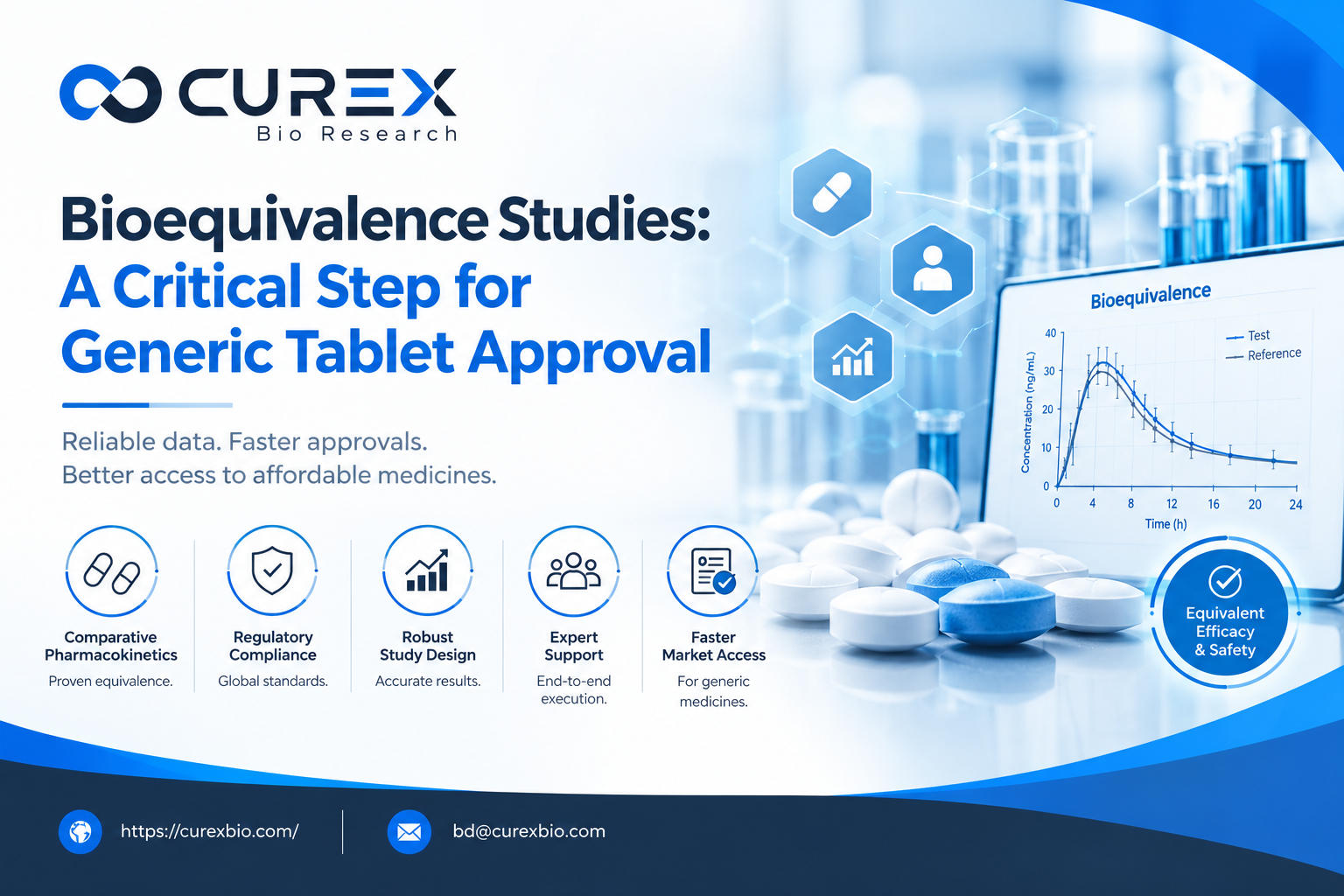
The pharmaceutical landscape is heavily driven by the demand for affordable, accessible, and high-quality medicines. When a brand-name drug's patent protection expires, generic drug manufacturers have the opportunity to introduce equivalent therapeutic options to the market. However, proving that a generic tablet is just as safe, effective, and high-performing as the innovator product requires rigorous scientific validation.
At the heart of this validation process lies the bioequivalence (BE) study.
For generic tablet approvals, bioequivalence studies serve as the definitive bridge between laboratory formulation and regulatory clearance by authorities such as the USFDA, EMA, and CDSCO.
Understanding Bioequivalence: Core Principles
Two medicinal products are considered bioequivalent if they are pharmaceutical equivalents or pharmaceutical alternatives, and their rates and extents of absorption—measured by key pharmacokinetic (PK) parameters—show no significant difference when administered under similar experimental conditions.
In the context of oral solid dosage forms like tablets, bioequivalence rests on two primary pharmacokinetic metrics:
-
$C_{max}$ (Maximum Plasma Concentration): Indicates the peak concentration of the drug in the bloodstream, reflecting the rate of absorption.
-
$AUC$ (Area Under the Curve): Measures the total systemic exposure of the drug over time, reflecting the extent of absorption.
If a generic tablet matches the innovator's $C_{max}$ and $AUC$ within strict regulatory acceptance intervals (typically $80\%$ to $125\%$), it is legally and scientifically presumed to provide the exact same clinical therapeutic effect.
Why Bioequivalence is Crucial for Generic Tablets
Unlike new chemical entities that require full-scale Phase I through Phase III clinical trials to establish safety and efficacy from scratch, generic drugs rely on the established safety and efficacy profile of the reference listed drug (RLD). BE studies replace these costly clinical trials, but they must meet uncompromising standards of precision.
-
Demonstrating Therapeutic Equivalence: Tablets can behave very differently in the gastrointestinal tract depending on excipients, manufacturing compression forces, and disintegration or dissolution profiles. A BE study proves that these formulation variations do not alter how the active pharmaceutical ingredient (API) enters the human body.
-
Accelerating Market Access: By substituting lengthy patient clinical trials with tightly controlled, cross-over pharmacokinetic studies in healthy human volunteers, manufacturers can bring cost-effective generic tablets to market rapidly.
-
Satisfying Global Regulatory Expectations: Regulatory agencies demand flawless data integrity, stringent adherence to Good Clinical Practice (GCP) and Good Laboratory Practice (GLP), and meticulous bio-analytical validation before granting approval.
Key Stages in Conducting a Successful BE Study
Executing a successful bioequivalence trial for generic tablets requires meticulous planning across several synchronized phases:
-
Pre-Study Analytical Validation: Before human dosing begins, high-performance bio-analytical methods (such as LC-MS/MS) must be developed and validated to accurately quantify trace amounts of the drug in plasma or serum.
-
Study Design & Protocol Optimization: Studies are typically randomized, single-dose, two-treatment, two-period crossover designs, conducted under both fasting and fed conditions (to evaluate food effects on the tablet formulation).
-
Clinical Phase Execution: Healthy volunteers are administered the test generic tablet and the reference product under strict clinical supervision, with serial blood samples drawn at precise time points.
-
Pharmacokinetic and Statistical Analysis: Bio-analytical samples are analyzed, and the resulting concentration-time profiles undergo rigorous statistical testing to verify that the confidence intervals fall well within regulatory thresholds.
Overcoming Common Challenges in Tablet BE Studies
Despite their standardized nature, tablet BE studies can face unexpected roadblocks:
-
In-Vitro/In-Vivo Dissolution Discrepancies: Differences in excipient interaction can cause a generic tablet to fail dissolution testing or show unexpected PK spikes.
-
High Inter-Subject Variability: Certain drug molecules exhibit high physiological variability across participants, requiring larger sample sizes or replicated study designs.
Partnering for Success
Navigating the complexities of bioequivalence trials, rigorous bio-analytical testing, and stringent global regulatory frameworks requires specialized expertise and cutting-edge laboratory infrastructure.
At CurexBio, we empower pharmaceutical innovators with comprehensive bioequivalence study management, advanced pharmacokinetic modeling, and expert bio-analytical services. Partner with us to streamline your generic tablet development pipeline, ensure absolute regulatory compliance, and deliver affordable, high-quality therapeutics to patients worldwide.

 English
 Arabic
 Spanish
 Portuguese
 Deutsch
 Turkish
 Dutch
Dutch
 Italiano
 Russian
 Romaian
 Portuguese (Brazil)
 Greek
Greek