


Clinical Development Challenges in Tablet and Capsule Manufacturing
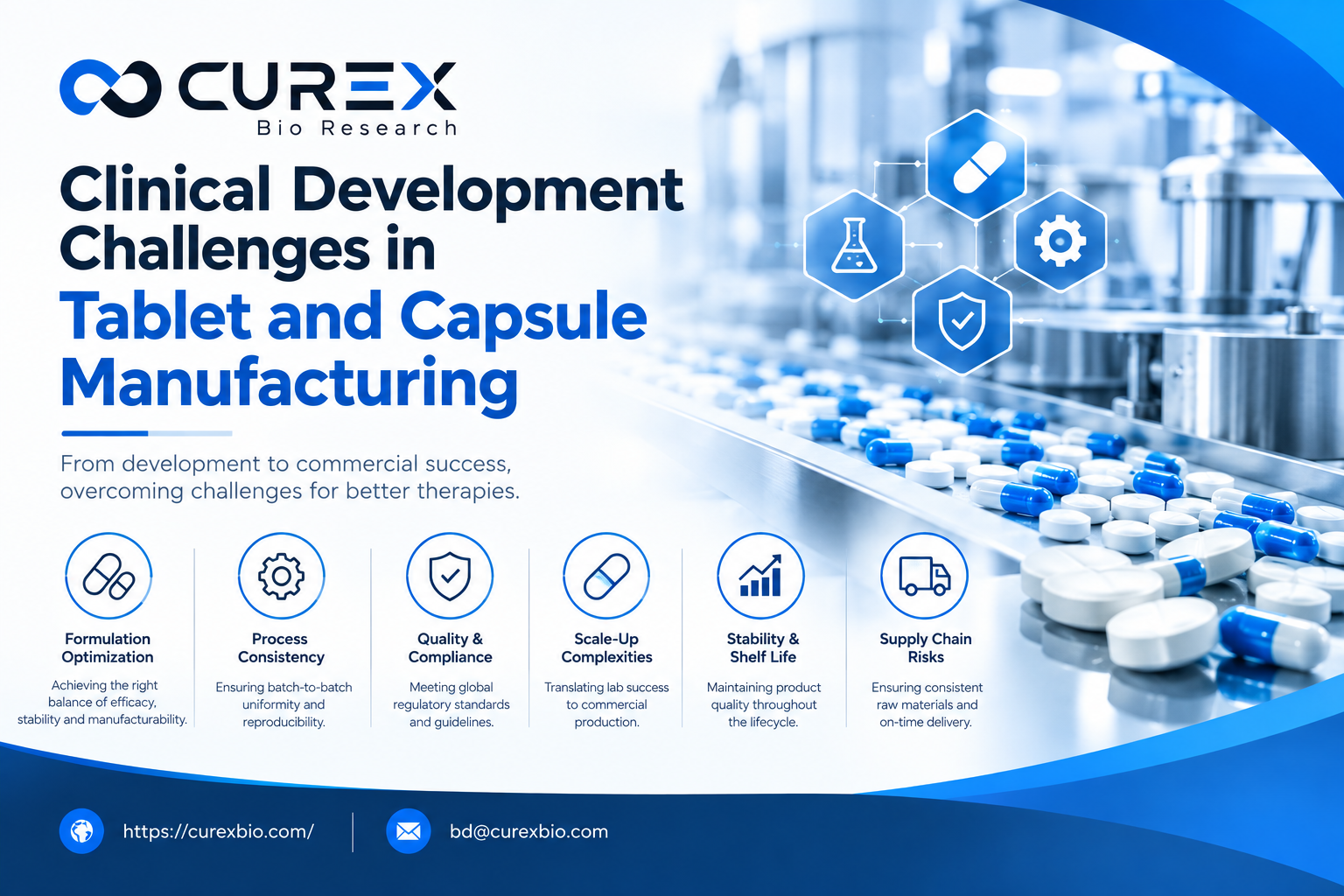
Tablets and capsules remain the gold standard in oral drug delivery, prized for their patient compliance, manufacturing scalability, and precise dosing. However, beneath their familiar exterior lies a complex developmental journey. Transitioning a novel molecule or a complex generic formulation from the benchtop into scalable, commercial-grade solid oral dosage forms is fraught with scientific, technical, and regulatory hurdles.
While chemistry, manufacturing, and controls (CMC) teams focus heavily on formulation development, the subsequent clinical development phase often exposes unforeseen bottlenecks. Understanding these challenges—and knowing how to navigate them—is essential for pharmaceutical and biotech companies aiming to achieve smooth regulatory approvals and successful commercial launches.
1. In-Vitro and In-Vivo Correlation (IVIVC) Discrepancies
One of the most frequent hurdles in tablet and capsule development is the failure of an in-vitro dissolution profile to accurately predict in-vivo performance.
-
The Challenge: Excipient interactions, compression forces during tableting, or polymer coatings on extended-release capsules can alter how a drug behaves in the gastrointestinal tract. A batch that passes lab dissolution testing may exhibit unexpected absorption spikes or delayed release in human subjects.
-
The Solution: Establishing robust In-Vitro/In-Vivo Correlations (IVIVC) early through pilot pharmacokinetic studies and advanced biopharmaceutics risk assessments helps align manufacturing parameters with real-world physiological performance.
2. Bioavailability and Solubility Hurdles (BCS Class II and IV)
A significant percentage of new chemical entities (NCEs) and complex generic APIs fall under Biopharmaceutics Classification System (BCS) Class II (low solubility, high permeability) or Class IV (low solubility, low permeability).
-
The Challenge: Compressing poorly soluble APIs into a stable tablet or enclosing them in a capsule often leads to erratic absorption, high inter-subject pharmacokinetic variability, and bioequivalence study failures.
-
The Solution: Utilizing advanced formulation technologies—such as amorphous solid dispersions, particle size reduction (micronization), lipid-based delivery systems, or specialized solubilizing excipients—during early clinical development can dramatically enhance bioavailability.
3. Food Effects and Physiological Variability
Oral solid dosage forms are heavily influenced by the patient's nutritional state.
-
The Challenge: Food intake can significantly alter gastric emptying rates, pH levels, and enzymatic activity, leading to "food effects" where a tablet's $C_{max}$ or $AUC$ fluctuates wildly depending on whether it is taken fed or fasting. This poses a major roadblock during Phase I bioequivalence or food-effect clinical trials.
-
The Solution: Designing robust fed-versus-fasting crossover studies and utilizing enteric coatings or abuse-deterrent/modified-release technologies help stabilize drug release regardless of gastrointestinal fluctuations.
4. Scale-Up and Manufacturing Reproducibility
Moving from a laboratory-scale batch (R&D scale) to commercial-scale manufacturing (pilot or full production) is a notorious bottleneck in solid oral dosage manufacturing.
-
The Challenge: Minor variations in blending homogeneity, moisture content, granule size distribution, or tablet press compression forces can result in batch failures, capping, lamination, or weight variation issues. Regulatory bodies like the USFDA and EMA scrutinize commercial process validation tightly.
-
The Solution: Implementing Quality by Design (QbD) principles, establishing strict Critical Quality Attributes (CQAs), and partnering with experienced development labs ensure that manufacturing processes are reproducible and robust from day one.
5. Stability and Shelf-Life Constraints
Tablets and capsules must maintain their physical, chemical, and microbiological integrity throughout their intended shelf-life across diverse climatic zones.
-
The Challenge: Moisture ingress, thermal sensitivity, and light degradation can cause API degradation or alter disintegration times over time, leading to failed stability testing during clinical trials.
-
The Solution: Conducting rigorous accelerated and real-time stability testing under ICH guidelines, alongside optimized packaging choices (e.g., blister packs versus HDPE bottles with desiccants), safeguards product integrity.
Accelerating Success with Strategic Expertise
Overcoming the intricacies of solid oral dosage development requires a seamless integration of formulation science, bio-analytical precision, and clinical execution. Navigating solubility issues, scale-up hurdles, and regulatory scrutiny demands specialized laboratory infrastructure and deep technical insight.
At CurexBio, we empower pharmaceutical innovators with end-to-end support—ranging from advanced bio-analytical testing and pharmacokinetic evaluations to comprehensive drug development strategies. Partner with us to streamline your tablet and capsule pipeline, mitigate clinical risks, and accelerate your path to global regulatory approval.

 English
 Arabic
 French
 Spanish
 Portuguese
 Deutsch
 Turkish
 Dutch
Dutch
 Italiano
 Russian
 Romaian
 Portuguese (Brazil)