


Baby Personal Care Market Expected to Reach USD 9.8 Billion by 2036 1/2
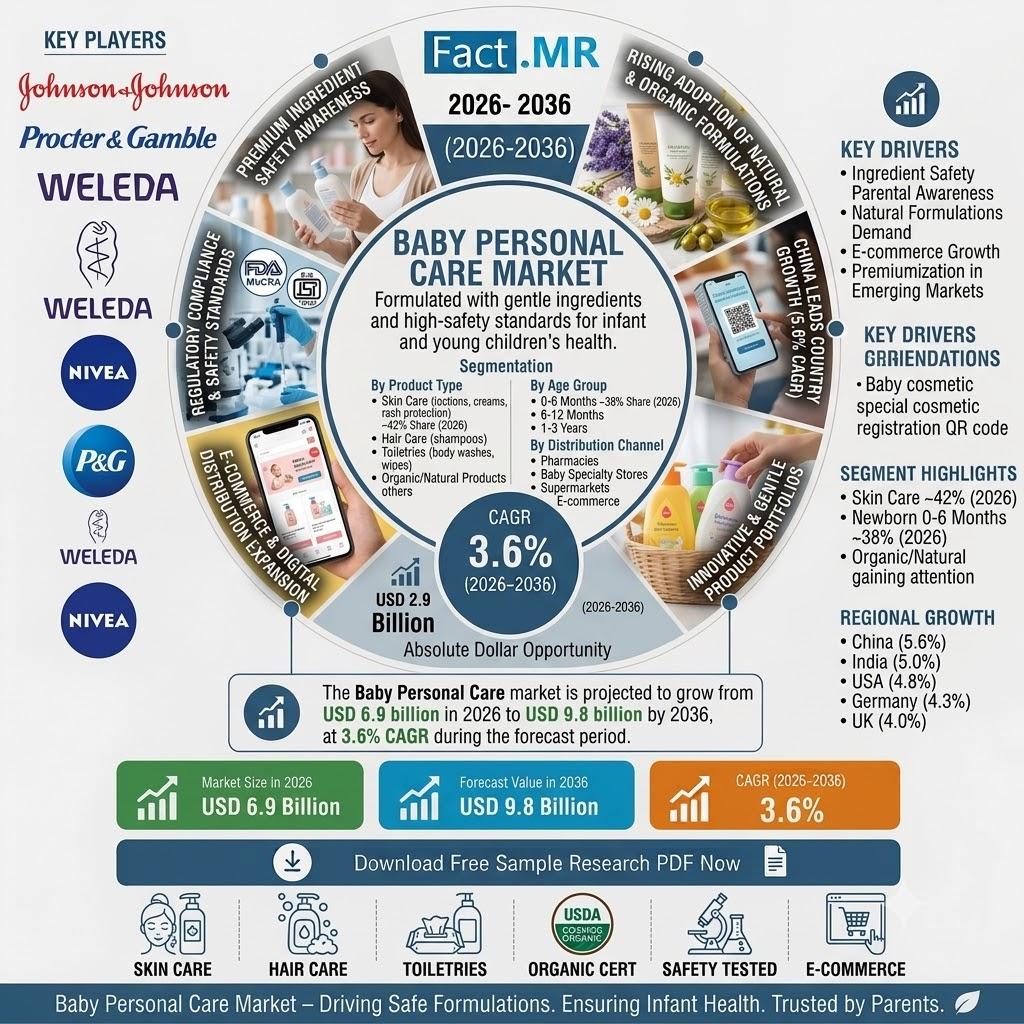
Subhead : Fact.MR forecasts the baby personal care market to grow from USD 6.9 billion in 2026 to USD 9.8 billion by 2036 at a 3.6% CAGR, with China leading country growth.
September 28, 2026 — The global baby personal care market is projected to reach USD 9.8 billion by 2036, rising from USD 6.9 billion in 2026 at a 3.6% CAGR, according to Fact.MR analysis. The market was valued at USD 6.7 billion in 2025 and is expected to create an absolute dollar opportunity of USD 2.9 billion between 2026 and 2036.
The baby personal care market includes skin care, hair care, toiletry, and hygiene products formulated for infants and young children. Demand is being shaped by parental awareness of ingredient safety, rising adoption of natural formulations, e-commerce expansion, and premium baby care spending in emerging markets. At the same time, declining birth rates in Europe, Japan, and South Korea and cost-of-living pressures are limiting the pace of expansion in some markets.
Get detailed market forecasts, competitive benchmarking, and pricing trends: https://www.factmr.com/connectus/sample?flag=S&rep_id=14523
Baby Personal Care Market Growth Reflects Changing Parent Preferences
Fact.MR is a market research firm that provides syndicated and customized research across global industries.
The baby personal care market covers products such as lotions, creams, oils, shampoos, body washes, powders, wipes, sunscreen, and oral care products sold through pharmacies, supermarkets, baby specialty stores, and online channels. The report covers global and regional forecasts from 2026 to 2036 across organic/natural and synthetic formats.
Skin care is projected to account for about 42% of market share in 2026, according to Fact.MR. Frequent use of lotions, creams, and rash protection products supports repeat purchases in this segment.
Synthetic products are expected to hold about 54% share in 2026, supported by lower costs, stable formulations, and broad retail distribution. Meanwhile, organic and natural products are gaining attention as parents increasingly examine ingredients used in infant products.
The 0-6 months age group accounts for about 38% share in 2026, reflecting high usage of newborn care products during the early months of life.
“Parents are paying closer attention to what goes into products used on newborn and infant skin,” said Shambhu Nath Jha, Principal Consultant at Fact.MR. “Premium natural products are gaining ground in developed markets, while first-time adoption is expanding in emerging economies.”
China Leads Country Growth as India Expands Premium Adoption
China is forecast to record a 5.6% CAGR from 2026 to 2036, followed by India at 5.0%, the United States at 4.8%, Germany at 4.3%, and the United Kingdom at 4.0%, according to Fact.MR.
China's projected growth is linked to premium natural baby care demand and the country's three-child policy. China also introduced special cosmetic registration requirements for baby and children's products claiming mild or gentle formulations in January 2024.
India's baby personal care market is expected to expand at a 5.0% CAGR through 2036. Urban parents' increasing preference for organic formulations is supporting premium product adoption, while the BIS IS 16621 baby cosmetics standard update in 2024 has strengthened the framework for certified natural products.
The United States is projected to grow at 4.8% through 2036. Demand for clean-label products and implementation of requirements under the FDA's Modernization of Cosmetics Regulation Act during 2024 and 2025 are shaping product and distribution strategies.
Germany is forecast at 4.3%, with strict EU ingredient standards influencing formulation and retail positioning. The United Kingdom is projected to grow at 4.0%, with NHS guidance supporting consumer awareness while declining birth rates and private-label competition constrain expansion.
Regulation and Certification Shape Product Development
Regulatory changes are influencing product formulation across major markets. The European Union's 2024 update to Regulation 1223/2009 restricted 23 additional cosmetic substances for children under three, according to the supplied Fact.MR research.
China's NMPA requirements have raised compliance standards for baby cosmetics, while India's 2024 BIS update to IS 16621 supports expanded safety testing and certification coverage.
In the United States, FDA MoCRA implementation continued through 2024 and 2025, including requirements related to cosmetic product listing and facility registration.
An insider detail from the market analysis is the projected USD 2.9 billion absolute dollar opportunity between 2026 and 2036. Fact.MR developed the forecast using birth-rate data, per-capita baby care spending, retail sales volumes, average selling prices, OEM revenue disclosures, regulatory filings, and primary interviews.
“Product compliance is becoming part of market strategy,” said Shambhu Nath Jha, Principal Consultant at Fact.MR. “Brands entering multiple regions have to account for different certification and registration requirements before scaling distribution.”
Companies Adapt Product Portfolios and Retail Strategies
The competitive landscape includes Johnson & Johnson, Procter & Gamble, Kimberly-Clark, Colgate-Palmolive, Hindustan Unilever, The Clorox Company, Me n Moms Pvt. Ltd., Weleda AG, Marks & Spencer PLC, and Nivea.
Fact.MR analysis cites several recent product developments. Johnson & Johnson expanded its Johnsons Baby NATURAL oat-based skin care range across the United States, Germany, and India in 2025. Weleda launched its Baby Calendula Sensitiv line with COSMOS Organic certification in 2024.
Procter & Gamble launched Pampers Botanical Protection diapers and Pampers Natural Clean wipes in the United States and Germany in 2025. Colgate-Palmolive introduced Tom's of Maine Baby and Toddler fluoride-free toothpaste with USDA Organic certification in 2024.
The full Fact.MR study examines product type, nature, age group, regional markets, regulatory developments, company strategies, and distribution channels through 2036.
Top Trending Reports :
https://social.mytamam.com/blogs/43204/Woodcore-Panel-Market-to-Reach-USD-4-3-Billion-by
https://ayushjadhavblogs.blogspot.com/2026/09/anti-failure-texture-stabilizer-blends.html
About Fact.MR
Fact.MR is a market research and consulting firm providing market intelligence, forecasts, competitive analysis, and strategic research across global industries. Its research combines primary interviews, secondary research, market sizing models, and validation using company disclosures, retail data, regulatory sources, and official statistics.

 English
 Arabic
 French
 Spanish
 Portuguese
 Deutsch
 Turkish
 Dutch
Dutch
 Russian
 Romaian
 Portuguese (Brazil)
 Greek
Greek