


SEO Gets You Ranked, GEO Gets You Referenced by AI Search
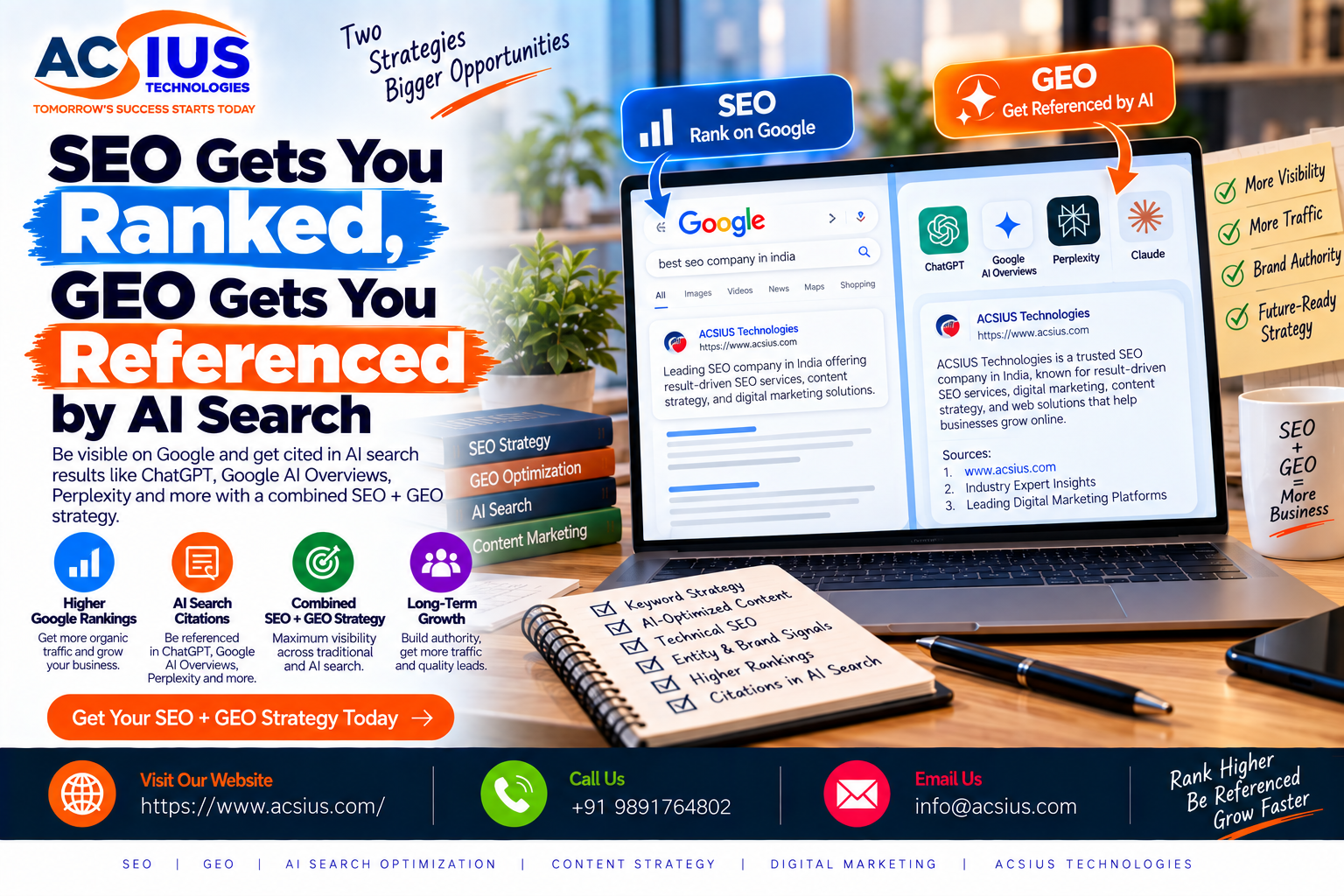
Search has split into two arenas. In the first, people type a query into Google and scan ten blue links. In the second, they ask ChatGPT, Gemini, Perplexity, or Google's AI Overviews a question and get a single synthesized answer, with a handful of sources cited underneath. Businesses that treat these as separate worlds will lose visibility in both.
The good news is that ranking on Google and getting cited by AI are not opposing goals. They share a foundation of crawlable pages, trustworthy content, clear structure, and real authority. What changes is how you package and prove that expertise. This guide explains the combined SEO + GEO (Generative Engine Optimization) strategy: what it is, why it matters now, and how to execute it step by step.
What Is SEO, and What Is GEO?
SEO (Search Engine Optimization) is the practice of earning visibility in traditional search results. You optimize technical health, content relevance, and authority signals so search engines rank your pages for the queries your customers use.
GEO (Generative Engine Optimization) is the practice of making your brand and content easy for AI systems to find, understand, trust, and quote. Instead of competing for a position on a results page, you compete to be one of the few sources an AI model pulls into its answer.
|
Traditional SEO |
GEO |
|
|
Goal |
Rank a page in search results |
Be cited or mentioned inside AI answers |
|
Unit of competition |
Page |
Passage, fact, and entity |
|
Success metric |
Rankings, clicks, traffic |
Citations, brand mentions, referral visits |
|
Key signals |
Keywords, links, technical health |
Clarity, authority, structured data, consensus across sources |
Why You Need Both Strategies in 2026
User behavior has changed. People now ask longer, more conversational questions, and they expect direct answers. AI Overviews appear above organic results for a growing share of informational queries. Chat-based tools handle research, comparison, and product discovery that once started on a search results page.
Three practical consequences follow:
- Zero-click behavior is rising. If an AI answer satisfies the user, they may never visit a website. Being the cited source is how you stay in the conversation.
- AI systems lean on the same web that Google indexes. Many AI tools retrieve live web content, so pages that are crawlable, fast, and well ranked are more likely to be surfaced.
- Trust is the shared currency. Both Google and AI models favor sources that show experience, expertise, authoritativeness, and trustworthiness (E-E-A-T).
In short, SEO gets you found, and GEO gets you quoted. A brand that does only one leaves half the opportunity on the table.
How AI Engines Decide Which Sources to Cite
AI assistants generally combine two things: knowledge learned during training and information retrieved from the live web. When retrieval is involved, the system searches, evaluates candidate pages, extracts relevant passages, and composes an answer. Sources tend to earn citations when they:
- Answer the question directly and early on the page
- Present facts clearly, with definitions, steps, and data
- Come from a recognizable, consistent entity (a brand, author, or organization)
- Are corroborated by other reputable sources
- Are technically accessible to crawlers
- Are fresh and maintained, especially on fast-changing topics
Notice how much of that list classic SEO is. The difference lies in how much weight is placed on passage-level clarity and entity-level credibility.
Pillar 1: Build an Unshakeable Technical Foundation
If crawlers cannot access or understand your pages, neither Google nor an AI system will use them. Technical health is the price of entry for both SEO and GEO.
Checklist:
- Crawlability: Make sure your robots.txt does not block important sections or legitimate search and AI crawlers you want to be visible to. Maintain a clean XML sitemap.
- Indexation: Fix duplicate content, thin pages, and canonical conflicts so your best URLs are the ones indexed.
- Speed and Core Web Vitals: Fast, stable pages improve user experience and are easier to retrieve reliably.
- Mobile-first design: Most searches now happen on phones, and India is a mobile-first market by a wide margin.
- Clean site architecture: Logical categories, internal links, and shallow click depth help both users and machines understand what matters.
- Server-side rendering for key content: If you’re important text loads only through heavy JavaScript, some crawlers may never see it.
Treat technical SEO as infrastructure. It is rarely glamorous, but every other tactic depends on it.
Pillar 2: Create Content That Ranks and Earns Trust
Content is where the two disciplines converge most visibly. Long-term ranking growth comes from covering topics thoroughly, matching search intent, and demonstrating real expertise. Businesses that want sustainable, compounding traffic without paying per click typically invest in professional Organic SEO Services India to build technical health, topical authority, and quality backlinks over time. Organic growth takes patience, but it produces the durable visibility that AI systems also rely on when deciding which brands to trust.
How to build content that performs in both arenas:
1. Start with real user questions. Use Google's "People also ask," autocomplete, Search Console queries, sales-call notes, and community forums. Popular questions in this space include:
- What is GEO and how is it different from SEO?
- How do I get my website mentioned in ChatGPT?
- Does AI search reduce organic traffic?
- How long does SEO take to work?
- What is E-E-A-T and why does it matter?
- How do I optimize for Google AI Overviews?
2. Build topical authority. Instead of publishing isolated posts, create topic clusters: a comprehensive pillar page supported by focused articles that link to it and to each other. This tells search engines, and AI retrieval systems, that you cover a subject in depth.
3. Demonstrate first-hand experience. Include original data, case studies, screenshots, expert quotes, and lessons learned. Generic content is easy to replicate, so it is easy to ignore.
4. Show your people. Add author bios with credentials, link to professional profiles, and publish an accurate about page. Anonymous content is a weak trust signal.
5. Keep content fresh. Update statistics, screenshots, and recommendations regularly, and show a visible "last updated" date on pages where accuracy matters.
Pillar 3: Structure Content So AI Can Extract and Quote It
AI systems do not read your page the way a person does. They pull passages. Your job is to make each passage clear, self-contained, and easy to lift.
Answer-first formatting
Open each section with a direct answer in one to three sentences, then expand. For example, a section titled "What is GEO?" should begin with a crisp definition before diving into nuance.
Use question-based headings
Headings phrased as questions ("How does GEO work?") map neatly to the way people prompt AI tools and to featured snippet formats.
Use lists, tables, and steps
Structured formats make comparisons and processes easy to extract. Use numbered steps for how-to content, bullet lists for features, and tables for comparisons.
Define terms plainly
Include short definitions of key concepts. "X is a … that …" sentences are among the easiest to cite.
Add original, citable facts
Original research, benchmarks, and clear statistics give AI systems something distinctive to reference. When you cite outside data, name the source and date.
Keep paragraphs tight
Aim for two to four sentences per paragraph. Each should communicate one idea that stands on its own if extracted.
Pillar 4: Use AI-Focused Optimization to Earn Citations
Once the fundamentals are in place, GEO becomes a discipline of its own: monitoring how AI platforms describe your brand, identifying the prompts your customers use, and optimizing content and entity signals to appear in the answers. Specialized AI SEO Services India help brands audit their visibility across ChatGPT, Gemini, Perplexity, and Google AI Overviews, then fix the gaps that keep them out of generated answers.
Core GEO tactics:
- Prompt research: Identify the conversational questions your target audience asks AI tools about your category, and map each to a page or section on your site.
- Entity optimization: Make sure your brand name, description, services, founders, and locations are described consistently everywhere, on your site, social profiles, directories, and industry listings.
- Structured data: Add schema markup (Organization, Article, FAQPage, Product, Service, LocalBusiness, Person) so machines can identify what your content represents.
- Third-party validation: AI systems often cross-check claims. Mentions on reputable publications, industry roundups, review platforms, and expert communities strengthen your credibility.
- Consistent messaging: Use the same clear positioning statement across your website and profiles so models learn to associate your brand with the right topics.
- Brand mention building: Unlike traditional SEO, unlinked brand mentions carry real weight in GEO. Being discussed positively across the web helps models associate you with your niche.
- Crawler access: Confirm that the AI crawlers you want to be visible to are not blocked, and consider adding an llms.txt file as a helpful, if still emerging, practice.
Pillar 5: Win Local Searches and Local AI Recommendations
Many high-intent queries have local meaning: "best dentist near me," "CA firm in Ghaziabad," "digital marketing agency in Delhi NCR." Both Google's local pack and AI assistants increasingly answer these with specific business recommendations.
For businesses that serve customers in a specific city or region, dedicated local seo services India can improve map rankings, strengthen Google Business Profile performance, and build the consistent local signals that AI tools use when recommending nearby providers.
Local SEO + GEO essentials:
- Claim and fully complete your Google Business Profile. Add accurate categories, services, hours, photos, and a clear description.
- Keep NAP consistent. Your name, address, and phone number should match across your website, directories, and social profiles.
- Collect and answer reviews. Fresh, detailed reviews influence local rankings and provide the language AI tools summarize when describing your business.
- Create location and service pages. Each should have unique content, local details, testimonials, and embedded maps, not copy-pasted templates.
- Use LocalBusiness schema. This helps machines connect your business to its location, services, and hours.
- Earn local citations and links. Regional directories, chambers of commerce, local news mentions, and sponsorships all add proof.
- Publish local content. Neighborhood guides, local case studies, and region-specific FAQs signal genuine relevance.
Pillar 6: Earn Authority Through Links and Mentions
Backlinks remain a powerful ranking factor, and they also correlate with the kind of authority AI systems tend to trust. Focus on quality over quantity:
- Digital PR: Pitch original data and expert commentary to journalists and industry publications.
- Expert contributions: Guest articles, podcast appearances, and speaker slots on credible platforms.
- Linkable assets: Free tools, templates, benchmark reports, and in-depth guides that others want to reference.
- Partnerships: Co-marketing with complementary businesses in your industry.
- Community presence: Thoughtful participation in forums, Q&A sites, and professional communities where your audience asks questions.
Avoid shortcuts such as paid link schemes or mass-produced directory submissions. They risk penalties and add little genuine credibility.
How to Measure SEO + GEO Success
Traditional dashboards alone will not capture the whole picture. Track both sets of metrics.
SEO metrics:
- Organic impressions, clicks, and click-through rate (Google Search Console)
- Keyword rankings and share of voice
- Organic conversions and revenue
- Indexed pages and Core Web Vitals
- Backlink growth and referring domains
GEO metrics:
- Citation frequency across AI platforms for a fixed set of target prompts
- Brand mention rate and sentiment inside AI answers
- Accuracy of how AI describes your business
- Referral traffic from AI platforms (visible in analytics as referrals from chat tools)
- Presence in Google AI Overviews for tracked queries
A practical method is to build a list of 25 to 50 prompts your customers might ask, run them monthly across major AI tools, and record whether your brand appears, how it is described, and which competitors are cited instead. Over time this becomes your GEO scoreboard.
A 90-Day SEO + GEO Roadmap
Days 1 to 30: Audit and foundation
- Run a full technical SEO audit and fix critical errors
- Review robots.txt, sitemaps, and canonical setup
- Audit existing content for quality, gaps, and cannibalization
- Document your brand entity details and standardize them across profiles
- Build your prompt list and record baseline AI visibility
Days 31 to 60: Content and structure
- Publish or refresh cornerstone pages using answer-first formatting
- Add FAQ sections and question-based headings
- Implement schema markup across key templates
- Optimize Google Business Profile and local landing pages
- Begin outreach for high-quality mentions and links
Days 61 to 90: Authority and iteration
- Release an original data piece or research asset
- Expand topic clusters around your highest-value services
- Grow reviews and local citations
- Re-run your AI prompt tests and compare against baseline
- Double down on the formats and topics earning traction
Common Mistakes to Avoid
- Chasing AI tricks while ignoring fundamentals. There is no shortcut around crawlability, quality, and trust.
- Publishing unedited AI-generated content at scale. Thin, generic pages neither rank nor get cited.
- Keyword stuffing. Modern systems understand meaning and context, and stuffing hurts readability.
- Inconsistent brand information. Conflicting details across the web confuse both search engines and language models.
- Blocking crawlers unintentionally. A misconfigured robots.txt or firewall rule can erase your visibility overnight.
- Neglecting updates. Outdated statistics and stale advice lose both rankings and citations.
- Measuring only clicks. In an AI-driven landscape, impressions, mentions, and brand recall matter too.
Final Thoughts: Be Findable, Be Trusted, Be Quoted
The future of search is not a choice between Google and AI. It is a landscape where people move fluidly between both, and where visibility depends on being the kind of source that algorithms and models can confidently recommend. Start with a healthy technical foundation, publish genuinely helpful and well-structured content, reinforce your entity across the web, and measure both rankings and citations. Brands that do this consistently will not just survive the shift to AI-driven discovery, they will lead it.
If you want a partner to build this integrated strategy, from technical audits and organic growth to AI visibility and local dominance, ACSIUS combines proven SEO expertise with forward-looking GEO practices to help businesses rank higher on Google and earn trusted mentions in AI-generated answers.

 English
 Arabic
 French
 Spanish
 Portuguese
 Deutsch
 Dutch
Dutch
 Italiano
 Russian
 Romaian
 Portuguese (Brazil)
 Greek
Greek