


Packaging Machinery & Converting Automation Market Develops As Food Producers Prioritize Flexibility
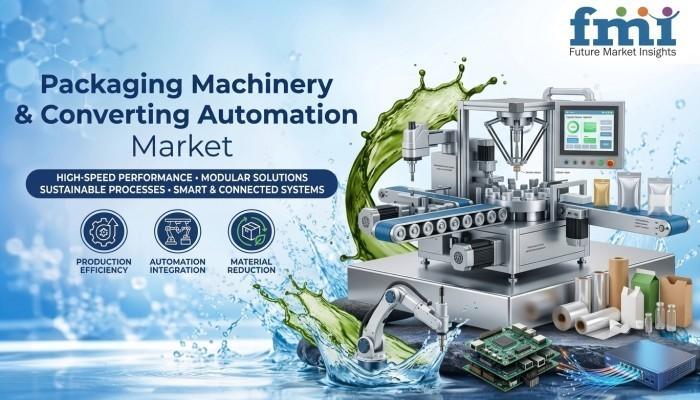
Packaging machinery and converting automation is becoming a capital planning priority for manufacturers managing frequent product changes, sanitation stops, labor constraints, and increasingly complex production lines. According to the latest market analysis by Future Market Insights (FMI), the global Packaging Machinery & Converting Automation Market is projected to grow from USD 52.6 billion in 2026 to USD 84.9 billion by 2036, registering a 4.9% CAGR during the forecast period.
The market was valued at USD 50.1 billion in 2025. Demand is being shaped by manufacturers seeking to protect throughput when package formats, product specifications, and production recipes change. Supplier evaluation is increasingly linked to demonstrated line performance, installation timelines, acceptance testing, and post-commissioning service rather than automation capability alone.
Get detailed market forecasts, competitive benchmarking, and pricing trends:
https://www.futuremarketinsights.com/reports/sample/rep-gb-33941
Throughput Protection Becomes a Procurement Priority
Food and beverage producers are examining equipment performance at package sizes that require frequent line changes. Product viscosity, packaging materials, sanitation requirements, and seasonal production schedules can all affect line performance.
Labor shortages are also increasing interest in automated feeding and inspection. Automatic systems can reduce manual transfers across production steps and support repeatable operation during extended shifts.
For converters, print registration and web handling remain important considerations when machinery is evaluated for short runs or mixed material structures. Engineering teams are also examining installation windows and acceptance criteria before equipment is approved for production.
PMMI reported that United States packaging machinery sales reached USD 11.3 billion in 2024, while Canadian packaging machinery sales reached USD 1.2 billion during the same year. These figures highlight the established equipment base across North America and the continuing relevance of replacement, retrofit, and service activity.
Filling and Sealing Leads the Machine Type Segment
Filling and sealing machinery is projected to account for 34.0% of the market in 2026. The equipment directly connects product dosing with package closure, making dosing accuracy and seal integrity central to production performance.
Plants are expected to favor systems that support shorter changeovers and repeatable sanitation routines. Integration with existing industrial filling systems and downstream equipment also remains important because machinery replacement can disrupt established package flows.
Fully automatic equipment is projected to hold a 63.0% share in 2026. These systems coordinate feeding and inspection with fewer manual handoffs, supporting production environments where consistent cycle control is required across multiple shifts.
Data integration is also becoming part of automation purchasing. Tetra Pak's launch of Factory OS in November 2025 illustrates the growing role of production information, alarm handling, and equipment connectivity alongside physical machinery.
Food Remains the Largest End-Use Segment
Food is projected to account for 39.0% of the market in 2026. Food plants face repeated product and package changes while maintaining hygiene controls and consistent package integrity.
Inspection records, automated recipe control, cleanable equipment designs, and documented cleaning procedures can influence machinery approval. In May 2025, Ishida introduced the QX-800 tray sealer for high-volume food lines, highlighting the continuing focus on quick tool changes and integrated line monitoring.
India and China Show Higher Forecast Growth
Country-level growth varies considerably across the market. India is forecast to register a 6.9% CAGR, followed by China at 6.2% and Brazil at 5.4% from 2026 to 2036.
India-based manufacturers are placing greater emphasis on local commissioning, operator training, and service support as production capacity expands. Chinese manufacturing clusters can benefit from repeatable machinery configurations across nearby production sites.
The United States is forecast to grow at 4.3%, supported by replacement and retrofit activity across its established installed base. Germany and Japan are projected to record CAGRs of 3.9% and 3.6%, respectively, with safety documentation, controlled acceptance testing, and established operating procedures remaining important considerations.
Italy is projected to grow at 4.1%, while Brazil records a 5.4% CAGR, reflecting differing investment and service requirements across regional production environments.
Installation Accountability Shapes Supplier Evaluation
“Installation accountability creates a commercial divide that extends beyond machine speed during supplier evaluation and contract review. A line that misses acceptance criteria disrupts production long after equipment arrival and delays the expected operating savings,” said Nandini Roy Choudhury, Principal Analyst at Future Market Insights.
The competitive landscape includes integrated line suppliers and specialists focused on filling, converting, printing, inspection, and end-of-line automation. Krones, Tetra Pak, Syntegon, BOBST, IMA Group, Coesia, ProMach, Sidel, MULTIVAC, and Ishida are among the notable companies profiled in the market.
Competition increasingly depends on application fit, controls integration, commissioning support, and service reach. BOBST has a strong role in converting and printing, while Krones and Tetra Pak combine processing and packaging capabilities. Syntegon and IMA Group address packaging workflows across food and pharmaceutical applications, while ProMach and Ishida compete in end-of-line and inspection-oriented projects.
Retrofit Activity Creates an Opportunity
Capital approval and planned shutdown requirements can delay complete machinery replacement inside operating plants. Manufacturers therefore compare production losses against expected labor savings, waste reduction, and operating improvements.
Modular robotic cells provide an alternative where a full line replacement is commercially impractical. Plants can add case packing or palletizing capacity while retaining established upstream machinery. Retrofit and service activity also allows manufacturers to introduce updated controls without replacing an entire production line.
Report Scope
The Packaging Machinery & Converting Automation Market covers machine type, automation level, end use, technology, sales type, and region. Machine types include filling and sealing, cartoning and case packing, labeling and coding, converting and printing, and palletizing and robotics.
Automation levels cover fully automatic, semi-automatic, and robotic cells. End-use industries include food, beverages, pharma, personal and home care, and others. The study covers North America, Latin America, Europe, East Asia, South Asia and Pacific, Oceania, and the Middle East and Africa.
Related Report Links:
https://www.openpr.com/news/4645380/odor-scavenger-packaging-additives-market-to-reach-usd-1-754-4
https://www.openpr.com/news/4645390/package-test-sockets-market-is-expected-to-grow-usd-3-124-2
https://www.openpr.com/news/4645396/inline-ocr-validation-for-packaging-lines-market-set-to-grow-usd
FMI Custom Research: Strategic Intelligence for Confident Decision-Making
In today’s rapidly evolving business environment, leadership teams need more than market data—they need clear, actionable intelligence tailored to their strategic objectives. FMI’s Custom Research solutions are designed around the specific business questions organizations need answered, enabling executives to evaluate growth opportunities, validate investments, assess competitive dynamics, and reduce uncertainty before making critical decisions. By combining deep industry expertise, primary research, and proprietary market intelligence, FMI delivers insights that help organizations move from assumptions to evidence-based strategies with greater speed and confidence.
Business Impact
FMI helps organizations transform market complexity into strategic clarity, enabling leadership teams to identify growth opportunities faster, optimize resource allocation, strengthen competitive positioning, and make high-stakes business decisions with confidence.
To explore how FMI Custom Research can support your strategic priorities, please connect with our team at – sales@futuremarketinsights.com
About Future Market Insights (FMI)
Future Market Insights, Inc. (FMI) is an ESOMAR-certified, ISO 9001:2015 market research and consulting organization, trusted by Fortune 500 clients and global enterprises. With operations in the U.S., UK, India, and Dubai, FMI provides data-backed insights and strategic intelligence across 30+ industries and 1200 markets worldwide.

 English
 Arabic
 French
 Spanish
 Portuguese
 Deutsch
 Turkish
 Dutch
Dutch
 Russian
 Romaian
 Portuguese (Brazil)
 Greek
Greek