


NFC / RFID Smart Label And Tamper-Detection Market Accelerates As Brands Prioritize Evidence
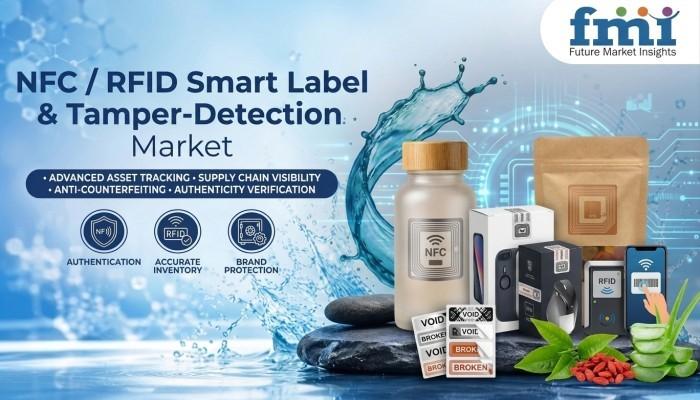
The global NFC / RFID smart label and tamper-detection market is projected to reach USD 33.4 billion by 2036, rising from USD 7.5 billion in 2026 at a 16.1% CAGR, according to the latest market analysis by Future Market Insights.
Connected labels are moving beyond basic identification as packaging manufacturers develop solutions that combine product authentication, traceability, consumer engagement, and package-opening evidence. Smartphone-readable NFC technology is gaining particular attention because it allows product verification without requiring dedicated scanning hardware.
The market is segmented across NFC, RFID, and printed electronics, with applications covering tamper detection, authentication, and engagement. Food, pharma, and beauty represent the assessed end-use segments across North America, Latin America, Europe, East Asia, South Asia and Pacific, and the Middle East and Africa.
Get detailed market forecasts, competitive benchmarking, and pricing trends:
https://www.futuremarketinsights.com/reports/sample/rep-gb-34281
NFC Leads Technology Demand
NFC is forecast to account for 60.2% of the technology segment in 2026. Smartphone compatibility and secure tap-based verification are supporting its use across connected packaging programs.
NXP Semiconductors introduced NTAG X DNA with 16 KB memory in May 2025, supporting secure unique NFC authentication across connected tags. Higher memory capacity can support richer product information and device diagnostics within authentication programs.
RFID continues to address longer-range inventory identification across cases and assets. Printed electronics provide flexible constructions for labels requiring thin conductors or integrated sensing features.
Tamper Detection Takes a Larger Role in Package Security
Tamper detection is estimated to hold a 40.0% share of application demand in 2026. Conductive loops, fragile antennas, and electronic status verification can provide evidence of first opening or seal disruption.
In November 2025, Tageos introduced two NFC and dual-frequency products, including EOS-620 Seal with an electronic tamper interface. Such multi-frequency constructions connect seal status with inventory records during item-level checks.
Authentication addresses product-origin verification through encoded credentials and secure chips. Engagement supports consumer-facing interactions such as instructions and recycling guidance without replacing core package-security functions.
Food Accounts for 42.6% of 2026 End-Use Demand
Food is forecast to represent 42.6% of end-use demand in 2026. Traceability, expiry control, reusable packaging, and package-integrity requirements are supporting adoption.
Tag performance can become more difficult around liquids, metals, moisture, and microwave exposure. Beontag reported eWave testing across 50 microwave cycles in March 2025 under food-service conditions, using 1,800 W for 3.5 minutes per cycle.
Pharma applications place greater emphasis on serialization, authenticated access, and tamper evidence. Beauty applications use compact security labels for product verification and controlled consumer engagement.
Traceability and Recycling Requirements Shape Adoption
Traceability duties across food and pharma applications remain an important market driver. Brand owners increasingly require item identity to connect production records with inventory events and authenticated package-opening controls.
At the same time, material recovery requirements can restrict label constructions that lack proven separation behavior within recycling systems. European Commission rules require recyclable design for all packaging by 2030 following regulation entry in February 2025, increasing the importance of documented material compatibility.
Read variation across liquid and metal packaging remains a deployment challenge. Buyers may need repeated antenna and adhesive assessments before connected labels can be qualified for specific finished-pack structures.
Thin chips, paper antennas, dual-frequency inlays, and recyclable adhesives create an opportunity for material-efficient connected-label designs. These constructions can help converters address identification and tamper requirements while limiting additional package complexity.
Country-Level Growth Shows Distinct Market Conditions
China is projected to record a 13.1% CAGR from 2026 to 2036, the highest among the disclosed country forecasts. The United States follows at 12.7%, while the United Kingdom is forecast at 12.3%. Germany and Japan are projected to expand at 11.9% and 11.5%, respectively.
Country conditions vary according to manufacturing capacity, traceability requirements, recycling practices, converter capabilities, and technology qualification procedures.
Competitive Landscape
The market includes Pragmatic Semiconductor Ltd., Avery Dennison Corporation, Identiv, Inc., NXP Semiconductors N.V., Tageos SAS, Beontag, Schreiner Group GmbH & Co. KG, and SATO Holdings Corporation.
Competition spans chip architecture, inlay conversion, antenna performance, tamper indication, adhesive compatibility, label integration, and application support.
Recent developments include Tageos introducing the EOS-450 U9 RAIN RFID inlay in June 2025, NXP Semiconductors introducing UCODE X in January 2026, and Pragmatic Semiconductor launching Pragmatic NFC Protect PR1311 in June 2026.
Analyst Perspective
“Connected labels create commercial value by delivering repeatable reads and secure identity across packaging structures suited to filling operations. Brand owners examine antenna behavior and seal failure evidence during supplier reviews across varied package formats. Commercial adoption improves as physical pack testing connects with traceability records under assigned converter responsibilities.”
— Nandini Roy Choudhury, Principal Consultant for Packaging, Future Market Insights
Report Scope
The NFC / RFID smart label and tamper-detection market study covers technology, application, end use, and regional demand. Technology includes NFC, RFID, and printed electronics. Applications include tamper detection, authentication, and engagement, while end uses cover food, pharma, and beauty.
The study covers North America, Latin America, Western Europe, Eastern Europe, East Asia, South Asia and Pacific, and the Middle East and Africa. The forecast period runs from 2026 to 2036.
Related Report Links:
https://www.openpr.com/news/4645376/robotic-case-erecting-cells-market-to-reach-usd-705-7-million
https://www.openpr.com/news/4645378/pharmaceutical-blister-vision-verification-market-set-to-reach
https://www.openpr.com/news/4645380/odor-scavenger-packaging-additives-market-to-reach-usd-1-754-4
FMI Custom Research: Strategic Intelligence for Confident Decision-Making
In today’s rapidly evolving business environment, leadership teams need more than market data—they need clear, actionable intelligence tailored to their strategic objectives. FMI’s Custom Research solutions are designed around the specific business questions organizations need answered, enabling executives to evaluate growth opportunities, validate investments, assess competitive dynamics, and reduce uncertainty before making critical decisions. By combining deep industry expertise, primary research, and proprietary market intelligence, FMI delivers insights that help organizations move from assumptions to evidence-based strategies with greater speed and confidence.
Business Impact
FMI helps organizations transform market complexity into strategic clarity, enabling leadership teams to identify growth opportunities faster, optimize resource allocation, strengthen competitive positioning, and make high-stakes business decisions with confidence.
To explore how FMI Custom Research can support your strategic priorities, please connect with our team at – sales@futuremarketinsights.com
About Future Market Insights (FMI)
Future Market Insights, Inc. (FMI) is an ESOMAR-certified, ISO 9001:2015 market research and consulting organization, trusted by Fortune 500 clients and global enterprises. With operations in the U.S., UK, India, and Dubai, FMI provides data-backed insights and strategic intelligence across 30+ industries and 1200 markets worldwide.

 English
 Arabic
 French
 Spanish
 Portuguese
 Deutsch
 Turkish
 Italiano
 Russian
 Romaian
 Portuguese (Brazil)
 Greek
Greek