


Virtual Security Appliance Market Gains USD 23.6 Bn by 2036: Germany's 12.0% Growth Supports Workload-Level Security
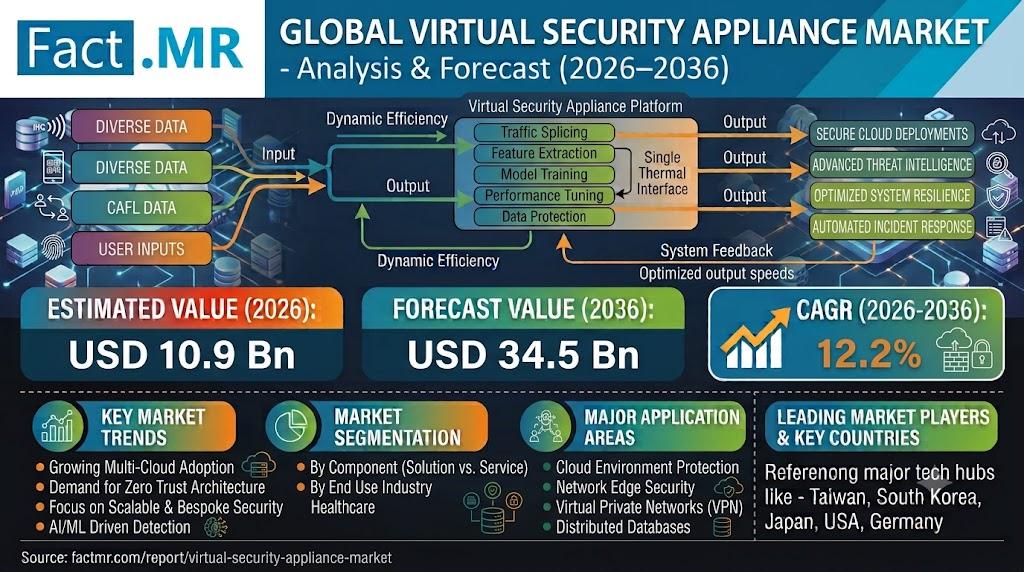
Virtual Security Appliance Market is projected to grow from USD 10.9 billion in 2026 to USD 34.5 billion by 2036, expanding at a 12.2% CAGR during the forecast period. The market reached USD 9.7 billion in 2025, creating an absolute opportunity of USD 23.6 billion through 2036. Cloud migration, zero-trust security programs, and the need to place traffic inspection closer to workloads are supporting demand for deployable virtual security controls.
Virtual security appliances allow organizations to inspect traffic and enforce security policies within public cloud, private cloud, hybrid, and virtualized infrastructure. Demand is also being shaped by encrypted traffic inspection, network segmentation, and managed security delivery models.
Get Detailed Market Forecasts, Competitive Benchmarking, and Pricing Trends: https://www.factmr.com/connectus/sample?flag=S&rep_id=15847
Global Segment Leaders
- Public Cloud — 43.0% share in 2026: Public cloud leads deployment because organizations can place virtual appliances close to workloads and traffic gateways without waiting for a hardware purchasing cycle. Flexible capacity also supports expansion as cloud environments change.
- Virtual Firewall — 39.0% share: Virtual firewalls remain the leading appliance type because they combine traffic inspection, access control, segmentation, and threat prevention within a single virtual security layer.
- Large Enterprises — 61.0% share: Large enterprises account for the largest enterprise-size segment because they operate multiple cloud accounts, data centers, and regulated environments. Centralized policies, logging, and failover requirements increase the relevance of virtual security appliances.
Country-Level Performance
- South Korea — 13.2% CAGR: South Korea records the highest country CAGR in the report. Telecom cloud programs and large enterprise security upgrades are supporting demand for virtual controls that can be inserted into cloud and data-center traffic paths.
- USA — 12.9% CAGR: U.S. growth is linked to federal modernization and large hybrid cloud estates. Enterprise customers increasingly require security controls that follow workloads across public cloud, data centers, and remote-access environments.
- Canada — 12.6% CAGR: Canada's market is supported by regulated cloud use and security governance. Banks, public agencies, and other regulated organizations require clear oversight before sensitive workloads move into production.
- UK — 12.3% CAGR: The UK market is shaped by cloud assurance, managed-service adoption, and internal security reviews. Virtual appliances provide centralized security control without returning to hardware-heavy perimeter designs.
- Germany — 12.0% CAGR: Germany's growth is supported by compliance-led approval and cloud expansion. Security architects and data-protection teams assess logging, access control, data handling, and stable operation before wider deployment.
- Australia — 11.7% CAGR: Australia's demand reflects the need for security controls across remote users, branch networks, and cloud-hosted applications. Managed support and simpler deployment packages are relevant to distributed enterprise environments.
- Japan — 11.4% CAGR: Japan shows a more measured growth trajectory as buyers emphasize detailed technical requirements, local implementation support, and clear data-residency responsibilities. Stable traffic handling and reduced configuration risk remain important for adoption.
Regional Context
The Virtual Security Appliance Market covers North America, Latin America, Europe, East Asia, South Asia and Pacific, and the Middle East and Africa. The country analysis includes the USA, Japan, Germany, UK, Canada, Australia, and South Korea.
South Korea and the USA show the highest forecast country growth rates at 13.2% and 12.9%, respectively. Canada and the UK follow at 12.6% and 12.3%. Germany, Australia, and Japan are projected at 12.0%, 11.7%, and 11.4%. The report links these differences to telecom cloud programs, federal modernization, regulated cloud use, compliance requirements, distributed networks, and local implementation practices.
Market Drivers and Opportunities
Cloud and hybrid workload migration is identified as a major driver. As workloads move between public cloud, private infrastructure, and hybrid environments, organizations need inspection points that can move closer to applications without waiting for physical hardware deployment. The report estimates this driver at approximately +3.1% impact on CAGR, with relevance to the USA, UK, and Canada.
Zero-trust enforcement planning is another important factor. Security teams are evaluating virtual appliances where access decisions require policy checks across users, devices, and workloads. Managed security delivery and encrypted traffic inspection add further demand.
The report identifies consumption-based virtual firewall offers as a short-term opportunity, with relevance to the USA and UK. DPU and offload-enabled private cloud designs, policy migration and automation services, and edge and distributed workload protection are also identified as opportunities across selected markets.
At the same time, throughput and latency validation remains a key restraint. Customers may delay expansion when encrypted inspection affects response time, computing requirements, or traffic-path costs. Routing and high-availability complexity, cloud cost visibility, and security skill gaps can also slow deployment.
Competitive Landscape
The competitive environment includes network security vendors, cloud security providers, virtualization companies, and enterprise technology suppliers. Key companies profiled by FactMR include Palo Alto Networks, Cisco Systems, Fortinet, Check Point Software Technologies, Broadcom Inc. (VMware vDefend), Hewlett Packard Enterprise (Juniper Networks), Sophos, SonicWall, Trend Micro, and Hillstone Networks.
Palo Alto Networks, Cisco, Fortinet, and Check Point have direct relevance through cloud firewall platforms, policy control, and enterprise network security capabilities. Broadcom's VMware vDefend and Hewlett Packard Enterprise's Juniper Networks add virtualization and network-security capabilities, while Sophos, SonicWall, Trend Micro, and Hillstone Networks address channel-led, midmarket, and workload-security requirements.
Recent developments cited in the report include Hewlett Packard Enterprise's July 2025 completion of its Juniper Networks acquisition and SonicWall's May 2026 expansion of its Gen 8 platform into the cloud with the NSv XS virtual firewall. The report also references the UK Cyber Security Breaches Survey 2025 and a July 2025 CISA publication on securing core cloud identity infrastructure.
Analyst Opinion
Shambhu Nath Jha, Principal Consultant at FactMR, states: “Virtual security appliance adoption is expected to depend on repeatable security insertion rather than simple image availability. Customers want tested routing patterns, clear failover behavior, policy migration support, and predictable cloud operating cost before they expand production use.”
The report's strategic assessment indicates that cloud security teams need to test policy portability before expanding appliance estates. Service providers can package virtual firewalls with monitoring, templates, and support, while buyers need to distinguish virtual-appliance revenue from SaaS security tools that operate outside the customer's traffic path.
Report Coverage
The Virtual Security Appliance Market covers deployable virtual security appliances and virtual functions used to inspect traffic, enforce access policies, and protect workloads across public cloud, private cloud, hybrid infrastructure, and virtualized networks. The scope includes virtual firewalls, virtual VPN gateways, virtual unified threat management, web application firewalls, and virtual secure web gateways.
The market is segmented by deployment, appliance type, enterprise size, end-user industry, security function, and region. Security functions include network security, traffic inspection, access control, threat prevention, secure remote access, monitoring, and compliance.
Physical hardware appliances and SaaS-only cloud security services are excluded from the market definition. Managed-service revenue that cannot be separated from appliance subscriptions, downstream cloud workload revenue, and professional services unrelated to appliance licensing are also outside the scope.
The analysis draws on 120+ sources, 35+ company portfolios, 25+ countries, and more than 20 industry interviews, combining primary research, desk research, market sizing, forecasting, and data validation.
Other Related Reports:
https://notebook.google.com/notebook/acbd9533-678a-4ff0-a780-9c288b1b086d
https://notebook.google.com/notebook/fac45245-5d26-44e1-a296-310c734af2ff
https://notebook.google.com/notebook/8b6819b4-bed9-414b-9595-7bc5baa3629d
About FactMR
FactMR is a global market research and consulting firm providing syndicated and customized research across technology, industrial goods, automotive, healthcare, consumer goods, food and beverage, and other major industries. Its research combines primary interviews, secondary research, company analysis, market modelling, and country-level assessment to evaluate market size, competitive conditions, adoption trends, and emerging opportunities.

 Arabic
 French
 Spanish
 Portuguese
 Deutsch
 Turkish
 Dutch
Dutch
 Italiano
 Russian
 Romaian
 Portuguese (Brazil)
 Greek
Greek