


Artificial Intelligence in Food and Beverages Market Poised for USD 68.3 Bn by 2036: Germany Advances at 16.5% as AI-Driven Forecasting Scales
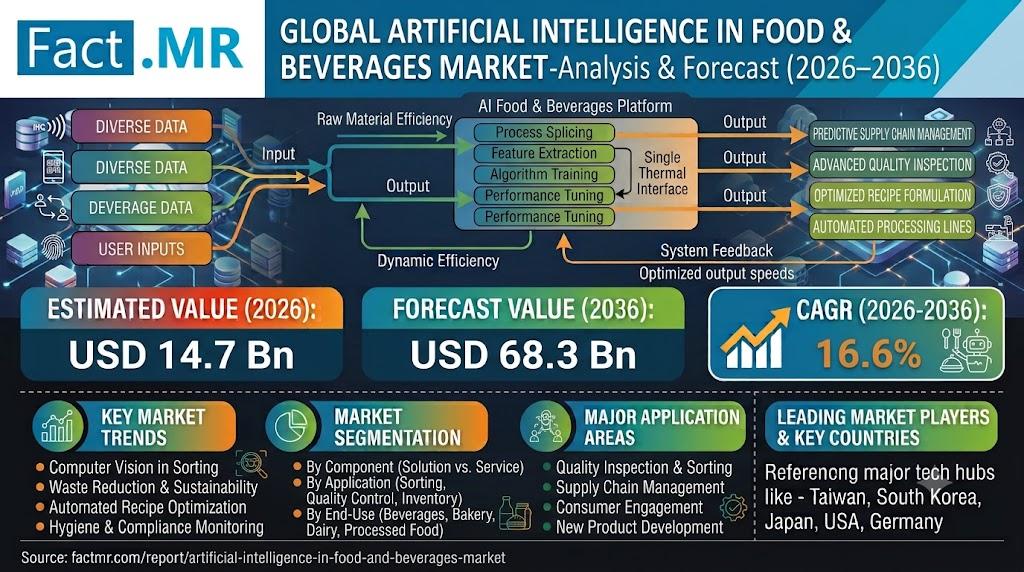
Artificial Intelligence in Food and Beverages Market is projected to grow from USD 14.7 billion in 2026 to USD 68.3 billion by 2036, registering a 16.6% CAGR during the forecast period. The market was valued at USD 12.6 billion in 2025, creating an absolute opportunity of USD 53.5 billion through 2036. Food manufacturers are adopting AI for demand planning, production optimization, quality inspection, and supply-chain visibility.
The strongest use cases are linked to decisions that can be measured on the factory floor or across supply chains. Predictive systems help manufacturers plan volumes for perishable products, while computer vision can identify defects and contamination signals at production-line speed.
Get Detailed Market Forecasts, Competitive Benchmarking, and Pricing Trends: https://www.factmr.com/report/artificial-intelligence-in-food-and-beverages-market
Global Segment Leaders
- Predictive Analytics Platforms — 38% share in 2026: Predictive analytics leads the AI solution segment as food businesses use forecasting for demand planning, inventory management, promotions, and shelf-life risk.
- Production Optimization — 36% share: Production optimization leads the food-industry function segment because manufacturers can use AI outputs for scheduling, changeovers, and labor planning.
- Food Processing — 40% share: Food processing accounts for the largest application area as packaged-food plants generate repeated production, batch, and inspection data that can support AI-based decisions.
- Food & Beverage Manufacturers — 43% share: Manufacturers lead end-user demand because they control production data, processing assets, and quality budgets. AI can be applied directly to production and quality workflows.
- Machine Learning — 39% share: Machine learning leads the AI technology segment because forecasting and anomaly detection are recurring requirements across food and beverage operations.
Country-Level Performance
- USA — 17.8% CAGR: The USA records the highest country CAGR in the report. Large food manufacturers have the budgets for multi-site AI deployment, with demand centered on systems that improve planning and quality review without weakening accountability.
- China — 17.2% CAGR: China's growth is shaped by large-scale food manufacturing and retail data flows. AI can support demand sensing across factories and e-commerce channels where planners need faster visibility.
- Germany — 16.5% CAGR: Germany's market is supported by deep industrial automation and established quality systems. Food companies are expected to favor AI tools that can work with factory controls and quality-check processes.
- Japan — 15.9% CAGR: Japan's growth is linked to labor pressure and food-service automation. AI applications in quality review and kitchen planning can help reduce manual workload while maintaining safety controls.
- UK — 15.3% CAGR: Food-safety assurance and retailer traceability requirements are shaping adoption. Buyers are expected to place greater emphasis on evidence-based AI use and clear review records.
- India — 14.8% CAGR: India's growth is connected with food-processing expansion and diverse regional demand. Planning and logistics applications can help factories manage varied local markets and reduce waste.
- South Korea — 14.2% CAGR: South Korea's market is supported by food-tech programs and automation capability. AI is expected to find applications in retail intelligence, production planning, and food robotics.
Regional Context
The report covers North America, Europe, Asia Pacific, Central and South America, and the Middle East and Africa. Country-level analysis focuses on the USA, China, Germany, Japan, the UK, India, and South Korea.
The country forecasts span 14.2% to 17.8% CAGR. The USA and China show the highest reported growth rates at 17.8% and 17.2%, followed by Germany at 16.5% and Japan at 15.9%. The UK, India, and South Korea are forecast at 15.3%, 14.8%, and 14.2%, respectively. FactMR links these differences to software maturity, manufacturing data availability, automation depth, traceability requirements, food-processing expansion, and food-tech programs.
Market Drivers and Opportunities
Predictive demand and inventory optimization is a major growth driver, particularly for perishable portfolios where forecasting needs to account for shelf life and order lead times. FactMR identifies this as having high relative impact across North America, China, and Europe.
AI-powered vision inspection is another important use case. Food manufacturers can use computer vision to identify defects and contamination signals, but buyers need to define acceptable false-rejection limits before deploying these systems at production speed.
The report also identifies connected supply-chain and cold-chain intelligence, production scheduling, process optimization, and consumer and recipe intelligence as adoption drivers.
On the opportunity side, edge computer vision integrated with production-line controls has high relevance in the USA, Germany, Japan, and South Korea. Unified food-data, traceability, and supplier-intelligence platforms are also identified as a high-impact opportunity across China, India, the UK, and Europe.
Generative AI for formulation knowledge and product content, along with AI for food-service ordering, personalization, and kitchen planning, represent additional opportunities identified by the report.
Market Restraints
Fragmented or poorly labeled operational data remains a major constraint. Food and beverage businesses often keep information across plant equipment and enterprise systems, making it harder to validate model performance.
Food-safety and quality decisions also require clear validation and accountability. Legacy equipment can delay implementation when AI outputs cannot flow into existing work orders or enterprise systems. Cybersecurity, intellectual-property protection, and model governance add further considerations for larger organizations.
Competitive Landscape
The competitive environment includes cloud providers, enterprise software companies, AI technology suppliers, and industrial automation firms. Key companies profiled by FactMR include Microsoft Corporation, Google LLC – Google Cloud, Amazon Web Services, Inc., IBM Corporation, NVIDIA Corporation, SAP SE, Oracle Corporation, Siemens AG, ABB Ltd., Rockwell Automation, Inc., and Honeywell International Inc.
Microsoft and Google Cloud bring cloud and data-platform capabilities, while Amazon Web Services adds analytics infrastructure. IBM and NVIDIA contribute machine-learning and accelerated-computing capabilities. SAP and Oracle connect AI with planning and supply-chain execution, while Siemens, ABB, Rockwell Automation, and Honeywell operate closer to plant controls and industrial automation.
Recent developments cited in the report include ABB's September 2025 collaboration with LandingAI on generative AI for robotic vision, Microsoft's September 2025 customer case showing Gay Lea Foods reducing reporting time from 24 days to under one day, Oracle's June 2024 introduction of Smart Ops for Fusion SCM, and Siemens' June 2025 AI-supported predictive-maintenance work with Sachsenmilch.
Analyst Opinion
Shambhu Nath Jha, Senior Consultant at FactMR, states: “The commercial test for AI in food and beverages is whether a model changes a measurable operating decision without creating a new control gap. Buyers expect forecasting systems to work with inventory rules and vision systems to work with rejection procedures. Generative tools must respect formulation and safety boundaries plus intellectual-property limits.”
The report's strategic assessment suggests that manufacturers should select AI applications with a clear decision owner and reliable operating data. Quality teams can evaluate computer-vision systems at full production speed, while supply-chain teams can assess forecasts alongside replenishment rules and shelf-life limits rather than relying only on model-accuracy scores.
Report Coverage
The Artificial Intelligence in Food and Beverages Market covers AI software, cloud services, analytics platforms, embedded systems, and integrated tools used to improve decisions across food and beverage production, quality, supply chains, retail, and food service.
The study is segmented by AI solution, food-industry function, application area, end user, AI technology, and region. AI solutions include Predictive Analytics Platforms, Quality Inspection Systems, Supply Chain Intelligence, and Consumer Intelligence. Technology coverage includes Machine Learning, Computer Vision, Natural Language Processing, and Generative AI.
General-purpose IT without an AI-enabled decision function is excluded. Standard cloud hosting, unrelated enterprise applications, and sensors or cameras without an AI decision layer are also outside the scope.
The analysis draws on 120+ sources, 35+ company portfolios, 25+ countries, and more than 20 industry interviews. FactMR uses a hybrid top-down and bottom-up approach incorporating manufacturing activity, AI adoption, software and automation spending, use-case attachment, country growth rates, and provider validation.
Other Related Reports:
https://notebook.google.com/notebook/33f7ee5a-dafd-4f05-87af-45260299cf86
https://notebook.google.com/notebook/befe3c76-60f5-4d6b-96c4-26683b47df52
https://notebook.google.com/notebook/15aa4dd0-d3ac-4175-aebd-95011a033f86
About FactMR
FactMR is a global market research and consulting firm providing syndicated and customized research across technology, food and beverage, consumer goods, healthcare, industrial goods, automotive, and other major industries. Its research combines primary interviews, secondary research, company analysis, market modelling, and country-level assessment to evaluate market size, competitive conditions, adoption trends, and emerging opportunities.

 English
 Arabic
 French
 Spanish
 Portuguese
 Deutsch
 Turkish
 Dutch
Dutch
 Italiano
 Romaian
 Portuguese (Brazil)
 Greek
Greek