


What Is the Typical Lifespan of a Golf Shaft?
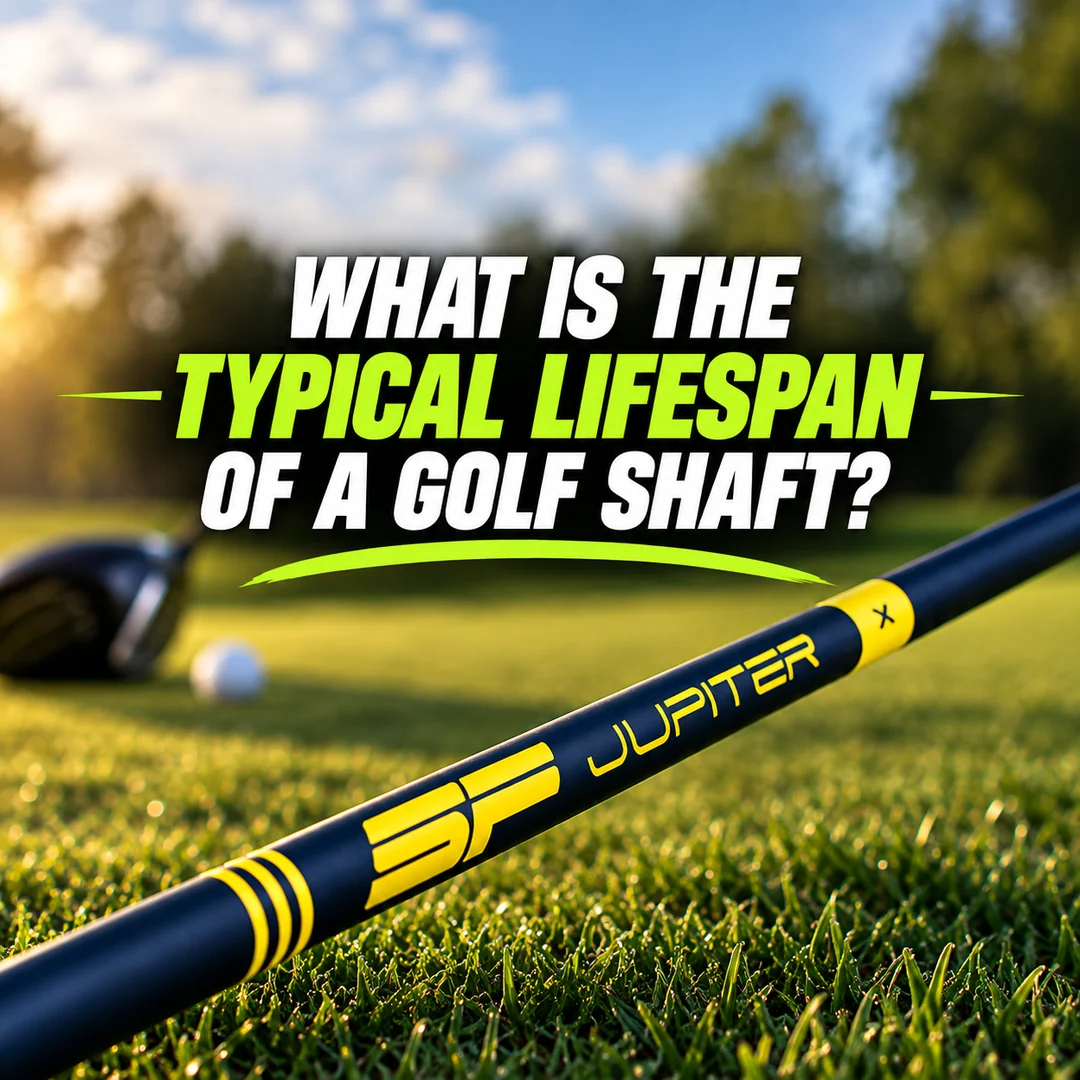
Golfers replace grips, balls, gloves, and even clubheads regularly. But what about the shaft? If you have been playing the same clubs for several years, you may eventually start wondering: what is the typical lifespan of a golf shaft?
The good news is that golf shafts do not come with a fixed expiration date.
A quality graphite or steel shaft can last for many years when it is properly maintained. In some cases, a shaft can remain perfectly playable for decades. Unlike grips, which naturally wear down through regular use, shafts usually do not need replacing simply because they have reached a certain age.
What matters more is the shaft's condition, how it has been handled, and whether it still fits your swing.
Let's look at how long golf shafts really last and the signs that can tell you when it may finally be time for a replacement.
How Long Do Golf Shafts Last?
There is no standard rule saying a golf shaft should be replaced after five, seven, or ten years.
Both graphite and steel shafts are designed to withstand thousands of swings. Under normal playing conditions, a properly maintained shaft can continue performing for many years.
Graphite shafts are made from layers of carbon-fiber material engineered to handle the repeated forces created during the golf swing. Simply getting older does not necessarily mean a graphite shaft gradually becomes softer or loses its performance.
Steel shafts are similarly durable. Their larger long-term concern is generally moisture and corrosion rather than normal swing fatigue.
That means you should pay more attention to the physical condition of the shaft than the date you purchased it.
What Can Shorten the Life of a Golf Shaft?
Although shafts can last a long time, certain conditions can shorten their useful lifespan.
1. Physical Damage
Visible damage is one of the strongest reasons to stop using a golf shaft.
Look for:
-
Cracks
-
Splintering
-
Deep scratches
-
Dents
-
Bending
-
Damage near the tip
Graphite shafts deserve particular attention because damage to their carbon-fiber structure may weaken the shaft even when the affected area initially looks small.
If you notice significant structural damage, replacing the shaft is generally better than continuing to play until it fails.
2. Rust and Moisture
This is particularly important for steel shafts.
Moisture can enter a shaft and contribute to corrosion over time, especially when golf clubs are repeatedly stored while wet or kept in a damp environment.
After playing in the rain or on particularly wet courses, dry your clubs before putting them away. Proper storage can help keep both the shaft and other components in better condition.
3. Repeated Shaft Removal
Graphite shafts can also experience unnecessary stress when they are repeatedly removed and installed in different clubheads.
Removing a bonded shaft often requires controlled heat to break down the epoxy. When excessive heat is used—or the process is performed incorrectly—the shaft may potentially be damaged.
For most golfers who keep their shafts installed normally, this is unlikely to be a major concern.
Your Shaft May Be Fine, but Your Swing Has Changed
One of the most overlooked reasons to replace a golf shaft has nothing to do with wear.
Your shaft may still be in excellent condition but no longer fit your swing.
Golf swings change.
Your swing speed, strength, flexibility, tempo, transition, and delivery can all change over the years. A shaft that worked extremely well for you several seasons ago may no longer produce the same results today.
For example, you may start noticing:
-
Lower or higher ball flight than usual
-
More inconsistent dispersion
-
Difficulty finding the center of the face
-
Unexpected distance loss
-
Changes in feel or timing
That does not automatically mean your shaft has worn out.
Instead, it may mean that its weight, flex, length, or overall profile no longer matches the way you deliver the club.
A fitting can help determine whether your current equipment still suits your swing.
Are 20-Year-Old Golf Clubs Still Good?
Yes. A 20-year-old golf club can still be perfectly playable if it has been stored and maintained correctly.
Age alone does not make a golf shaft unusable.
A 20-year-old graphite shaft with no cracking, splintering, or other structural problems may still function normally. The same applies to a steel shaft that has remained free from serious corrosion or damage.
Where older clubs may differ more noticeably is in the surrounding technology.
Modern golf equipment offers newer clubhead designs, materials, adjustability, shaft profiles, and fitting options. Drivers, in particular, may offer significantly more adjustability than equipment from decades ago.
However, newer does not automatically mean better for every golfer.
If you consistently strike your older clubs well, like the feel, and produce predictable results, there is no reason to replace them purely because of their age.
Can a Regular-Flex Shaft Still Produce Long Drives?
Absolutely.
A regular-flex shaft can produce plenty of distance when it matches the golfer's swing.
Shaft flex alone does not determine how far you hit a driver. Distance is influenced by several factors, including:
-
Clubhead speed
-
Ball speed
-
Strike location
-
Launch angle
-
Spin rate
-
Swing efficiency
-
Weather and course conditions
Instead of asking whether regular flex can hit a certain distance, a better question is whether a regular-flex shaft matches your swing characteristics.
Golfers with faster speeds or more aggressive transitions may sometimes benefit from a stiffer profile. Others can perform extremely well with a softer flex because of the way they load and release the shaft.
The goal is not simply to choose the stiffest shaft you can swing. It is to find a setup that helps you deliver the club consistently.
Does Age Determine How Far You Should Hit Your Irons?
Not necessarily.
Two golfers of the same age can produce completely different distances.
Strength, mobility, technique, club specifications, swing speed, strike quality, fitness, and playing frequency can all affect how far someone hits an iron.
Instead of comparing yourself with an age-based benchmark, watch your own distance pattern.
Suppose your normal 7-iron distance was around 140 yards and has gradually dropped to 125 yards.
The important question is not whether 125 yards is considered normal for your age.
The better question is: what changed?
It could be related to swing speed, strike quality, physical changes, equipment specifications, or several factors working together.
If your distances have changed noticeably, a fitting can help determine whether your current shaft and club setup still complement your swing.
How Much Does It Cost to Replace a Golf Shaft?
Replacement costs vary significantly depending on the shaft, grip, adapter, and installation.
Budget and mid-range setups may cost around 100–150, while premium aftermarket shafts can cost $300 or more.
Before spending money, however, determine why you are replacing the shaft.
If your current shaft is structurally healthy and still fits your swing, replacing it simply because it is old may provide little practical benefit.
If your performance has changed or the shaft has suffered damage, replacement becomes a much more reasonable consideration.
How Do You Know When It's Time to Replace a Golf Shaft?
Instead of asking only, “How old is my shaft?”, ask three more useful questions.
Is it physically damaged?
Check for cracks, splintering, dents, corrosion, deep scratches, or visible problems around the tip.
Has your swing changed?
Changes in speed, strength, tempo, transition, flexibility, or mobility can make your old shaft specifications less suitable.
Has your performance changed?
Unexpected distance loss, inconsistent dispersion, unusual launch conditions, or significant changes in ball flight may justify having both your swing and equipment checked.
If the shaft is damaged, replacement may be necessary.
If your swing has changed, a fitting can help determine whether a different flex, weight, length, or shaft profile would suit your game better.
If neither applies, you may have no reason to replace the shaft at all.
Find a Shaft That Fits Your Game
Not sure whether your current golf shaft still suits your swing?
Take the Steadfast Golf Shaft Selector Quiz to narrow down your options based on your current game.
Rather than replacing equipment based solely on age, focus on what actually matters: condition, consistency, feel, and fit.
The Bottom Line
So, what is the typical lifespan of a golf shaft?
There is no universal number.
A properly maintained graphite or steel golf shaft can remain playable for many years and potentially even decades. Golf shafts are more likely to reach the end of their useful life because of physical damage, corrosion, improper handling, or changes in the golfer's swing than simply because they are old.
Before replacing your shaft, inspect it carefully and think about how your performance has changed.
If it is undamaged and still fits your swing, there may be no reason to replace it.
Your golf shaft might have a lot more rounds left in it.

 English
 Arabic
 French
 Spanish
 Portuguese
 Turkish
 Dutch
Dutch
 Italiano
 Russian
 Romaian
 Portuguese (Brazil)
 Greek
Greek