


Heat Recovery Biologics Market to Reach USD 947.8 Million by 2036 at 12.1% CAGR
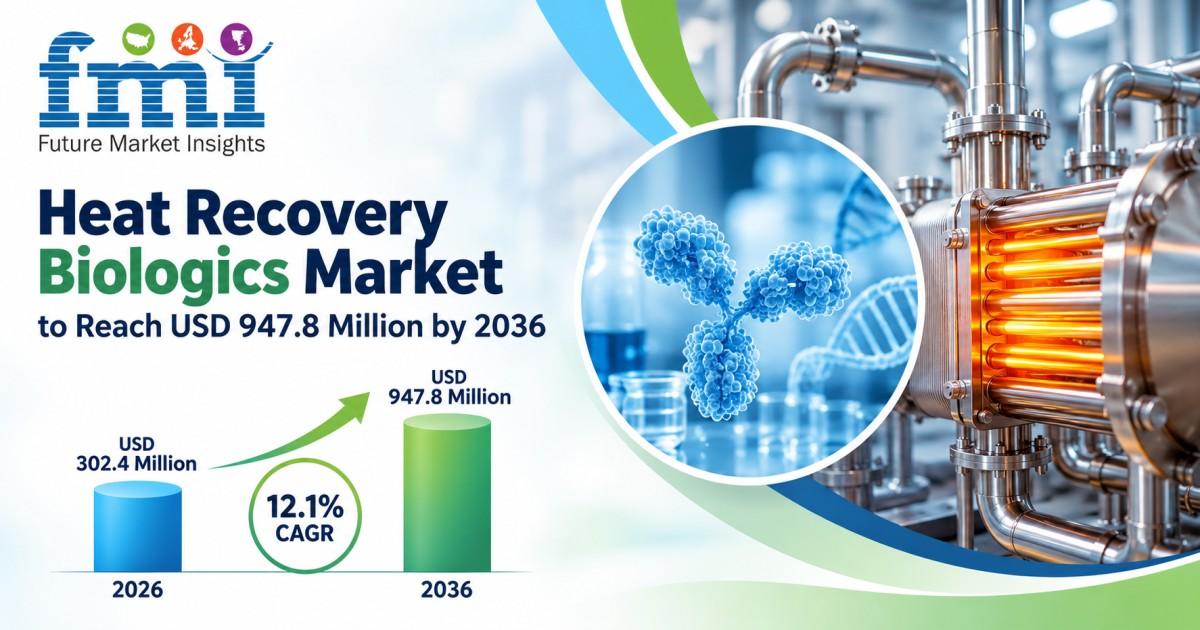
The global heat recovery biologics market is forecast to increase from USD 302.4 million in 2026 to USD 947.8 million by 2036, expanding at a 12.1% CAGR during the 2026–2036 forecast period, according to Future Market Insights. The market stood at USD 269.8 million in 2025. Growth is being supported by increasing heat exposure during sensitive crop stages, growing use of preventive biological treatments, and the integration of stress-management products into planned crop-care and field-pass schedules.
Get detailed market forecasts, competitive benchmarking, and pricing trends:
https://www.futuremarketinsights.com/reports/sample/rep-gb-35568
Regional Segment Leaders
As this is a global agricultural biologics market report, the segment analysis reflects demand across crop types, treatment methods, farm structures, and agricultural distribution channels.
- Osmoprotectant Blends — 43.2% of Product Type revenue in 2026: Glycine betaine and proline-based formulations provide direct cellular stress support and can be incorporated into preventive crop-care programs before heat reaches sensitive growth stages.
- Cereals & Grains — 48.0% of Crop Type revenue in 2026: Broad cultivated acreage and heat-sensitive reproductive stages create substantial demand for treatments that can be integrated into existing cereal field programs.
- Soil Application — 49.6% of Application Method revenue in 2026: Root-zone treatments can be scheduled before visible canopy damage and combined with planting or irrigation operations.
- Large Commercial Farms — 50.6% of Farm Type revenue in 2026: Larger farms can conduct treated-versus-untreated trials across multiple fields and evaluate crop response before expanding recurring purchases.
- Agri-Input Distributors — 42.3% of Sales Channel revenue in 2026: Local stock, agronomic advice, and practical dose and application guidance help growers respond quickly during short heat-treatment windows.
Country-Level Performance
The five profiled countries span 1.8 percentage points in CAGR during 2026–2036, reflecting differences in weather exposure, farm structures, agricultural technology, field-trial requirements, and distribution systems.
- South Korea | CAGR 11.7% (2026–2036) | Key drivers: Protected farming, weather monitoring, and controlled crop systems support preventive heat-management programs and allow growers to adjust irrigation and crop-care timing.
- USA | CAGR 11.4% (2026–2036) | Key drivers: Broad-acre agriculture creates opportunities for regional trials, while measurable per-acre returns remain important before farms expand stress-treatment programs.
- Germany | CAGR 11.1% (2026–2036) | Key drivers: Structured agronomy channels and specialty-fertilizer programs encourage products supported by precise claims and local evidence.
- UK | CAGR 10.8% (2026–2036) | Key drivers: Agronomist-led spray planning and warmer growing conditions increase the importance of reliable treatment timing and local distributor availability.
- Japan | CAGR 9.9% (2026–2036) | Key drivers: Crop-quality priorities and established technical distribution channels support crop-specific heat-stress trials with clear dose and application guidance.
Regional Context
Heat recovery biologics are gaining relevance as growers seek preventive treatments before heat affects flowering, fruit set, grain fill, or other sensitive crop stages. Weather alerts and field monitoring can help agronomists connect heat forecasts with planned application windows.
Cereals and grains represent a major opportunity because broad acreage exposes large crop areas to short periods of reproductive-stage heat. Farms can integrate biological stress treatments with existing nutrition and crop-care passes, limiting additional labor and application costs.
However, field response can vary according to crop stage, water availability, soil fertility, and heat intensity. This variability makes local trials important before growers commit to repeat purchases. Product claims and application requirements must also align with applicable regulatory frameworks in individual markets.
Weather-linked agronomy presents an emerging opportunity. By combining weather information, crop-stage records, field monitoring, and tested dose recommendations, distributors and agronomists can help growers determine when a stress-management treatment is most relevant.
Competitive Landscape
The competitive landscape combines global agricultural-input groups, formulation and agronomy specialists, and marine-derived stress-management companies.
- Broad Biological Platforms: Syngenta Biologicals (Valagro), UPL Corp (NPP), and Rovensa Next (Tradecorp) combine biological crop inputs with broad agricultural distribution and technical support.
- Formulation and Agronomy Specialists: Brandt, Biolchim, and Hello Nature focus on crop nutrition, stress-management formulations, and field-level agronomic programs.
- Marine-Derived Stress Management Specialists: Acadian Plant Health and BioAtlantis emphasize seaweed-based solutions and research focused on abiotic stress management.
Notable developments include Rovensa Next's May 2026 launch of Luxyva in Mexico for crops exposed to high solar radiation. In December 2025, UPL launched HYCOXA seaweed technology targeting abiotic stress and nitrogen uptake. In February 2025, Acadian Plant Health introduced its Abiotic Stress Management portfolio for specialty and broad-acre crops with supporting field trials.
Get the Complete Story-Read More About Our Latest Report:
https://www.futuremarketinsights.com/reports/heat-recovery-biologics-market
Analyst Perspective
“Heat-recovery biologics gain practical adoption when weather alerts translate into tested treatments within existing field passes. Wider use depends on local evidence that retained yield or crop quality can justify treatment cost across another season.” — Nandini Roy Choudhury, Principal Consultant, Future Market Insights
Explore More Research Reports by FMI
USA Empanadas Market:
https://www.newstrail.com/usa-empanadas-market/
About Future Market Insights (FMI)
Future Market Insights, Inc. (FMI) is an ESOMAR-certified, ISO 9001:2015 market research and consulting organization, trusted by Fortune 500 clients and global enterprises. With operations in the U.S., UK, India, and Dubai, FMI provides data-backed insights and strategic intelligence across 30+ industries and 1200 markets worldwide.
For Press & Corporate Inquiries
Rahul Singh
AVP - Marketing and Growth Strategy
Future Market Insights, Inc.
+91 8600020075
For Sales: sales@futuremarketinsights.com
For Media: Rahul.singh@futuremarketinsights.com
For Web: https://www.futuremarketinsights.com/

 English
 Arabic
 French
 Spanish
 Portuguese
 Deutsch
 Turkish
 Dutch
Dutch
 Italiano
 Russian
 Romaian
 Greek
Greek