


What Produces the Hamon Line of a Realistic Katana?
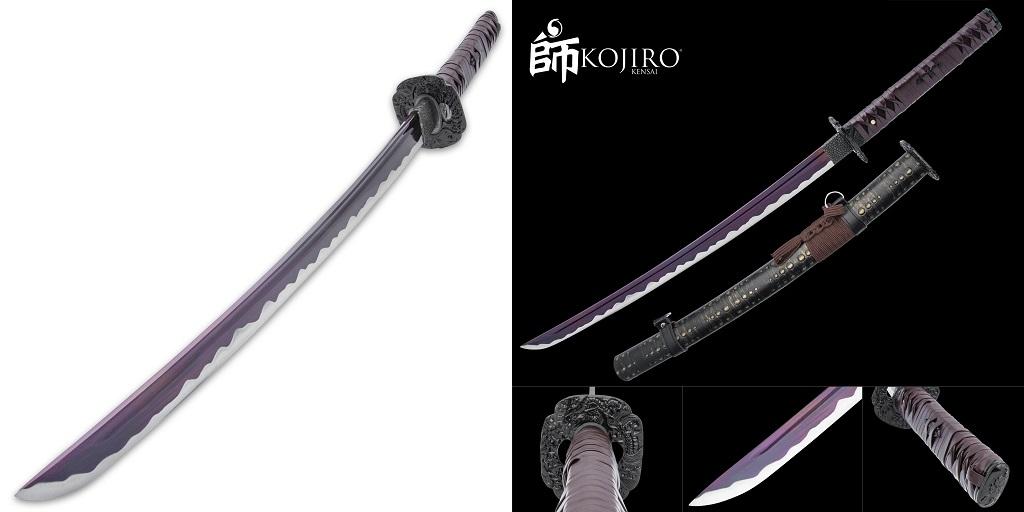
The hamon line, a wavy, clouded line near the edge of a realistic katana (or other traditional Japanese sword) is so indelibly linked with the image of the sword that even modern katanas that are not made in accordance with traditional techniques have something of the sort etched onto the edge of the blade that produces the same aesthetic effect.
But what is the hamon line, really, and why is it there? Let’s take a closer look so you can be better informed when speaking about these swords (or even be a smarter shopper, if you intend to buy one).
The Yaki Ire Process: Clay Tempering
The hamon line is produced during the yaki ire process, which in English is referred to as “clay tempering.”
After the smith forms the blade, he prepares a paste that consists mostly of clay with a little bit of charcoal and a little bit of other powdered stone or other natural materials. This mixture is called tsuchioki; the clay helps it stick to the blade and the charcoal powder helps control heat.
The smith applies a thin layer to the blade, which allows for more rapid cooling when the blade is tempered, and a thicker layer is applied near the spine. Typically there is a wavy pattern at the margin between the thicker and thinner layers which is responsible for the appearance of the hamon line once tempering is complete.
After applying, the smith heats up the forge and the steel blade stock. Traditionally, the smith will not use a thermometer to gauge the temperature of the steel; once it is a bright orange red (hotter than a dull red but not bright white hot) it is ready to quench.
The sword, with the clay mixture still adhering to it, is plunged into water. This rapidly cools the blade, preserving the properties of the steel matrix at the point at which it was quenched. Since there is a thinner layer of clay on the edge and a thicker layer on the spine, the properties of each will vary after the blade has been quenched.
What It Yields
Aesthetically, this process yields the hamon line. But it is what the quenching really confers to the steel in terms of physical properties that is so significant.
Because the edge is covered by a thinner layer of clay, it cools off more rapidly during quenching, forming a material known as martensite, and the spine forms a material known as pearlite.
The martensitic edge is harder yet slightly more brittle than the spine, giving it an excellent ability to take a fine edge and hold it. The spine, of pearlite, is softer and more abuse resistant than the edge.
This ultimately yields a sword that has a harder edge that will last longer paired with a spine that is softer and more resilient to abuse, reducing the risk that the sword will shatter when struck.
The clay tempering process ultimately yields a tougher, stronger sword with an edge that is easier to maintain without being too brittle, and also produces the hamon line, an aesthetic indicator that clay tempering has been performed according to traditional processes, and a mark that what you’re looking at is a realistic katana.
Where to Learn More About Realistic Katanas and Other Traditional Japanese Swords
Looking for realistic katanas and other traditional Japanese swords that have a real hamon line that is indicative of a differential temper? Visit True Swords. They carry a wide range of Japanese swords, including katana and odachi swords; visit their website and get in touch with them if you have any questions.
For More Information About Odachi Sword and Replica Blade Sword Please Visit: True Swords.

 English
 Arabic
 French
 Portuguese
 Deutsch
 Turkish
 Dutch
Dutch
 Italiano
 Russian
 Romaian
 Portuguese (Brazil)
 Greek
Greek