


Liquid Egg Market to 2036: Rising Demand from Food Processing and Foodservice
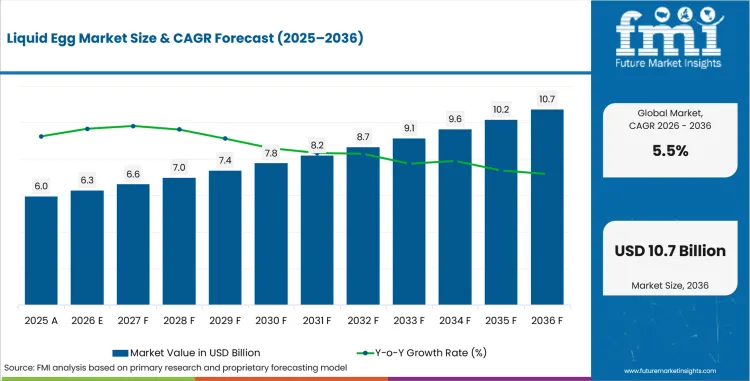
Liquid Egg Market Set to Reach USD 10.7 Billion by 2036
The global Liquid Egg Market is becoming an increasingly important component of modern food manufacturing and foodservice operations as processors seek greater efficiency, food safety, consistency, and simplified handling. According to Future Market Insights, the market is projected to increase from USD 6.3 billion in 2026 to USD 10.7 billion by 2036, expanding at a 5.5% CAGR during the forecast period. The market was valued at approximately USD 6.0 billion in 2025, creating an incremental opportunity of USD 4.4 billion between 2026 and 2036.
The market's development is being shaped by the transition from shell egg handling toward pre-processed formats, particularly across commercial food manufacturing, bakery, foodservice, and institutional applications. At the segment level, whole egg liquid products are expected to account for 42.0% of product sales in 2026, while frozen liquid egg products are projected to hold a 67.0% share. Pasteurized products are expected to account for 72.0% of processing technology demand, while business-to-business sales represent 58.0% of the market.
Explore detailed Liquid Egg Market forecasts, segmentation, regional analysis, and competitive insights: https://www.futuremarketinsights.com/reports/sample/rep-gb-14337
Analyst Perspective
"Liquid egg processors that combine efficient pasteurization capacity with reliable cold chain distribution and food safety traceability are likely to gain share as the food industry shifts from shell egg handling to pre-processed formats."
- Nandini Roy Choudhury, Principal Consultant, Future Market Insights
Why Is the Liquid Egg Market Growing?
The central market shift is being driven by the food industry's increasing preference for ingredients that simplify production while delivering consistent quality and food safety.
Liquid egg products eliminate many of the operational requirements associated with shell egg handling, including cracking, separation, disposal, and manual preparation. This makes them particularly attractive to commercial bakeries, food manufacturers, restaurants, institutional kitchens, and other high-volume food operations.
Labor efficiency is becoming increasingly important as foodservice and manufacturing businesses seek to streamline production processes. Liquid eggs can be supplied in standardized formats and integrated directly into production systems, reducing preparation requirements and improving portion control.
Food safety is another important demand driver. Pasteurization allows processors and commercial users to manage microbiological risks while maintaining the functionality required for food production.
The expansion of packaged bakery products, convenience foods, prepared meals, and processed foods is further supporting demand for consistent egg-based inputs that can be incorporated into automated production lines.
Whole Egg Liquid Products Account for 42% of Product Demand
In 2026, whole egg liquid products are expected to represent 42.0% of product sales.
Whole egg formats benefit from their broad applicability across multiple food categories. Bakery products, confectionery, pasta, sauces, prepared foods, and foodservice operations can use whole liquid eggs where consistent egg functionality and simplified handling are important.
For food manufacturers, the value proposition extends beyond convenience. Standardized liquid egg products can support consistent formulation, portion control, and production-line efficiency.
The broad application base of whole egg liquid products helps explain their leading position within the product category.
As food manufacturers continue to automate production and optimize ingredient handling, liquid whole egg can provide an operationally efficient alternative to processing shell eggs within individual facilities.
Frozen Liquid Egg Products Lead with 67% Share
Frozen liquid egg products are expected to account for 67.0% of the market in 2026.
Frozen formats provide processors and commercial users with an approach to inventory management and product handling that can support high-volume procurement.
The format is particularly relevant where liquid egg is purchased in larger quantities and incorporated into manufacturing processes according to production schedules.
Cold chain infrastructure therefore remains an important component of market development. Improvements in refrigerated and frozen distribution networks can expand access to liquid egg products while supporting product quality throughout the supply chain.
For suppliers, the ability to combine egg breaking, processing, freezing, storage, and distribution can create advantages in serving large commercial customers.
Pasteurization Supports Food Safety and Commercial Adoption
Pasteurized products are projected to account for 72.0% of processing technology demand.
Pasteurization is central to the commercial liquid egg market because food manufacturers and foodservice operators require reliable approaches to food safety management.
The use of pasteurized liquid egg allows commercial users to incorporate egg ingredients into production processes without requiring the same level of on-site shell egg handling.
This is particularly significant for institutional kitchens, food manufacturers, bakeries, and foodservice operations where standardized food safety procedures are essential.
The combination of pasteurization, standardized packaging, cold chain management, and traceability is consequently becoming an important part of the commercial value proposition.
B2B Sales Account for 58% of Demand
Business-to-business sales are expected to dominate the market, accounting for 58.0% in 2026.
The dominance of B2B procurement reflects the role of liquid egg as an industrial and foodservice ingredient rather than simply a consumer product.
Commercial bakeries purchase liquid egg for high-volume production, while food manufacturers use it in products ranging from baked goods and pasta to prepared foods and other processed categories.
Institutional foodservice operations can also benefit from pre-processed egg formats because they reduce preparation requirements and support standardized recipes.
As procurement becomes increasingly centralized, suppliers capable of providing consistent volume, food safety documentation, reliable delivery, and flexible packaging can strengthen relationships with large commercial buyers.
Bulk Packaging Leads with 64% Share
Bulk packaging is projected to represent 64.0% of the market in 2026.
The leading position of bulk packaging reflects the purchasing behavior of large food manufacturers and foodservice operators.
High-volume users generally require liquid egg formats that can be integrated efficiently into production lines and large-scale food preparation processes.
Bulk packaging can reduce repeated handling and support continuous or batch production environments.
This creates opportunities for processors that can combine packaging efficiency with cold chain reliability and product consistency.
The packaging segment is therefore closely connected to broader trends in food manufacturing automation and procurement consolidation.
USA Shows Strong Growth Through 2036
Country-level growth varies across major markets, with the USA projected to expand at a 5.6% CAGR through 2036.
Growth in the USA is supported by established processed food manufacturing, a large foodservice industry, expanding demand for convenience foods, and improvements in cold chain infrastructure.
The shift toward pre-processed ingredients is also supported by labor considerations. Food manufacturers and foodservice operators can use liquid egg to reduce manual preparation and simplify production workflows.
North America maintains a strong position because of its established food processing infrastructure, high foodservice penetration, and regulatory emphasis on food safety and pasteurization.
The combination of industrial-scale food production and sophisticated distribution infrastructure creates a favorable environment for liquid egg adoption.
What Are the Key Challenges?
Despite positive growth prospects, the Liquid Egg Market faces several operational and commercial considerations.
Cold chain management remains critical because liquid and frozen egg products require appropriate temperature control throughout storage and transportation.
Food safety and traceability also remain central requirements. Processors must maintain rigorous controls across egg breaking, pasteurization, packaging, storage, and distribution.
Cost management represents another consideration. Energy requirements associated with refrigeration, freezing, processing, and transportation can influence supplier economics.
Egg supply and price volatility can also affect production costs and procurement decisions. Processors therefore need reliable sourcing strategies and efficient production systems to maintain consistency for commercial customers.
For market participants, the ability to combine food safety, processing efficiency, supply reliability, and distribution capabilities will remain important as customers increasingly consolidate procurement.
Competitive Landscape: From Egg Processing to Integrated Supply Chains
Competition in the liquid egg industry increasingly extends beyond basic egg processing.
Companies with integrated capabilities across egg breaking, pasteurization, freezing, packaging, cold chain distribution, and food safety traceability can address more requirements within the commercial procurement process.
Large food manufacturers and foodservice operators typically prioritize consistency, dependable supply, regulatory compliance, and the ability to meet high-volume requirements.
As procurement becomes more centralized, integrated processors may be positioned to serve customers seeking fewer suppliers and more standardized ingredient systems.
Competitive differentiation is therefore increasingly connected to processing capacity, product consistency, food safety systems, packaging formats, distribution networks, and customer service.
What Does the Liquid Egg Market Look Like by 2036?
The Liquid Egg Market is projected to reach USD 10.7 billion by 2036, reflecting the continued transition of commercial food production toward standardized, pre-processed ingredients.
The market's 5.5% CAGR between 2026 and 2036 highlights a sustained opportunity across food manufacturing, bakery, foodservice, institutional food preparation, and convenience food production.
The next phase of development will depend on how effectively processors address food safety, cold chain reliability, processing efficiency, packaging requirements, supply consistency, and cost management.
For food manufacturers and foodservice operators, liquid egg offers an opportunity to simplify egg handling while supporting standardized production processes.
For suppliers, the commercial opportunity extends beyond supplying liquid egg itself. Integrated capabilities in processing, pasteurization, freezing, packaging, traceability, and distribution can become increasingly important as large buyers consolidate procurement and demand dependable ingredient supply.
Frequently Asked Questions
What is the Liquid Egg Market size in 2026?
The global Liquid Egg Market is expected to reach approximately USD 6.3 billion in 2026.
How large will the Liquid Egg Market be in 2036?
Future Market Insights projects the market to reach approximately USD 10.7 billion by 2036.
What is the expected CAGR of the Liquid Egg Market?
The market is projected to expand at a 5.5% CAGR from 2026 to 2036.
Which product type leads the market?
Whole Egg Liquid Products are expected to lead the product category, accounting for 42.0% of product sales in 2026.
Which processing technology dominates the market?
Pasteurized products are projected to account for 72.0% of processing technology demand in 2026.
Which packaging format leads the market?
Bulk packaging is expected to hold the leading position with 64.0% of demand in 2026.
Which sales channel dominates the Liquid Egg Market?
Business-to-business sales are projected to account for 58.0% of the market in 2026.
Which country shows the fastest growth?
The USA is projected to record a 5.6% CAGR through 2036.
Final Outlook
The Liquid Egg Market Outlook reflects the food industry's broader movement toward efficient, standardized, and safety-focused ingredient systems.
With the market projected to grow from USD 6.3 billion in 2026 to USD 10.7 billion by 2036, opportunities are emerging across whole egg liquid products, frozen formats, pasteurized processing, bulk packaging, food manufacturing, bakery, and foodservice applications.
The market's development will increasingly depend on more than egg supply alone. Processors will need to demonstrate reliable food safety, efficient pasteurization, dependable cold chain distribution, consistent product quality, and traceability.
As food manufacturers and foodservice operators continue to prioritize labor efficiency and standardized production, liquid egg is positioned to remain an important pre-processed ingredient across the commercial food value chain.
About Future Market Insights (FMI)
Future Market Insights, Inc. (FMI) is an ESOMAR-certified, ISO 9001:2015 market research and consulting organization, trusted by Fortune 500 clients and global enterprises. With operations in the U.S., UK, India, and Dubai, FMI provides data-backed insights and strategic intelligence across 30+ industries and 1200 markets worldwide.
For Press & Corporate Inquiries
Rahul Singh
AVP - Marketing and Growth Strategy
Future Market Insights, Inc.
+91 8600020075
For Sales: sales@futuremarketinsights.com
For Media: Rahul.singh@futuremarketinsights.com
For Web: https://www.futuremarketinsights.com/

 English
 French
 Spanish
 Portuguese
 Deutsch
 Turkish
 Dutch
Dutch
 Italiano
 Russian
 Romaian
 Portuguese (Brazil)
 Greek
Greek