


5G New Radio NR Market to Grow at 14.3% CAGR in India, 13.1% in China, Reaching USD 89.7 Billion by 2036
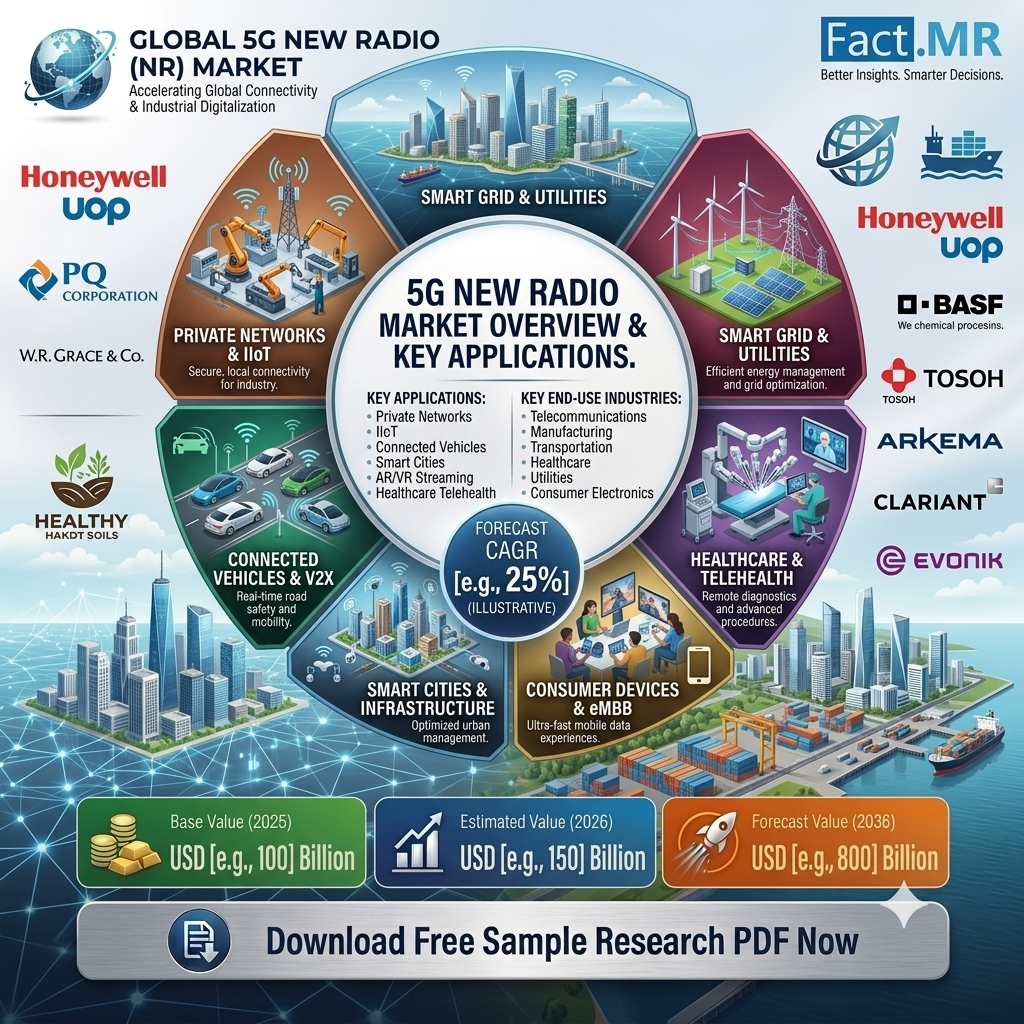
The 5G New Radio NR market is forecast to expand from USD 28.4 billion in 2026 to USD 89.7 billion by 2036, registering a 12.2% CAGR over the forecast period. Fact.MR attributes this growth to operators moving beyond initial 5G coverage deployments toward standalone networks, capacity expansion, and 5G-Advanced upgrades.
Demand for 5G NR is becoming increasingly focused on network performance, spectrum efficiency, and higher capacity. Operators are upgrading radio infrastructure to handle rising mobile data traffic, improve uplink performance, and strengthen mobility across dense urban locations and enterprise sites. At the same time, standalone NR is gaining relevance because it can support lower latency and network slicing for advanced applications.
Private 5G networks are creating another area of demand. Enterprises in manufacturing and logistics are deploying private NR systems for secure local connectivity, connected equipment, and automation. Fixed wireless access is also expanding the role of NR by providing broadband connectivity in locations where fiber deployment can be difficult or costly.
Get detailed market forecasts, competitive benchmarking, and pricing trends:
https://www.factmr.com/connectus/sample?flag=S&rep_id=15142
Radio Access Hardware Holds Leading Component Share
By component, radio access hardware is expected to account for 39.0% of the 5G New Radio NR market in 2026. NR deployment begins with radio units and antennas that establish coverage and capacity across licensed spectrum, giving hardware a central role in network expansion. Baseband and protocol software are also gaining importance as operators migrate toward standalone architectures and cloud-based RAN environments.
By deployment mode, non-standalone NR is projected to hold a 43.0% share in 2026. Many operators continue to use existing 4G core networks alongside 5G radios, allowing them to expand 5G services without immediately replacing their core infrastructure. Standalone NR is expected to gain share as operators upgrade network cores and seek lower latency and network-slicing capabilities.
Sub-6 GHz is forecast to capture 58.0% of the market in 2026. The frequency range provides a balance between coverage and capacity, making it suitable for broad network deployment and stable outdoor mobility. C-band is supporting capacity expansion, while mmWave remains relevant for high-capacity locations and fixed wireless access applications.
Enhanced mobile broadband represents the leading application segment, with a projected 54.0% share in 2026. Smartphones and mobile routers continue to generate the largest commercial requirement for higher throughput and improved coverage. Fixed wireless access and ultra-reliable low-latency communication are expanding NR usage across residential, enterprise, and industrial environments.
India, China, and Germany Show Strong Growth Potential
India is projected to record a 14.3% CAGR from 2026 to 2036, the fastest growth rate among the countries assessed. Continued operator rollout and increasing fixed wireless access demand are supporting the country's expansion. Operators are upgrading NR radios and software to improve urban capacity and regional reach, while private NR is gaining attention across factories and logistics facilities.
China is expected to advance at a 13.1% CAGR through 2036. The country has a large installed 5G base and extensive domestic network equipment capacity. Market development is shifting from broad coverage toward network densification and industrial applications, with manufacturing facilities using private NR for automation and site connectivity.
Germany is forecast to register a 10.1% CAGR during the same period. Industrial campus networks are supporting private 5G adoption across automotive plants and manufacturing facilities. Demand is also being shaped by standalone migration as operators and industrial users seek predictable latency, stronger data control, and support for advanced network services.
The United States is projected to grow at an 11.2% CAGR through 2036. Operators are upgrading mid-band capacity and expanding fixed wireless access, while standalone NR and private network deployments gain wider commercial attention. Japan, meanwhile, is expected to record a 9.4% CAGR as mature 5G networks move toward densification and 5G-Advanced upgrades.
Competitive Landscape
Competition in the 5G New Radio NR market includes major radio access and network infrastructure suppliers. Key companies profiled by Fact.MR include Huawei Technologies Co., Ltd., Ericsson, Nokia Corporation, Samsung Electronics Co., Ltd., and ZTE Corporation. These companies compete across public 5G infrastructure, private networks, radio platforms, and network software.
Operators are assessing suppliers based on radio performance, software upgrade support, energy efficiency, multi-band capabilities, and field integration. Support for standalone migration and future 5G-Advanced requirements is also becoming increasingly important as networks move from initial coverage deployment toward performance-focused upgrades.
Standalone Migration and 5G-Advanced Shape Market Opportunities
Standalone migration and 5G-Advanced readiness are among the primary factors influencing future 5G NR demand. Fact.MR notes that suppliers need platforms capable of supporting Release 18 and subsequent 5G-Advanced features. Chipset providers are also expected to address wider band aggregation and improved power efficiency as device requirements evolve.
Open RAN development is creating additional opportunities for flexible, interoperable network architectures. However, deployment complexity remains a consideration because standalone NR requires core-network upgrades and compatible devices, while mmWave networks can require dense site deployment and stronger backhaul. Operators are also facing power-cost pressures as radio density increases.
As telecom operators, enterprises, and device manufacturers continue shifting toward capacity-focused 5G infrastructure, demand for NR radios, software, chipsets, testing systems, and integration services is expected to expand through 2036. The full Fact.MR report provides detailed forecasts across components, deployment modes, frequency bands, applications, end users, countries, and competitive developments.
Top Reports:
https://adamaamresearch.blogspot.com/2026/09/genomic-nutrition-platforms-market.html
https://social.mytamam.com/blogs/43986/Genomic-Nutrition-Platforms-Market-to-Reach-USD-829-8-Million
https://zeuspage.org/blogs/63887/Genomic-Nutrition-Platforms-Market-Worth-USD-829-8-Million-by
https://kaamkaaziclub.com/read-blog/62586
About Fact.MR
Fact.MR is a market research and consulting company providing market intelligence, competitive analysis, and forecasting across global industries. Its research supports businesses with data-driven insights into emerging markets, technology trends, competitive dynamics, regional opportunities, and changing demand patterns.

 English
 Arabic
 French
 Spanish
 Portuguese
 Turkish
 Dutch
Dutch
 Italiano
 Russian
 Romaian
 Portuguese (Brazil)
 Greek
Greek