


How to Build Custom Financial Software for Your Business
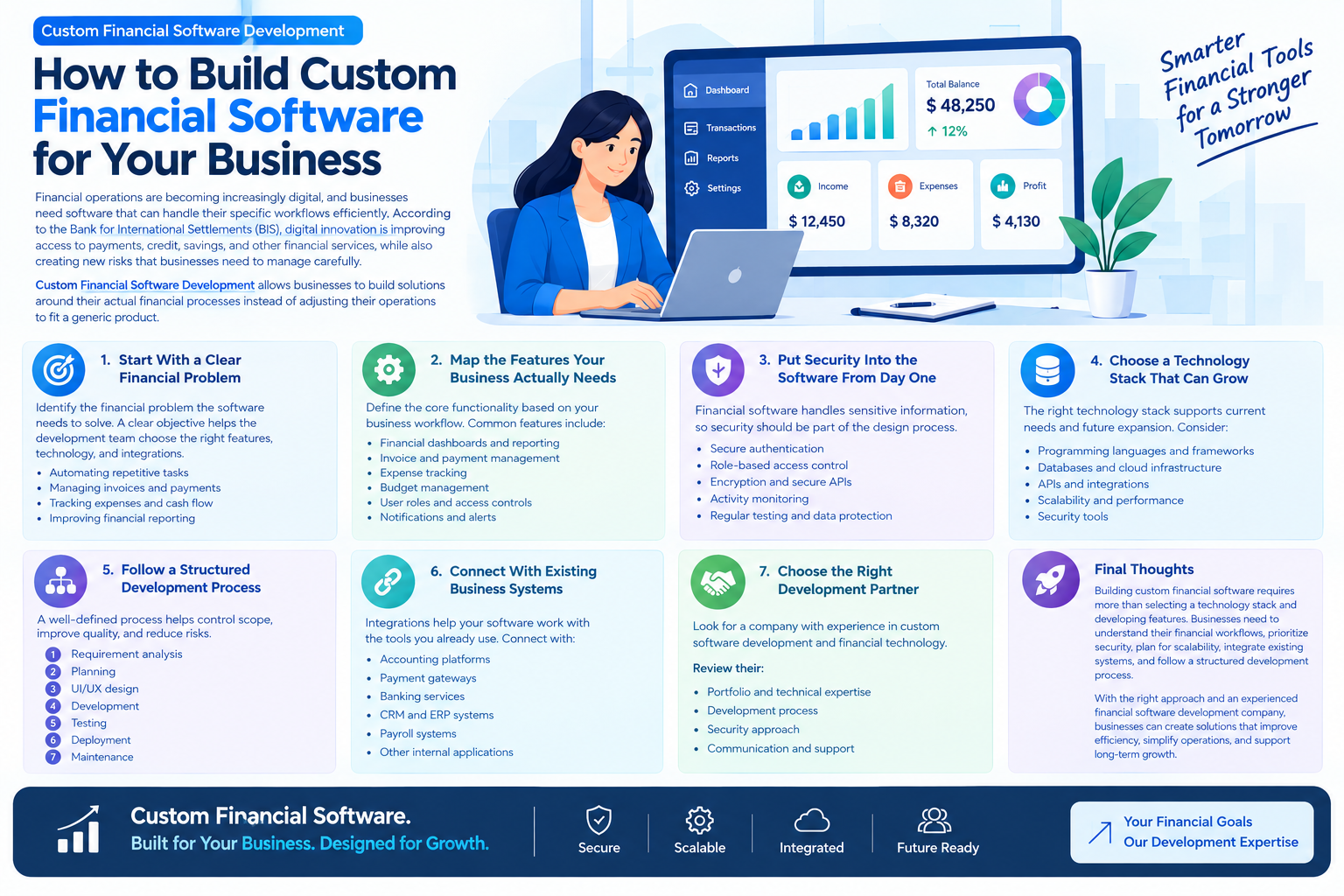
Financial operations are becoming increasingly digital, and businesses need software that can handle their specific workflows efficiently. According to the Bank for International Settlements (BIS), digital innovation is improving access to payments, credit, savings, and other financial services, while also creating new risks that businesses need to manage carefully. This makes secure and flexible financial technology increasingly important.
Custom Financial Software Development allows businesses to build solutions around their actual financial processes instead of adjusting their operations to fit a generic product. Here is how businesses can approach the development process.
Start With a Clear Financial Problem
Before development begins, identify the financial problem the software needs to solve. A clear objective helps the development team choose the right features, technology, and integrations.
- Automating repetitive financial tasks
- Managing invoices and payments
- Tracking business expenses
- Improving financial reporting
- Managing budgets and cash flow
- Reducing manual data entry
Defining the problem first prevents unnecessary features and keeps development focused on measurable business needs.
Map the Features Your Business Actually Needs
Every business has different financial requirements, so the feature set should match the company's workflow. Common features may include:
- Financial dashboards and reporting
- Invoice and payment management
- Expense tracking
- Budget management
- Automated financial calculations
- User roles and access controls
- Notifications and alerts
- Data export and reporting tools
Businesses can start with essential features and add advanced capabilities as their needs grow.
Put Security Into the Software From Day One
Financial software handles sensitive information, so security should not be treated as a final development step. Security requirements should be considered throughout the design and development process.
Important measures can include secure authentication, role-based access control, encryption, secure APIs, activity monitoring, regular testing, and appropriate data protection practices. Strong security can help reduce the risks associated with unauthorized access, fraud, and data exposure.
Choose a Technology Stack That Can Grow
The technology stack should support the current requirements while leaving room for future growth. Depending on the project, developers may select modern programming languages, frameworks, databases, cloud infrastructure, APIs, and security tools.
A scalable architecture makes it easier to add users, features, integrations, and transaction volumes without rebuilding the entire application.
Follow a Structured Development Process
A well-defined development process helps control scope, improve quality, and reduce unexpected problems.
- Requirement Analysis: Understand the business workflow, users, financial requirements, and project goals.
- Planning: Define the features, technology stack, development timeline, and project scope.
- UI/UX Design: Create an interface that makes financial information easy to understand and use.
- Development: Build the core software, features, APIs, and integrations.
- Testing: Test functionality, security, performance, compatibility, and reliability.
- Deployment: Launch the software in the appropriate production environment.
- Maintenance: Monitor the system, fix issues, improve security, and introduce new features.
Connect the Software With Existing Business Systems
Custom financial software often needs to communicate with other business tools. Integrations can connect the system with accounting platforms, payment gateways, banking services, CRM systems, ERP software, payroll systems, or other internal applications.
Well-planned integrations reduce duplicate data entry and help businesses maintain a more connected financial workflow.
Choose the Right Development Partner
Choosing an experienced development partner is an important part of building reliable financial software. Look for a company with experience in custom software development, financial technology, API integrations, security, testing, and scalable application architecture.
Before starting the project, review the company's portfolio, technical expertise, development process, communication practices, security approach, pricing structure, and post-launch support.
Final Thoughts
Building custom financial software requires more than selecting a technology stack and developing features. Businesses need to understand their financial workflows, prioritize security, plan for scalability, integrate existing systems, and follow a structured development process.
With the right approach and an experienced financial software development company, businesses can create solutions that improve efficiency, simplify financial operations, and support long-term growth.

 English
 Arabic
 French
 Spanish
 Portuguese
 Deutsch
 Turkish
 Dutch
Dutch
 Italiano
 Russian
 Portuguese (Brazil)
 Greek
Greek