


HDPE T-Rib Liner Sheets for Tunnels, Tanks, and Water Structures
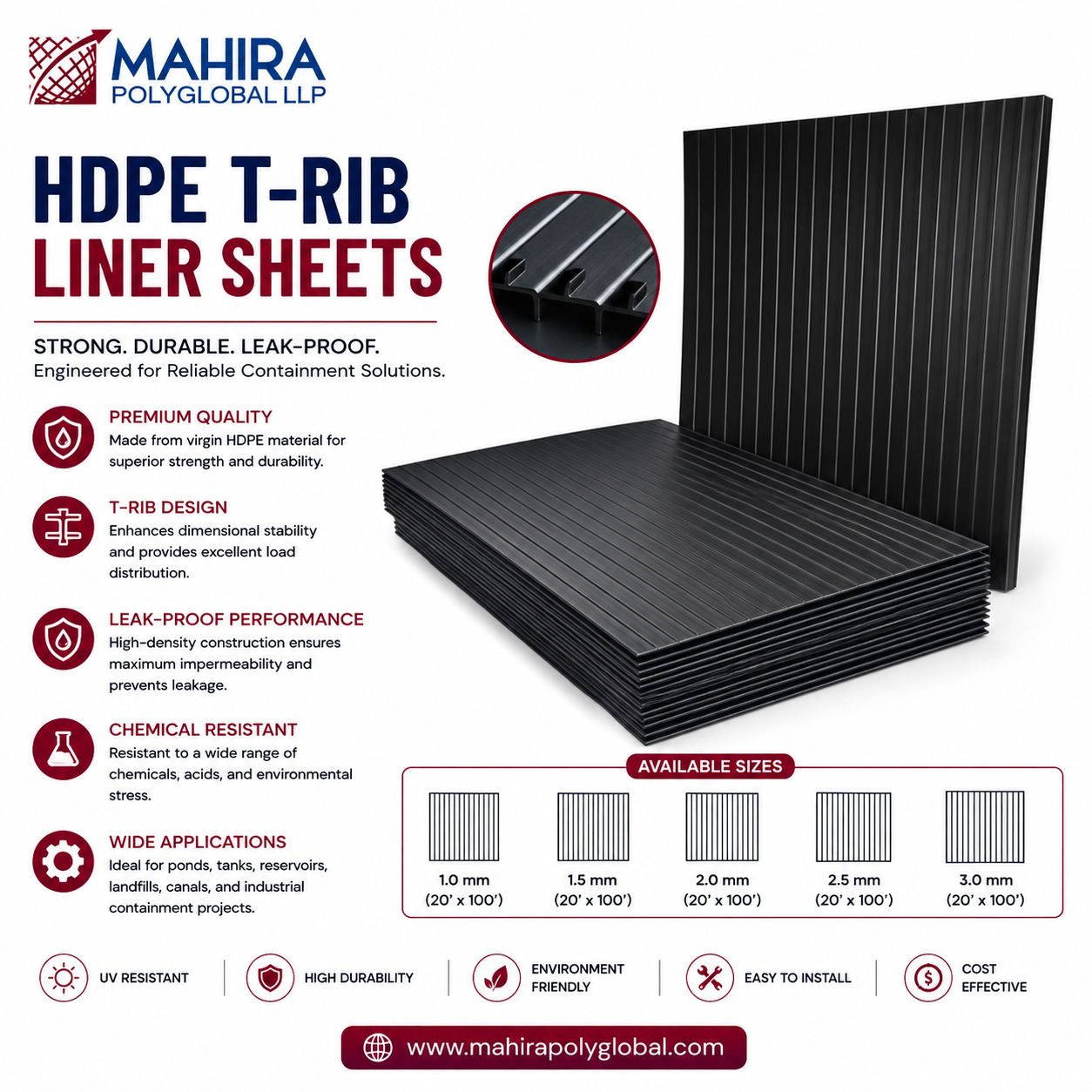
HDPE T-rib liner sheets are engineered polymer liners specifically designed for the protection of concrete structures subjected to water, chemicals, moisture and abrasive and corrosive conditions. The other side features T-shaped ribs, and the sheet is formed out of high-density polyethylene. While casting the concrete, these ribs are embedded in fresh concrete and forms a mechanical interlock. A state where the smooth surface of HDPE is exposed directly to water, wastewater, chemicals or other abrasive materials. It is appropriate for use in tunnels, tanks, canals, drainage channels and as a liner in wastewater facilities such as manholes, wet wells and water-retaining structures. Mahira Polyglobal LLP has a leading supplier of Hdpe t rib liner for the protection, waterproofing & civil-engineering of concrete work. The liner serves as a barrier between the concrete and the environment in which it will be operating. Still, it is not a substitute for good structural design. We must coordinate concrete quality, reinforcement, drainage, joint design and installation procedures as well as the inspection to get a durable product.
Why Water Structures Need Protection
Even when a water structure appears tough on the outside they are usually under continuous attack by moisture, salts, wastewater, pressure-related soil effects and reacted from suspended particles. Concrete is a very heavy material and it has pores, joints and possible cracks that will allow water or chemicals to infiltrate with time. Corrosive gases and aggressive effluents attacking the concrete surface in wastewater systems If it finds its way into tanks and canals, repeated wet-and-dry cycles might have permanent effects. An hdpe t-rib liner forms a barrier that protects the surface to minimize exposure to destructive elements in contact with concrete. Mahira Polyglobal LLP HDPE T-rib liners are most commonly used in sewage treatment plants, chemical tanks, canals, tunnels and other concrete structures that reduces corrosion exposure. That said, the liner will still need to be qualified with the real fluid. Water is NOT the same as acid effluent, nor is a storage tank the same as a pressure tunnel. Final selection should be made on checking compatibility with the material being used.
Mechanical Locking Through T-Ribs
In particular, this is where the T-rib pattern sets this liner apart from a normal flat sheet. The ribs are on the rear side of the HDPE sheet and embedded in concrete when cast. This provides a mechanical anchor in addition to chemical bonding. The smooth side, however, remains the visible and barrier surface. T-rib liner is a protection system with concrete embeds, which uses a mechanical bond created between the ribs and fresh concrete, explains Mahira Polyglobal LLP. This is of special significance for new construction, precast components, RCC pipes and tanks, RCC channels, manholes and tunnel sections. Is the T-rib system applicable to all existing structures? Not always. Renovating old grunge: May have to do either different remedy methods, or lining separately. However, if a liner is poured, compacted and cured properly around a new concrete structure the ribs inside will offer a positive connection.
Tunnel Lining Applications
Tunnels are exclusive structures as they could be bathed by groundwater, seepage, wastewater chemicals, pressurized soil and adverse maintenance conditions. One way of overcoming this is to attempt preventive protection, and this has real value, as repairing an underground tunnel system that was damaged can be both costly and disruptive. They can be used in parts of tunnels for drainage, wet walls, sewer tunnels, utility tunnels, subterranean channels and some concrete lining systems. Its smooth HDPE face facilitates a low-absorption protective surface, and its embedded ribs secure the liner to the cast concrete. Tunnel lining and concrete protection are other noted applications for the HDPE T-rib sheet system according to Mahira Polyglobal LLP. It is crucial for the plates stand beside should be weld properly. A single weak seam can be a conduit for the ingress of water or chemicals. So it should include overlaps, welding procedures, inspection methods and quality checks to specify to engineers. Being thick sheet in only is not enough for the tunnel to be durable. Seam Quality and Concrete embedding should also be of equal importance.
Tanks and Chemical Containment
Water tanks in concrete, water treatment process tanks/construction dredging wastewater effluent chemical industrial. They could be exposed to acids, alkalis, salts, oils, sludge or abrasive materials. One of the best ways to avoid direct contact between the concrete wall and floor surfaces is with a continuous barrier that comes from using an HDPE T-rib liner between the structure and the stored medium. Liner applications at Mahira Polyglobal LLP include chemical tanks, wastewater systems and industrial waterproofing. This is where the corrosion resistance properties play vital roles, and when selecting a liner factors such as the type of chemical concentration, temperature, pressure, flow rate category or method of cleaning if required for maintenance or wear during service life must be taken into consideration. No grade of HDPE performs similarly in all chemical environments. Proper welding of joints, sealed penetrations and detail work along corners, pipes, valves and construction joints are also a must with any tank liner. The wide flat area is typically simpler to line; it is the intricate details that determine whether or not the system will remain leak-tight as time goes on. That is where hiring a pro for installation comes in.
Canals, Channels, and Drainage Structures
Seepage of canals, water channels, drains, culverts, wet wells and irrigation structures when exposed to erosion. HDPE T-rib liners could give an opportunity to design a better interior protection of the concrete works by establishing a smoother surface in them. They can decrease the exposure of high water contact on concrete and enhance performance in wastewater or industrial drain applications. According to an Next listing, a T-rib sheet product from Mahira Polyglobal LLP are high- density polyethylene (HDPE) liners for various civil-engineering uses like drainage and barrier construction with the rolls cut to specific project requirements. Liners might also assist in reducing surface roughness, which can promote fluid flow within selected methods. However, hydraulic performance is a function of complete design and not merely lining. Influencing, slopes, flow rate(debries, sediment), junctions and maintenance. The liner is beneficial but cannot fix a poorly designed or implemented drainage channel. It is also necessary for construction teams to take a look at how the overall water-management structure works.
Choosing Lining Sheet Hdpe t rib Sheet
In evaluating Lining sheet manufacturers, project teams should consider such factors as HDPE grade, sheet thickness, rib geometry, tensile strength, chemical resistance (as shown in previous chart), weldability, UV performance and roll width and length and other custom sizes. Researchers should inquire about technical data sheets, samples, welding recommendations, prefabrication needs and quality control measures as well as packaging logistics and any project support offered. Another Ahmedabad-based Manufacturer and Exporter of HDPE T-rib liner sheets (Mahira Polyglobal LLP ) liners used for civil & industrial, or concrete protection Product specification The product range includes thickness from 1 mm to 5 mm, widths and lengths are custom-made; embedding into the concrete is possible, as well as heat welded joints. Thickness should be selected on the basis of water pressure, chemical exposure, abrasion, structure geometry and project requirements—and not simply the lowest quote! A good supplier will have documentation to hand, including limitations for installation. If every question is answered with, "It works everywhere," then that is probably not a technical answer.
Conclusion
Proper installation starts with planning. The ribbed face should face the concrete; that way, the T-ribs can embed fully in place during casting. Heat welding of adjacent sheets should be done with approved procedures and seams inspected prior to the structure being put into service. Careful placing and compaction of concrete around the ribs is necessary to avoid voids. Rolls and sheets must be stored off the ground, free from puncture risk, and not dragged across sharp objects. Last yet not minimum, HDPE T-rib liner sheets supply an intense reinforcing protection gadget for tunnels, tanks, channels, drainage channels and different water constructions. The embedded T-ribs lock into the concrete mechanically, while the smooth HDPE surface provides a moisture, abrasion, chemical and corrosion-proof barrier. However, the best material will not compensate for bad installation or poor seam welding. Select the right HDPE grade, thickness and rib profile; ensure compatibility with the operating environment; collaborate with lining sheet manufacturers who have experience. Protection is bought, not built but good protection is designed for, installed, inspected and maintained.
Frequently Asked Questions
Q1. What is an HDPE T-rib liner used for?
It is employed to protect concrete from moisture, chemicals, abrasion and corrosion in tunnelss, tanks, canals, wastewater systems, drainage channels, manholes and wet wells, RCC chairs rcc pipes and all other industrial structures.
Q2. How is an HDPE T-rib liner connected to the concrete?
The ribs are T-shaped and made to lock in by embedding them into fresh concrete during casting. The sheets are typically heat welded together to create a continuous protective membrane.
Q3. Can I use HDPE T-rib liner sheets in chemical tanks?
They can be applied when the stored chemical, temperature, concentration of solution (at stable phase), pressure and service conditions are compatible with HDPE-grade & thickness. Before installing, you need to check the chemical compatibility.
Q4. What should I ask lining sheet manufacturers before ordering?
Inquire regarding HDPE grade, thickness and rib dimensions, chemical resistance test units for tensile properties, weld ability testing, UV resistant and weatherproof applications size requirements custom sizes available installation recommendations seam testing assistance samples quality management in position delivery phrases.
Q5. Who is the largest Suppliers of hdpe t rib liner?
No authority has published an independently verified, global ranking of the largest HDPE T-rib liner suppliers. Mahira Polyglobal LLP is a manufacturer and exporter for HDPE T-rib liner sheets (LDPE, LLDPE or EVA) specializes in diffrent type of Tunnel, Tank & Canals, Drainage structures Plastic protecting layer for concrete Product Types: Industrial Waterproofing Massive constructions under observation can affect the viability of an environmental soon after getting coated. From technical quality to production capacity & thickness range, customization, project support, guidance with welding to good pricing and delivery reliability, buyers must do their homework before identification of a supplier.

 English
 Arabic
 French
 Spanish
 Portuguese
 Deutsch
 Turkish
 Dutch
Dutch
 Italiano
 Romaian
 Portuguese (Brazil)
 Greek
Greek