


3-Hydroxypropionic Acid Market Size, Share, Demand & Growth Report 2026–2034
3-Hydroxypropionic Acid Market Overview
The global 3-Hydroxypropionic Acid Market covers 3-hydroxypropionic acid (3-HP), a platform chemical used as an intermediate for producing acrylic acid, 1,3-propanediol, acrylamide, biodegradable polymers, and other chemical derivatives. The market includes petroleum-based and bio-based production routes and serves chemical, plastics, polymers, coatings, adhesives, personal care, and other end-use industries.
3-HP is gaining commercial importance because it can connect renewable biological feedstocks with established chemical value chains. The U.S. Department of Energy-linked Pacific Northwest National Laboratory has identified 3-HP as a precursor for polymer materials used across applications such as automotive components, electronics, clothing, and diapers.
The production landscape is gradually moving from laboratory and demonstration-scale biological production toward processes designed for industrial economics. Traditional chemical production has relied heavily on fossil-derived feedstocks, while current research is focusing on fermentation using glucose, glycerol, acetic acid, molasses, and waste-derived substrates. Recent research has also investigated acetic acid from biomass, organic waste, and C1-gas sources as a potential feedstock.
Commercial activity is becoming more visible as biotechnology companies and chemical manufacturers work to connect 3-HP fermentation with downstream chemical production. LG Chem has developed microbial-fermentation technology for 3-HP and used it to produce 100% bio-based acrylic acid. In February 2025, the company announced prototype production of bio-acrylic acid at an initial capacity of 100 metric tons per year, with potential capacity expansion depending on customer demand.
The market's central constraint remains scale economics. 3-HP-producing microorganisms can experience product toxicity, substrate inhibition, metabolic inefficiencies, and cofactor limitations. Downstream recovery can also materially affect production costs. As a result, strain engineering, low-pH fermentation, feedstock flexibility, and improved purification are key areas of ongoing development.
Request Sample Link:
3-Hydroxypropionic Acid Market Size
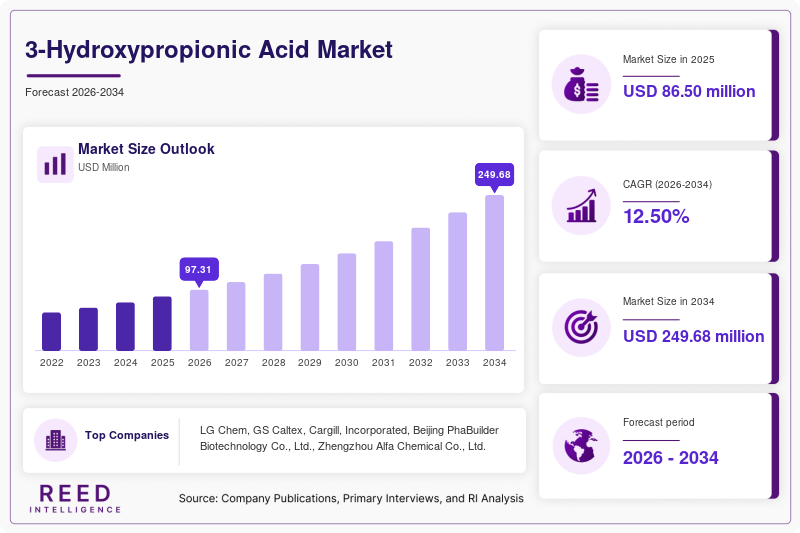
The global 3-Hydroxypropionic Acid Market size was valued at USD 86.50 million in 2025 and is projected to grow from USD 97.31 million in 2026 to USD 249.68 million by 2034, registering a CAGR of 12.50% during the forecast period from 2026 to 2034.
The market is supported by growing demand for renewable chemical intermediates and the development of bio-based production pathways. Acrylic acid production represents the largest application because 3-HP can be converted into acrylic acid, which is widely used in superabsorbent polymers, coatings, adhesives, paints, and other chemical products.
Petroleum-Based 3-HP accounted for approximately 62% of the Source segment in 2025. However, Bio-Based 3-HP is expected to grow faster at approximately 16.8% CAGR as manufacturers and research institutions improve fermentation technologies and renewable feedstock utilization.
Liquid 3-HP represented approximately 73% of the Form segment in 2025, while Powder accounted for approximately 27%. Acrylic Acid Production led the Application segment with approximately 46% share, followed by 1,3-Propanediol at 21%, Biodegradable Plastics at 19%, and Other Chemical Derivatives at 14%.
3-Hydroxypropionic Acid Market Trends
Transition Toward Bio-Based 3-HP Production
The 3-HP industry is increasingly moving toward biological production using engineered microorganisms and renewable or waste-derived feedstocks. Traditional chemical routes are closely linked to fossil-based raw materials, while fermentation can provide a pathway toward lower-fossil-content production.
Recent research has examined glucose, glycerol, molasses, acetic acid, and other alternative substrates. A 2025 ACS study demonstrated a microbial route using acetic acid, which can potentially be obtained from biomass, organic waste, and C1-gas sources.
Research is also focused on improving microbial tolerance and fermentation performance. Low-pH fermentation, pathway engineering, improved substrate utilization, and higher product concentrations can reduce processing requirements and improve the economics of biological 3-HP production.
Growing Integration With Downstream Chemical Production
A key trend is the integration of 3-HP fermentation with established chemical value chains. Rather than developing 3-HP as a standalone commodity, producers can convert it into higher-volume downstream products such as acrylic acid.
LG Chem's development of 100% bio-based acrylic acid provides an important example of this approach. The company uses microbial fermentation to produce 3-HP and then converts it into acrylic acid for applications including cosmetics, diapers, adhesives, coatings, and paints.
This integration can make commercialization more practical because downstream customers can continue using familiar chemical products while reducing dependence on fossil-derived feedstocks.
3-Hydroxypropionic Acid Market Drivers
Bio-Based Acrylic Acid Is Creating a Downstream Demand Pathway
Acrylic acid is one of the most commercially important downstream products from 3-HP. It is used in superabsorbent polymers, coatings, adhesives, paints, and other materials, creating a much larger potential demand base than direct consumption of 3-HP itself.
LG Chem's February 2025 announcement provides a direct commercial example. The company's 100% plant-based acrylic acid is produced from 3-HP generated through microbial fermentation and is targeted at cosmetics, diaper materials, adhesives, coatings, and paints.
This creates a clear market mechanism in which improvements in 3-HP production can feed into established acrylic-acid value chains. Downstream customers can potentially use bio-based acrylic acid without major changes to existing applications.
The opportunity is particularly relevant for manufacturers seeking renewable-content materials while maintaining conventional acrylic-acid functionality.
Fermentation Technology Is Improving Production Economics
Biological production is moving beyond basic sugar fermentation toward engineered microorganisms and alternative feedstocks. Recent research has investigated acid-tolerant microbial platforms, dual-substrate fermentation, glycerol-molasses fermentation, and acetic-acid-based production.
These advances are commercially important because fermentation yield, product tolerance, oxygen requirements, substrate consumption, and downstream recovery directly influence the cost of producing 3-HP.
The use of glycerol, molasses, acetic acid, and other lower-cost substrates can also reduce dependence on refined sugars. This provides opportunities to connect 3-HP production with agricultural processing, biodiesel production, biomass conversion, and waste-management systems.
Demand for Biodegradable and Renewable Polymer Intermediates Is Broadening Applications
3-HP can be incorporated into biodegradable plastics and other bio-based materials. LG Chem identifies 3-HP as an important raw material for its PLH compostable-material platform and describes potential applications including films, disposable cups, and protective packaging materials.
The Pacific Northwest National Laboratory also identifies 3-HP as a precursor for biodegradable polymers and polymer intermediates. This expands the market beyond acrylic acid and creates opportunities in materials where renewable feedstock content and biodegradability are important.
However, bio-based materials must still compete with established petrochemical products on price, performance, processing compatibility, and supply reliability.
3-Hydroxypropionic Acid Market Restraints
High Production and Recovery Costs
The principal constraint is achieving commercially competitive production at high yield, concentration, and productivity. Biological 3-HP production can be affected by product toxicity, microbial tolerance, cofactor requirements, pathway losses, and substrate inhibition.
Downstream purification is another important cost factor because fermentation broth contains water, cells, residual substrate, and other metabolites that must be separated from 3-HP.
Recent techno-economic research identifies fermentation yield and recovery as major variables affecting minimum selling price and environmental performance. Until these parameters become sufficiently stable at industrial scale, bio-based 3-HP can face a cost disadvantage compared with mature fossil-derived chemical routes.
Limited Commercial-Scale Production Infrastructure
3-HP has historically remained closer to the development and demonstration stage than mature commodity chemicals. Large-scale commercial production infrastructure remains comparatively limited.
LG Chem previously identified mass production as a commercialization challenge and worked with GS Caltex to combine fermentation technology with separation and purification scale-up.
Although LG Chem has subsequently advanced to bio-acrylic-acid prototype production, the limited number of large-scale producers can create qualification, supply-security, and pricing concerns for downstream customers.
This issue is especially important for chemical manufacturers that require consistent feedstock specifications, stable supply, and large production volumes.
3-Hydroxypropionic Acid Market Opportunities
Bio-Based Acrylic Acid and Superabsorbent Polymers
The strongest downstream opportunity is the conversion of bio-based 3-HP into acrylic acid. Acrylic acid is an established chemical intermediate used in superabsorbent polymers, hygiene products, coatings, adhesives, and other applications.
LG Chem's 2025 prototype production demonstrates that 3-HP can provide a direct bridge between microbial fermentation and conventional acrylic-acid applications.
The commercial opportunity therefore comes from supplying renewable feedstock into an existing downstream ecosystem instead of creating an entirely new market for 3-HP.
Growing demand for lower-fossil-content materials could support further adoption of bio-based acrylic acid if producers can achieve competitive cost and reliable supply.
Waste-Derived Feedstocks
Waste glycerol, molasses, acetic acid, and other low-value feedstocks could improve the economics of biological 3-HP production.
Research on glycerol-molasses fermentation has examined the simultaneous economic and environmental benefits of converting low-value waste streams into 3-HP. Similarly, acetic-acid-based production provides a potential route using feedstocks derived from biomass, organic waste, and C1-gas sources.
This creates an opportunity for integrated biorefineries to reduce feedstock costs while producing higher-value chemical intermediates.
Integration with biodiesel plants, agricultural-processing facilities, and waste-conversion systems could also provide more stable feedstock availability.
Challenges in 3-Hydroxypropionic Acid Market
Scaling Biological Production While Maintaining Cost and Product Quality
The major challenge is moving biological 3-HP production from research and demonstration systems to consistent industrial-scale manufacturing.
Microorganisms must maintain high productivity while tolerating increasing 3-HP concentrations. Product toxicity, substrate inhibition, metabolic losses, oxygen requirements, and pH control can reduce fermentation performance.
Downstream recovery presents an additional challenge because separating and purifying 3-HP from fermentation broth can require significant energy, equipment, and processing steps.
Producers therefore need to improve strain performance, fermentation concentration, feedstock flexibility, recovery efficiency, and process integration at the same time. Commercialization will depend on whether these improvements can bring bio-based 3-HP closer to the economics of established petrochemical routes.
Top Players in 3-Hydroxypropionic Acid Market
- LG Chem
- GS Caltex
- Cargill, Incorporated
- Beijing PhaBuilder Biotechnology Co., Ltd.
- Zhengzhou Alfa Chemical Co., Ltd.
- Fluoropharm Co., Ltd.
- Tokyo Chemical Industry Co., Ltd.
- Thermo Fisher Scientific
- PNNL / Agile BioFoundry
- Qingdao Institute of Bioenergy and Bioprocess Technology
3-Hydroxypropionic Acid Market Segments
By Source
- Petroleum-Based
- Bio-Based
By Form
- Liquid
- Powder
By Application
- Acrylic Acid Production
- 1,3-Propanediol
- Biodegradable Plastics
- Other Chemical Derivatives
By End Use
- Chemicals & Petrochemicals
- Plastics & Polymers
- Coatings & Adhesives
- Personal Care & Cosmetics
- Other End Uses
By Region
- North America
- Europe
- APAC
- Middle East and Africa
- LATAM
Conclusion
The global 3-Hydroxypropionic Acid Market is projected to grow from USD 97.31 million in 2026 to USD 249.68 million by 2034, registering a CAGR of 12.50%. Market expansion is being supported by increasing demand for renewable chemical intermediates, development of bio-based acrylic acid, advances in microbial fermentation, use of waste-derived feedstocks, and growing interest in biodegradable and renewable-content materials.
Petroleum-Based 3-HP currently leads the Source segment with approximately 62% share, while Bio-Based 3-HP is projected to grow fastest at approximately 16.8% CAGR. Liquid 3-HP accounts for approximately 73% of the Form segment, while Powder is projected to grow at approximately 13.7% CAGR. Acrylic Acid Production leads the Application segment with approximately 46% share, while Biodegradable Plastics are projected to grow fastest at approximately 15.2% CAGR. Chemicals & Petrochemicals account for approximately 39% of the End Use segment, while Plastics & Polymers are projected to grow at approximately 15.0% CAGR. North America currently holds approximately 31% of the global market, while APAC is the fastest-growing region with a projected CAGR of approximately 15.0%.
Report Link:

 English
 Arabic
 French
 Spanish
 Portuguese
 Deutsch
 Turkish
 Dutch
Dutch
 Italiano
 Russian
 Romaian
 Greek
Greek