


3D Motion Capture Market Size, Share, Demand & Growth Report 2026–2034
3D Motion Capture Market Overview
The global 3D Motion Capture Market covers technologies used to record, analyze, and reproduce three-dimensional human and object movement. The market includes hardware, software, and services across optical, inertial, electromagnetic, and markerless systems. These technologies are used in media and entertainment, sports, healthcare, industrial and robotics, defense and aerospace, and education and research.
3D motion capture is moving from a specialist production technology toward a broader movement-data platform. Vicon identifies applications across films, games, live events, sports performance, clinical gait analysis, engineering, military training, ergonomics, and robotics. This expansion is increasing the number of industries that use motion data for visualization, analysis, simulation, and digital content creation.
The technology landscape is also shifting toward combined workflows rather than a replacement of one capture method by another. Optical systems continue to provide high tracking accuracy for professional applications, while inertial systems offer wearable flexibility. Markerless systems are reducing setup requirements by using cameras and artificial intelligence to estimate skeletal movement without physical markers.
AI-based computer vision is lowering the operational barrier to motion capture. Move AI's Genesis uses multiple cameras and deep-learning models to reconstruct human movement in 3D, while Qualisys has expanded into markerless biomechanics through Prisma Pose. Vicon has also demonstrated hybrid workflows that combine markerless body tracking with optical tracking for physical objects and complex interactions.
The market is therefore developing around a combination of precision, portability, automation, and software intelligence. Increasing integration with real-time engines, virtual production platforms, sports analytics systems, healthcare applications, and robotics is creating additional demand for motion capture technologies.
Request Sample Link:
3D Motion Capture Market Size
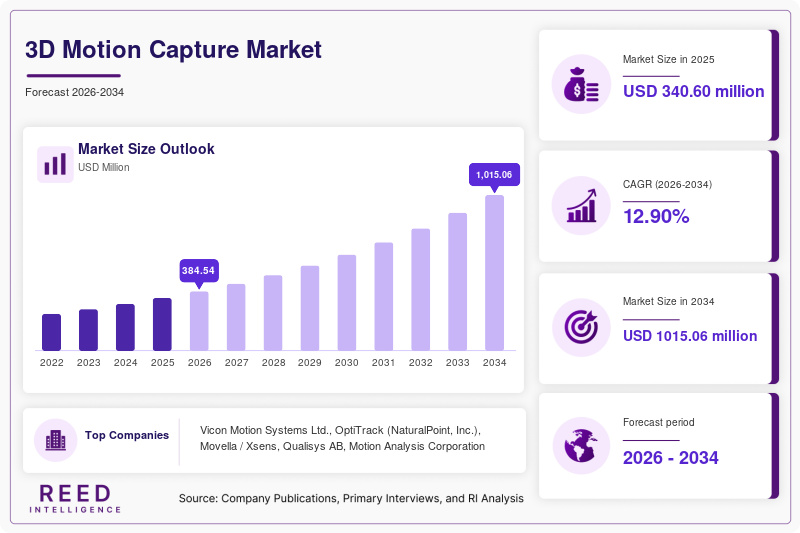
The global 3D Motion Capture Market size was valued at USD 340.60 million in 2025 and is projected to grow from USD 387.20 million in 2026 to USD 1,015.06 million by 2034, registering a CAGR of 12.90% during the forecast period from 2026 to 2034.
Market growth is being supported by increasing use of motion capture in film and television, video games, virtual production, sports performance, healthcare, robotics, and research. The technology is increasingly being integrated into real-time production workflows, allowing users to capture, process, and visualize movement during content creation or analysis.
Hardware represented approximately 44% of the Component segment in 2025, while Software accounted for approximately 34%. Software is expected to be the fastest-growing component, with a CAGR of approximately 15.1%, supported by AI-based processing, markerless tracking, skeletal solving, retargeting, and motion-data management.
Optical systems represented approximately 49% of the System Type segment in 2025, followed by Inertial at 27%, Markerless at 19%, and Electromagnetic at 5%. Markerless systems are projected to grow fastest at approximately 19.2% CAGR as organizations seek faster setup, lower operational requirements, and more flexible capture workflows.
North America accounted for approximately 37% of the global market in 2025, making it the leading regional market. APAC is projected to be the fastest-growing region at approximately 16.1% CAGR through 2034.
3D Motion Capture Market Trends
AI-Powered Markerless Motion Capture Is Expanding
Artificial intelligence and computer vision are changing how motion data is collected. Traditional optical motion capture often requires calibration, markers, specialized operators, and dedicated capture spaces. Markerless systems can reduce several of these requirements by estimating human skeletal movement directly from video.
Move AI's Genesis uses multiple cameras and deep-learning models to reconstruct human motion in 3D. Vicon and Qualisys are also incorporating markerless technologies into established motion-capture and biomechanics workflows.
The growing availability of AI-based capture can make motion capture more accessible to smaller studios, sports organizations, research institutions, and other users that may not require a traditional high-end optical installation.
Real-Time Virtual Production and Game Development Are Increasing Demand
Motion capture is becoming more closely connected with real-time engines and virtual production rather than being limited to post-production animation. Vicon's workflows include real-time retargeting and Unreal Engine integration for virtual production, game development, and cinematics.
Epic Games' Unreal Engine 5.8, released in June 2026, also expanded MetaHuman capabilities, including full-body performance capture and large-scale digital-human workflows.
These developments increase the value of motion data because creators can review and adjust performances while digital scenes are being developed. The integration of capture hardware, processing software, and game-engine platforms is therefore becoming an important part of modern production workflows.
3D Motion Capture Market Drivers
Markerless Capture Is Reducing the Operational Cost of Motion Capture
Traditional optical motion capture can require cameras, calibration, markers, specialized operators, and performer preparation. Markerless systems remove several of these steps by extracting skeletal movement from video.
Vicon's markerless technology is designed for game studios, film productions, and television creatives. Its 2026 demonstrations also showed performers entering a capture volume and beginning recording without suits or markers.
Move AI similarly positions markerless technology around lower setup requirements, faster shooting, and scalable capture volumes. The commercial mechanism is reduced setup friction, allowing studios and organizations to capture more iterations without treating motion capture as a highly specialized production stage.
This can be particularly relevant to smaller production teams and organizations that previously found conventional motion capture systems difficult to justify.
Real-Time Virtual Production and Game Development Are Increasing Capture Requirements
Motion capture is increasingly integrated into real-time production environments. Vicon's 2026 GDC activities highlighted real-time retargeting and Unreal Engine integration for virtual production, game development, and cinematics.
The increasing use of digital humans, virtual characters, immersive experiences, and real-time animation creates additional requirements for accurate and responsive movement data.
As game engines become more central to content production, motion-capture systems can become part of the broader digital production pipeline rather than standalone equipment.
Motion Capture Is Expanding Into Sports, Healthcare, and Robotics
The addressable customer base is expanding beyond entertainment. Motion capture is increasingly being used for athlete assessment, clinical gait analysis, rehabilitation, biomechanics, robotics, and engineering research.
In July 2026, Carnegie Mellon University selected OptiTrack as a motion-capture technology partner for its Robotics Innovation Center, deploying 92 cameras across indoor and outdoor research facilities.
Qualisys also launched OnTraq for elite sports and Prisma Pose for biomechanics laboratories in 2026. These applications create demand for different system characteristics, with sports customers focusing on repeatable movement analysis, healthcare users requiring biomechanical accuracy, and robotics researchers requiring precise movement data.
This diversification reduces reliance on film and game production cycles and creates demand across multiple industries.
3D Motion Capture Market Restraints
High Hardware and Infrastructure Requirements
Professional optical motion capture remains capital-intensive because high-quality cameras, tracking systems, calibration infrastructure, computing equipment, and dedicated capture spaces can be required.
OptiTrack's Prime X 260 system, for example, targets large-volume environments with high-resolution sensors and long tracking ranges. While these capabilities support precision and larger capture volumes, they can increase the investment required from customers.
Smaller studios, universities, and organizations may therefore choose inertial or markerless alternatives even when optical systems provide higher tracking performance.
The market consequently remains divided between premium high-precision installations and more accessible systems designed to reduce infrastructure requirements.
Accuracy and Data-Quality Trade-Offs
Markerless capture improves convenience but does not eliminate technical limitations. Physical props can remain difficult for generalized markerless systems because their shapes, surfaces, and movements vary substantially.
Optical markers can therefore retain advantages for rigid objects and complex interactions. Markerless systems can also depend on camera positioning, lighting, occlusion handling, and AI reconstruction quality.
Customers working on high-value productions, clinical applications, or research projects may continue to use optical or hybrid systems where data reliability is more important than setup speed.
3D Motion Capture Market Opportunities
AI-Powered Markerless Motion Capture
AI-powered markerless capture represents a major expansion opportunity because it can reduce the physical infrastructure required to generate usable movement data.
Move AI's Genesis is designed as an enterprise markerless system capable of local processing, while Vicon and Qualisys are integrating markerless capture into established optical and biomechanics workflows.
The opportunity is not limited to replacing optical cameras. Hybrid systems can combine markerless human tracking with optical tracking for props, equipment, and difficult objects. This allows customers to use different technologies for different parts of a production or research workflow.
As computer vision models improve, markerless systems can become more practical for smaller studios, sports facilities, healthcare institutions, and research environments.
Sports, Healthcare, and Biomechanics
Sports and healthcare provide additional growth opportunities because motion capture can convert physical movement into measurable biomechanical data.
Qualisys launched OnTraq for elite sports assessment and Prisma Pose for biomechanics laboratories in 2026. These applications create demand for software, analytics, and data-management services in addition to capture hardware.
The commercial model can therefore move beyond one-time equipment purchases toward integrated hardware, software, analytics, and ongoing motion-data services.
Healthcare applications such as gait analysis, rehabilitation assessment, and movement evaluation can further expand the use of motion capture outside traditional entertainment markets.
Challenges in 3D Motion Capture Market
Complex Data Processing and Maintaining Consistent Accuracy
A major challenge for the 3D Motion Capture Market is maintaining accurate and consistent movement data across different environments, performers, objects, and applications.
Optical systems require careful calibration and camera positioning, while markerless systems depend on camera views, lighting, occlusion handling, and AI-based reconstruction. Inertial systems can provide greater mobility but may face issues related to sensor drift and calibration.
The challenge becomes more complex when motion capture is used for high-value film productions, clinical analysis, sports assessment, or robotics research. These applications can require highly reliable data and repeatable measurements.
Manufacturers therefore need to improve tracking algorithms, sensor fusion, calibration, data processing, and software integration while keeping systems easy to operate. The ability to combine optical, inertial, and markerless technologies can help address different accuracy and flexibility requirements.
Top Players in 3D Motion Capture Market
- Vicon Motion Systems Ltd.
- OptiTrack (NaturalPoint, Inc.)
- Movella / Xsens
- Qualisys AB
- Motion Analysis Corporation
- Move AI
- Rokoko
- Noitom
- Noraxon USA
- PhaseSpace
- Codamotion
- BTS Bioengineering
- Northern Digital Inc. (NDI)
3D Motion Capture Market Segments
By Component
- Hardware
- Software
- Services
By System Type
- Optical
- Inertial
- Electromagnetic
- Markerless
By Application
- Media & Entertainment
- Sports & Performance Analytics
- Healthcare & Rehabilitation
- Industrial & Robotics
- Defense & Aerospace
- Education & Research
By End User
- Film & Television Studios
- Game Developers
- Sports Organizations
- Healthcare Institutions
- Industrial Enterprises
- Research Institutions
By Region
- North America
- Europe
- APAC
- Middle East and Africa
- LATAM
Conclusion
The global 3D Motion Capture Market is projected to grow from USD 387.20 million in 2026 to USD 1,015.06 million by 2034, registering a CAGR of 12.90%. Market expansion is being supported by AI-powered markerless capture, real-time virtual production, game development, sports performance analytics, healthcare and rehabilitation, robotics research, and increasing integration with digital production platforms.
Hardware currently leads the Component segment with approximately 44% share, while Software is projected to grow fastest at approximately 15.1% CAGR. Optical systems account for approximately 49% of the System Type segment, while Markerless systems are projected to grow fastest at approximately 19.2% CAGR. Media & Entertainment leads the Application segment with approximately 42% share, while Healthcare & Rehabilitation is projected to grow at approximately 16.8% CAGR. Film & Television Studios represent approximately 31% of the End User segment, while Sports Organizations are projected to grow fastest at approximately 15.8% CAGR. North America currently holds approximately 37% of the global market, while APAC is the fastest-growing region with a projected CAGR of approximately 16.1%.
Report Link:

 English
 Arabic
 French
 Spanish
 Portuguese
 Deutsch
 Turkish
 Dutch
Dutch
 Italiano
 Russian
 Romaian
 Greek
Greek