


Can a Torch Down Membrane Handle Henderson's Heat on a Patio Cover or Balcony?
A patio cover in Henderson has a harder job than most people realize. From June through September, the surface is baked by relentless sun. Then a monsoon storm can drop a season's worth of drama in twenty minutes, and winter nights bring a temperature drop that makes materials expand and contract again and again. A balcony faces the same stress, with one added problem: there is usually living space or a garage directly beneath it.
Torch down roofing is one of the few low-slope systems built with this kind of punishment in mind. It is not right for every structure, though, and it takes careful installation on small residential projects. This article explains how the system works, where it fits, and what to check before a crew lights a torch near your home.
What Torch Down Actually Is, and Why Flat Surfaces Need It
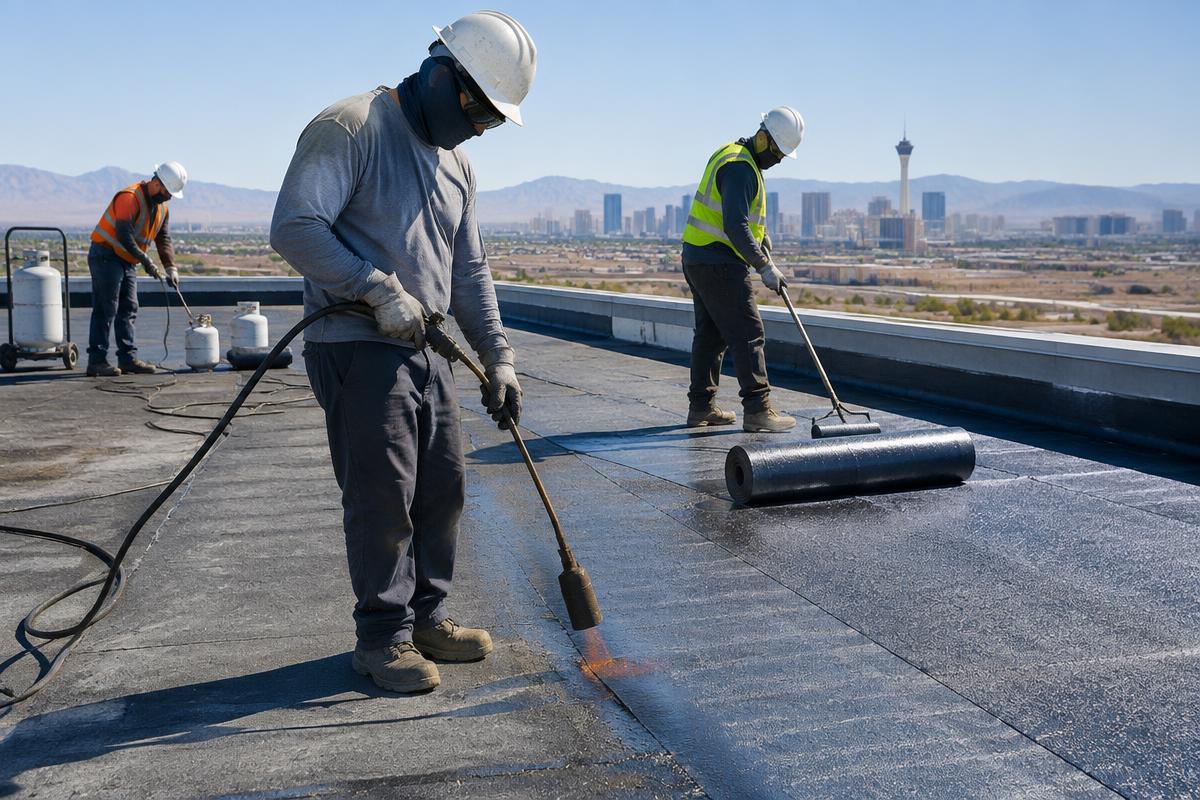
Torch down is a modified bitumen membrane. Asphalt is blended with polymers (usually APP, or atactic polypropylene) and reinforced with a polyester or fiberglass mat. The rolls are heated on the underside with a propane torch, which softens the asphalt so it fuses to the surface below. Once it cools, the sheet becomes a continuous, bonded layer rather than a covering held on by fasteners alone.
That matters on a patio cover or balcony because these surfaces are nearly flat. Shingles and tiles depend on a steep pitch to shed water quickly. A low-slope deck can hold water for hours, so it needs a membrane that stays watertight even when puddles form.
Layers That Do the Work
A typical torch down assembly has two membrane layers over a prepared deck:
- Base sheet. Fastened or adhered to the deck, it creates a stable foundation.
- Cap sheet. Torched over the base, it carries a mineral granule surface that shields the asphalt from ultraviolet radiation.
Around the edges, the details matter as much as the field of the roof. Flashing at the house wall, metal drip edges, and sealed penetrations for posts or railings are where leaks usually begin. A membrane can be flawless in the middle and still fail at a poorly finished corner.
The Desert Factors That Shape a Henderson Installation
The Mojave climate affects almost every decision on a project like this.
Heat and Ultraviolet Exposure
Sun is the main enemy of any roofing material in Southern Nevada. Granulated cap sheets help because the mineral surface blocks much of the UV that would otherwise dry out the asphalt. Many property owners also add a reflective coating, which lowers surface temperature and reduces thermal stress. That can be especially useful over a balcony that sits above a bedroom or office, since heat transfers downward.
Monsoon Rain and Drainage
Henderson doesn't get much rain, but when it comes, it arrives hard. A balcony or patio cover needs a clear path for water to leave the surface: a slight slope toward an edge, a scupper, or a drain. A membrane laid over a deck with low spots will collect water in the same places every storm. Good installers check the slope first and correct the deck if needed, because a roof cannot be waterproof if water has nowhere to go.
Expansion and Movement
Large daily temperature swings make wood framing, metal flashing, and membrane layers move at slightly different rates. Torch down's reinforced mat gives it flexibility, but only if the seams are fully fused and the edges are properly terminated.
Is Your Structure Actually Suited to Torch Application?
This is the question that separates a thoughtful project from a risky one. Because the method uses an open flame, fire safety comes first.
Many patio covers and balconies are built from wood, and some are attached directly to the house through the wall framing. Heat near wood, stucco gaps, or insulation requires careful technique, protective shielding, and a fire watch after the work is done. Some contractors choose a different method on smaller or more combustible-heavy structures, such as a self-adhered or cold-applied modified bitumen system. Those use the same material family without an open flame.
A reputable contractor should be willing to explain why one method suits your structure better than the other. If the answer is vague, that is a reason to keep asking.
Homeowners in master-planned neighborhoods should also confirm HOA requirements before choosing a color or finish, and should check with the City of Henderson about whether the work needs a permit. Requirements vary with the scope of the project.
Choosing Who Does the Work
Torch down punishes sloppy craftsmanship. Overheated membrane can scorch the asphalt, and underheated membrane won't bond fully. Either mistake can look fine on the day of installation and show up as a leak months later.
For homeowners comparing providers, working with a team that offers residential torch-down roofing for patio covers and balconies in Henderson can make the process more straightforward, particularly when the project involves small rooftop areas, tight access, and detail work around posts and house walls. Whoever you hire, ask how they handle fire safety, how they prepare the deck, and how they finish the flashing. A confident answer on those three points tells you more than a brochure.
Questions Worth Asking Before You Sign
- What method will be used on this particular structure, and why?
- How will the existing deck be inspected for rot or soft spots?
- What drainage solution is planned?
- How will the membrane be terminated at the house wall and at the edges?
- Is a warranty offered, and what does it actually cover?
Get the answers in writing, and make sure the written scope matches what was discussed.
What Happens on Installation Day
Knowing the sequence helps you spot a rushed job.
First comes preparation. The crew clears debris, removes the old covering if necessary, and inspects the deck. Damaged sheathing should be repaired or replaced, since a membrane is only as sound as what's underneath it. On a balcony, the framing and any visible signs of past water intrusion deserve special attention.
Next, the base sheet goes down and the detail work begins: flashing at walls, corners, and penetrations. Then the cap sheet is torched into place, with seams overlapped and checked as the roll advances. A properly fused seam shows a thin bead of asphalt at its edge. Finally, the crew cleans the area and, if specified, applies a reflective coating.
Looking After the Surface Afterward
Torch down is durable, but it is not maintenance-free. A few habits help it last:
- Keep scuppers, drains, and gutters clear of leaves, dust, and debris.
- Walk on the surface as little as possible, and never drag furniture across it.
- Inspect the membrane after major storms, paying attention to seams and edges.
- Trim back branches that scrape the surface or drop debris.
- Re-coat reflective surfaces as recommended by the installer.
Small repairs caught early are inexpensive compared with replacing a saturated deck.
Warning Signs That Something Is Wrong
Even a well-installed membrane deserves an occasional look. Bubbling or blistering, lifted seams, exposed fabric where granules have worn away, cracks near flashing, and stains on the ceiling or wall below a balcony all point to trouble. Standing water that remains for more than a day or two suggests a slope problem. None of these signs gets better with time, and desert sun accelerates the damage once the surface is breached.
Final Thoughts
Torch down roofing can be an excellent match for Henderson patio covers and balconies. It forms a seamless, UV-resistant layer that copes with extreme heat, sudden storms, and constant thermal movement. The system's success depends less on the material itself than on the decisions around it: the condition of the deck, the drainage plan, the fire safety approach, and the quality of the flashing details.
Ask direct questions, confirm local requirements, and treat the small surfaces above your living space with the same seriousness as a full roof. A well-installed membrane will quietly do its work for years, and that is exactly what a good patio cover or balcony roof should do.
For additional information, visit: Rank Business Listings

 English
 Arabic
 French
 Spanish
 Portuguese
 Deutsch
 Turkish
 Dutch
Dutch
 Italiano
 Romaian
 Portuguese (Brazil)
 Greek
Greek