


How Should You Compare Tissot vs Seiko Watch Quality
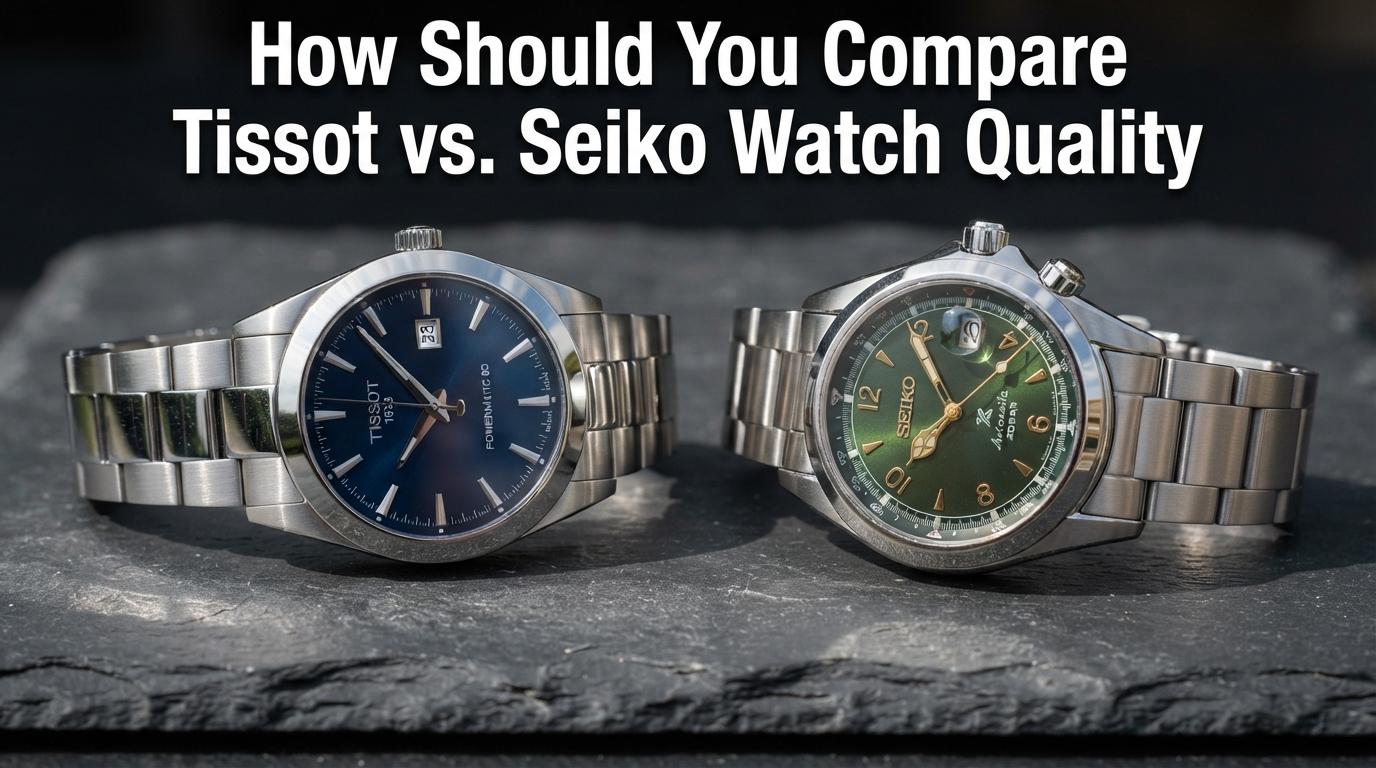
Picking a mid-range watch sounds simple until you are actually at the decision. Few debates in the watch community hold up as long or get as heated as this one. When you sit down to evaluate Tissot vs. Seiko, you are not comparing two products on a shelf; you are choosing between two countries, two engineering cultures, and two genuinely different ideas about what a watch should accomplish. Tissot has been making watches in Le Locle, Switzerland, since 1853. Seiko started in Tokyo in 1881. Both live in the 200–1,000 range, where most first serious-watch purchases happen, which makes this comparison worth working through rather than just picking whichever case looks better in photos.
Movement Technology in Tissot vs. Seiko: Where the Gap Actually Shows
The movement is basically what the watch does when nobody is watching, and yeah, here is where these two brands sort of push each other, in opposite ways, like, constantly. Tissot leans on its automatics using the Powermatic 80, a caliber that’s ETA based, with an 80-hour power reserve, plus a silicon hairspring that handles magnetic interference better than more usual alloys. And that 80-hour thing… it isn't just some shiny number either. In this price tier, most other options give you about half of that, or something close. Seiko, meanwhile, has a bigger movement menu. The 4R and 6R lines are dependable mechanical workhorses, the kind that show up across a ton of their models. Then you get Spring Drive, which is a bit more unusual, because it’s patented and mixes a mechanical mainspring with an electromagnetic brake, so it lasts around one second per day, more or less, without needing a battery at all. Seiko also came up with solar + kinetic quartz tech a while back, where light or wrist motion turns into electricity, and that means you’re not doing battery swaps all the time. A Tissot like-for-like option at similar pricing… basically doesn’t exist. So if movement variety and actual innovation matter, Seiko wins in depth. If you care more about longer power reserve plus tighter rated automatic accuracy right out the gate, then Tissot holds the advantage.
Build Quality and Materials: Closer Than Most People Expect
This is where people’s assumptions usually get a little messy. Tissot uses 316L stainless steel across much of the line and sapphire crystal on most collections, and you’ll see water resistance up to 200 meters on the sports models. The PRX also feels built past what the price implies. The bracelet fits together clean, the finishing looks polished, and the watch gives off that “more expensive than it should be” vibe, even after you look at the receipt. Seiko is less uniform; across its lineup you get more variation. Some entry watches use Hardlex crystal, which is a kind of proprietary mineral glass that’s tougher than normal but still not quite sapphire. Move up, and Sapphire starts appearing more often. On the Presage range, you notice brushed and polished surfaces that feel genuinely intentional, not just cost-saving. And then, up top, Grand Seiko comes in with Zaratsu hand polishing that creates flat mirror-like reflections, and a lot of collectors argue it can rival, or even outdo, Swiss finishing at prices that are equal or higher. Bottom line… Tissot tends to be more consistent overall. Seiko goes higher at the top but also trims more corners down at the lower end.
Design Philosophy and Who Each Brand Is Actually For
Tissot leans into versatility, the kind you can wear without thinking too hard. Dials look tidy, proportions stay pretty reasonable, and most models move easily between work life and weekend time without looking out of place. “Swiss Made” still has that recognizable weight for gifting and resale, especially if the buyer isn't deep in watch culture. Seiko doesn’t commit to just one design language, which is either its biggest strength or its most confusing trait, depending on how you shop. The SKX diver is basically pure tool-watch energy. The Presage Cocktail Hour collection uses lacquer dials inspired by Japanese bar tradition. Grand Seiko references snowfield and mountain textures from Japan’s Shinshu region. If you want one consistent look and something that’s easier to browse, Tissot is the simpler path. If you want real variety and you don't mind digging, Seiko’s catalog has no close Swiss equivalent at these kinds of prices.
Value Proposition: What Your Money Buys at Each Price Point
Under $300, Seiko usually takes the win on specs, most of the time. You get solid automatic movements, strong enough builds, and a lot of availability, so it becomes the default first pick for a mechanical watch in that budget. Tissot costs more at similar spec levels, but the brand recognition is stronger in Western markets, which matters in practical ways for gifting and resale, even if nobody can really “price” that feeling cleanly. The Le Locle also placed first at the 2011 International Timing Competition, scoring 764 out of 1,000 for accuracy, which basically supports that Tissot QC is real, not just implied by the label. Seiko, meanwhile, launched 155 new models in just the first half of 2022, so buyers get this huge range of entry points across nearly every budget tier. Above $1,000, Grand Seiko steps into a finishing category Tissot doesn’t really try to chase directly, with surface work that pushes back against Swiss brands charging noticeably more.
Making the Final Call
Neither brand totally wins across every category, and anyone saying "oh, it’s obvious” is probably pitching something. Pick Tissot if you care about a longer power reserve, dependable sapphire crystal protection, Swiss heritage recognition, and a design that fits formal settings without looking like it is forcing the moment. Pick Seiko if you want more movement innovation, stronger value under $300, a bigger design catalog overall, and a kind of depth that actually rewards you if you like sticking with a brand and watching what it does over time. This Tissot vs. Seiko comparison doesn’t really hand you one perfect answer; it just sharpens the picture of what matters to you. Either way you end up with a solid watch on your wrist, and neither route is, technically, the wrong choice.

 English
 Arabic
 Spanish
 Portuguese
 Deutsch
 Turkish
 Dutch
Dutch
 Italiano
 Russian
 Romaian
 Portuguese (Brazil)
 Greek
Greek