


What Is the Average Lifespan of a Boiler?
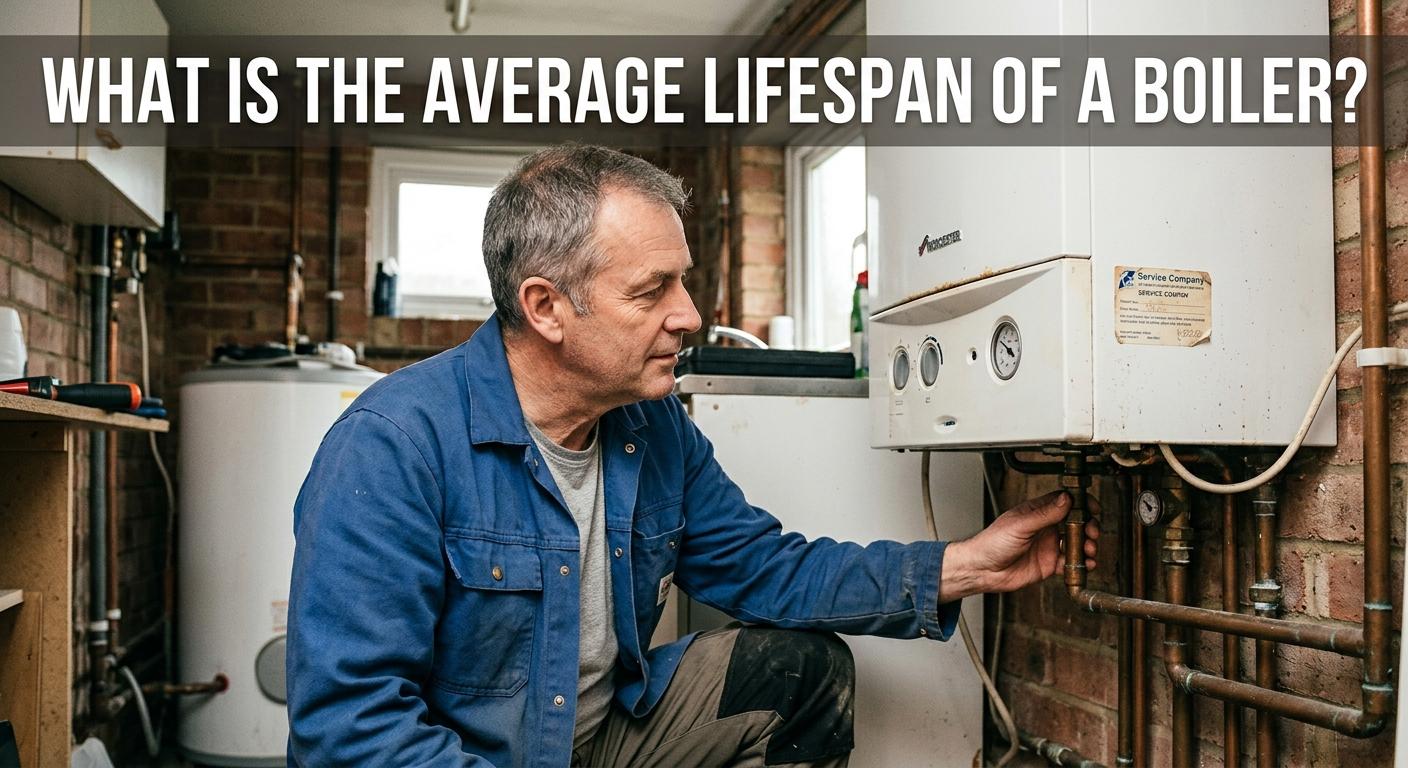
A typical boiler lasts around 10 to 15 years, although some can continue working beyond this point with proper servicing and timely repairs. Reaching 15 years does not mean the boiler will suddenly stop working, but older systems are more likely to need repairs and may become less economical to keep.
The way a boiler has been used matters too. A unit that has been serviced regularly and operates under sensible heating conditions can age differently from one that has dealt with repeated faults or poor maintenance.
What Affects How Long A Boiler Lasts?
Two boilers of the same age can be in very different condition.
Regular servicing gives an engineer the opportunity to identify developing faults before they turn into expensive breakdowns. Water quality, heating demand, installation quality and how often the system runs can also influence its working life.
The repair history provides another useful clue. If an older boiler has needed several major repairs recently, its remaining useful life may be more difficult to justify financially.
When Is A Boiler Considered Old?
Once a boiler reaches around 10 to 15 years, it is sensible to start thinking about replacement rather than waiting for a complete failure.
That does not mean every older boiler needs immediate removal. A well-maintained system can continue operating beyond the usual lifespan. The important point is to assess its current performance instead of relying on age alone.
For example, a 12-year-old boiler with minimal repair needs may be a better proposition than a 9-year-old appliance that repeatedly breaks down.
Can Government Help With Replacing An Old Boiler?
A government free boiler scheme is not a general entitlement based simply on having an old boiler. Government support varies according to the programme and its eligibility conditions.
The current Boiler Upgrade Scheme is different from a standard boiler replacement grant. It provides funding for eligible low-carbon heating installations, including air-to-water and ground-source heat pumps. The standard grant for these systems is currently £7,500, while eligible off-gas-grid properties can receive £9,000 for certain installations.
The scheme applies in England and Wales and requires the existing fossil-fuel heating system to be replaced by an eligible technology.
Does Being Over 60 Affect Boiler Replacement Support?
Age can be relevant to some assistance programmes, but there is no universal rule that gives everyone over 60 a free boiler.
That is why searches for a boiler replacement scheme over 60s should be treated carefully. Eligibility can depend on the particular programme, household circumstances and the type of heating system being installed.
Before making plans around a grant, check the current criteria for the scheme you are considering rather than relying on age alone.
Should You Replace A Boiler At The End Of Its Lifespan?
Not always immediately.
A boiler that remains safe, dependable and reasonably economical may have useful life left. However, once repairs become frequent or parts become difficult to source, continuing to maintain it can become less practical.
If replacement is approaching, compare the likely cost of keeping the existing system with the available alternatives. That gives you time to choose a suitable heating system instead of making the decision during an unexpected winter breakdown.
In simple terms, 10 to 15 years is a useful working benchmark, not an expiry date. The boiler's condition, maintenance record, repair costs and the needs of your home should determine what happens next.

 Arabic
 French
 Spanish
 Portuguese
 Deutsch
 Turkish
 Dutch
Dutch
 Italiano
 Russian
 Romaian
 Portuguese (Brazil)
 Greek
Greek