


Brewer’s Yeast Market to Grow 6.0% Annually Through 2036
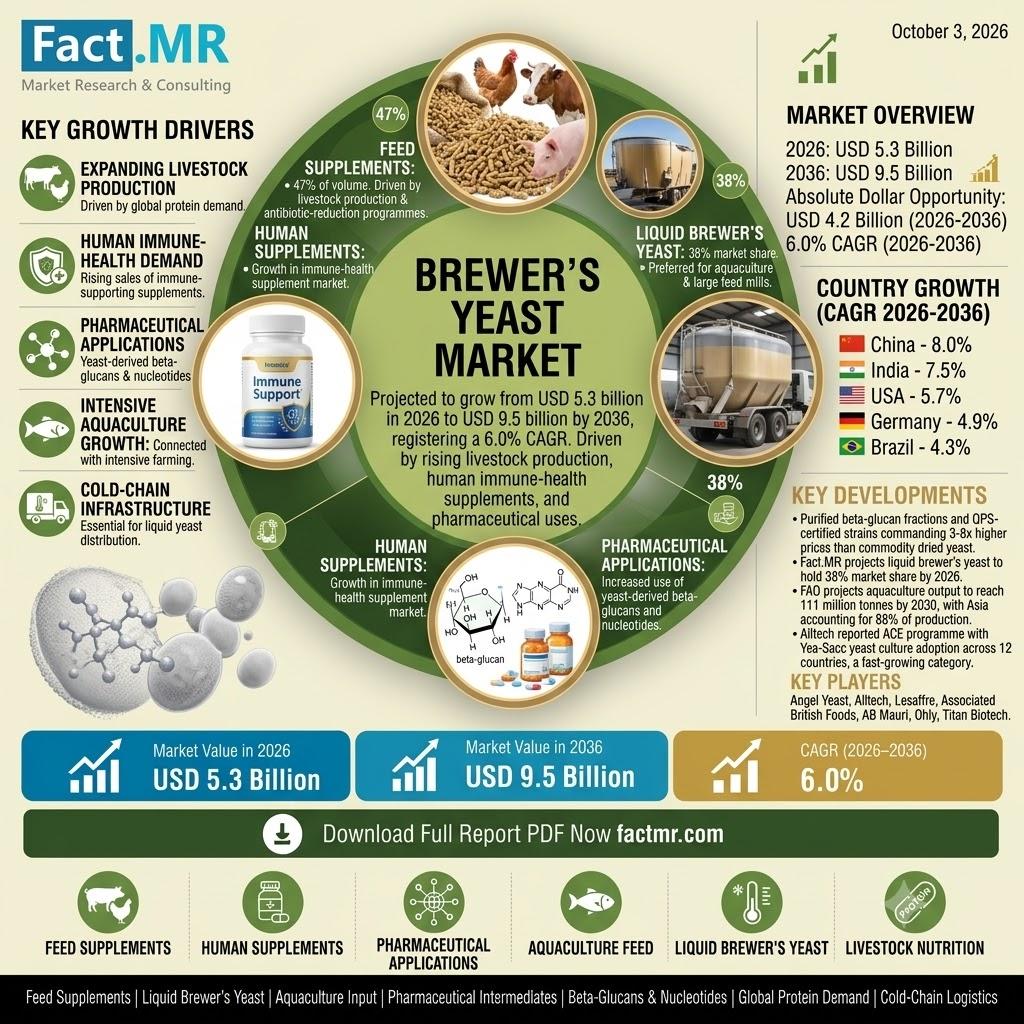
Fact.MR forecasts the brewer’s yeast market to grow from USD 5.3 billion in 2026 to USD 9.5 billion by 2036 at a 6.0% CAGR.
ROCKVILLE, MD — October 3, 2026 — The Brewer’s Yeast Market is projected to reach USD 9.5 billion by 2036, rising from USD 5.3 billion in 2026 at a 6.0% CAGR, according to Fact.MR analysis. The market surpassed USD 5.1 billion in 2025 and is expected to create an absolute dollar opportunity of USD 4.2 billion between 2026 and 2036.
The answer to why demand is rising is closely tied to livestock nutrition, human immune-health supplements, and pharmaceutical applications. Fact.MR identifies expanding livestock production, growing demand for immune-supporting supplements, and increased use of yeast-derived beta-glucans and nucleotides in pharmaceutical applications as structural demand factors.
Get detailed market forecasts, competitive benchmarking, and pricing trends: https://www.factmr.com/connectus/sample?flag=S&rep_id=14411
Brewer’s Yeast Market Shifts Toward Functional Applications
The Brewer’s Yeast Market covers Saccharomyces cerevisiae and closely related strains recovered from beer brewing or intentionally cultivated for nutritional and pharmaceutical uses. Products are supplied in liquid slurry and dried powder formats for feed supplements, food supplements, pharmaceutical intermediates, and related applications.
Fact block: Fact.MR is a market research company that provides global revenue forecasts, segment analysis, and industry intelligence across the brewer’s yeast market.
The market is moving beyond traditional feed applications. Purified beta-glucan fractions and QPS-certified strains are identified in the source as commanding prices 3 to 8 times higher than commodity dried yeast, creating a distinction between bulk products and higher-value functional ingredients.
Liquid brewer’s yeast represents an important part of this shift. Fact.MR projects the liquid form to hold 38% market share in 2026, with large feed mills and aquaculture operators preferring the format because it preserves live cells and integrates directly into wet mixing systems.
“Guided by nature-inspired innovation, ... all while prioritizing the health, welfare, and optimal nutrition of animals,” said Eric Ao, General Manager of Angel Yeast Europe.
Feed Supplements Account for 47% of Market Volume
Feed supplements are projected to account for 47% of total market volume in 2026, according to Fact.MR. Demand is connected with livestock production and the adoption of yeast-based inputs as antibiotic-reduction programmes expand across major markets.
The source identifies the EU, United States, and China as important markets for yeast-based feed applications. In 2024, Alltech reported adoption of its ACE programme using Yea-Sacc yeast culture across 12 countries, with yeast culture cited as its fastest-growing revenue category.
Aquaculture is another important demand channel. The Food and Agriculture Organization of the United Nations projects aquaculture output to reach 111 million tonnes by 2030, with Asia accounting for more than 88% of production. Fact.MR links the expansion of intensive farming with increased adoption of yeast-based feed inputs.
The human supplement segment also provides a defined opportunity. The immune-health supplement market reached USD 22.6 billion in 2024, growing at 7.1%, while yeast-derived beta-glucan was identified among the faster-growing ingredients by new product launches.
China and India Record Strong Country Growth
China is projected to record an 8.0% CAGR from 2026 to 2036, the highest among the countries covered in the supplied analysis. Demand is concentrated in aquaculture-intensive provinces including Guangdong, Fujian, and Shandong.
India follows with a projected 7.5% CAGR through 2036. Fact.MR links this growth with the country's integrated poultry sector and increasing demand for consistent, certified yeast nutrition inputs.
The United States is projected to grow at 5.7% CAGR, while Germany and Brazil are forecast to record 4.9% and 4.3%, respectively. These markets reflect different demand structures, including pharmaceutical applications, livestock nutrition, and protein exports.
Market Supply Faces Logistics and Feedstock Constraints
The market also faces operational constraints. Handling live liquid yeast requires temperature-controlled logistics, while feedstock availability is connected with the seasonal and capacity-driven nature of the brewing industry.
Cold-chain infrastructure is therefore becoming relevant to liquid yeast distribution. The source notes that liquid yeast shipments maintained at 2–8°C are increasing across Asia Pacific and Latin America.
Shambhu Nath Jha, Principal Consultant at FACT.MR, said, “CXOs will find this report essential for mapping where brewer’s yeast is moving beyond commodity feed ingredient status into defensible high-margin nutrition and pharmaceutical positions.”
Fact.MR's analysis covers 2026 to 2036 and segments the market by form, application, geography, and country. The research combines primary interviews with feed nutritionists, procurement managers, pharmaceutical API buyers, and supplement brand managers with desk research using FAO statistics, WHO data, company reports, investor presentations, regulatory filings, and tender data.
About Fact.MR
Fact.MR is a market research and consulting firm providing industry intelligence, market sizing, forecasts, and strategic analysis across global markets. Its brewer’s yeast market study covers regional demand, competitive positioning, pricing dynamics, trade flows, capacity utilisation, product segmentation, and regulatory developments.

 English
 Arabic
 French
 Spanish
 Portuguese
 Deutsch
 Turkish
 Dutch
Dutch
 Italiano
 Russian
 Portuguese (Brazil)
 Greek
Greek