


Smart Locks Market Growth Gains Pace Across Residential and Commercial Buildings
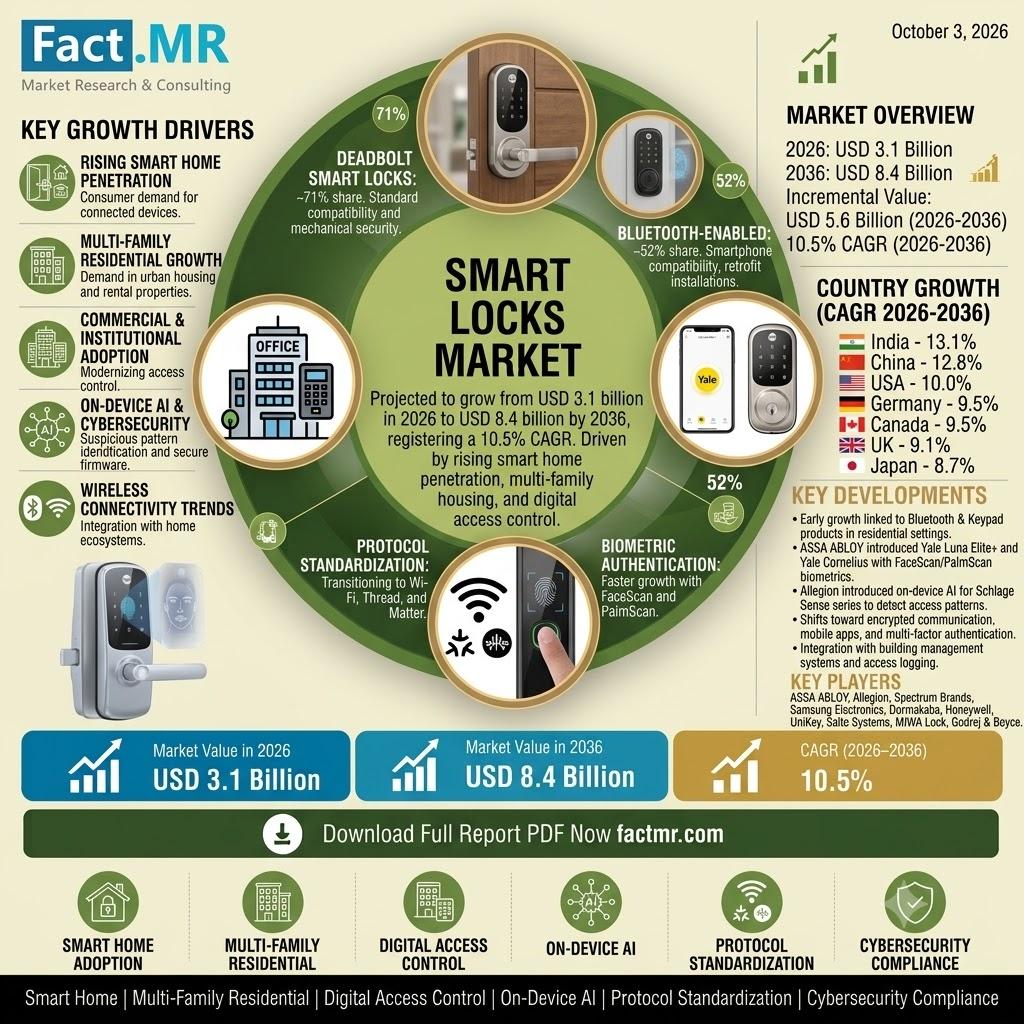
The Smart Locks Market is projected to grow from USD 3.1 billion in 2026 to USD 8.4 billion by 2036 at a 10.5% CAGR, according to Fact.MR.
October 3, 2026 — The Smart Locks Market is projected to reach USD 8.4 billion by 2036, rising from USD 3.1 billion in 2026 at a 10.5% CAGR, according to Fact.MR analysis. The market was valued at USD 2.8 billion in 2025. Rising smart home penetration, multi-family residential construction, and digital access control adoption across commercial and institutional buildings are supporting demand through the forecast period.
The market is expected to add approximately USD 5.6 billion in incremental value between 2026 and 2036. Early growth is linked to Bluetooth and keypad-based products in residential settings, particularly urban housing and rental properties. Later expansion is associated with Wi-Fi, biometric authentication, and protocol standardization involving Thread and Matter.
Get detailed market forecasts, competitive benchmarking, and pricing trends: https://www.factmr.com/connectus/sample?flag=S&rep_id=14347
Smart Locks Market Growth Tracks Connected Access Adoption
Why now? Fact.MR identifies smart home penetration, multi-family housing growth, and digital access control as key factors supporting market expansion. Smart locks provide keyless access through technologies including Bluetooth, Wi-Fi, keypad entry, and biometric authentication.
Smart Locks Market fact block: Fact.MR is a market research provider that analyzes smart locking demand, segmentation, regional growth, technology adoption, and competitive developments across more than 40 countries.
The market covers electronically controlled locking devices used across residential, commercial, institutional, and hospitality properties. The report examines lock types, authentication methods, communication protocols, end-use applications, regional demand, pricing benchmarks, and international trade flows.
Fact.MR estimates that Bluetooth-enabled smart locks account for about 52% of global market share. Lower power consumption, smartphone compatibility, and offline operation support their use in retrofit installations, rental properties, residential buildings, and small commercial premises.
Deadbolt smart locks represent another major segment, holding approximately 71% share. Fact.MR attributes this position to compatibility with standard door preparations and the combination of mechanical security with electronic access control.
India Records the Fastest Country Growth in the Forecast
India is projected to record a 13.1% CAGR from 2026 to 2036, according to Fact.MR. Rapid urban housing development and increasing adoption of app-enabled residential security systems are supporting demand.
China follows with a 12.8% CAGR, supported by urban apartment construction and consumer adoption of connected home devices. The United States is projected to grow at 10.0% CAGR, while Germany and Canada are each expected to expand at 9.5% CAGR.
The United Kingdom records a projected 9.1% CAGR, and Japan is expected to grow at 8.7% CAGR. These differences reflect varying levels of smart home penetration, retrofit activity, technology evaluation cycles, and construction patterns across national markets.
Cybersecurity and Protocol Standards Shape Product Development
Connected access devices increasingly intersect with cybersecurity and electronic compliance requirements. Fact.MR cites guidance from the National Institute of Standards and Technology (NIST) as relevant to secure communication, device authentication, and IoT security practices.
The report also references the U.S. Consumer Product Safety Commission in relation to consumer product safety and electronic compliance.
Manufacturers are therefore assessing secure firmware architecture alongside multi-protocol compatibility. Integration with building management systems and access logging platforms is also becoming relevant to the lifecycle value of installations.
Shambhu Nath Jha, Principal Consultant at Fact.MR, said: “CXOs will find this report useful for evaluating how protocol standardization, biometric authentication reliability, and cybersecurity compliance are shaping procurement frameworks and platform integration strategies in the smart locks market.”
The report also identifies a shift toward products combining wireless connectivity, biometric authentication, remote management, and traditional locking mechanisms. Higher-value solutions can incorporate encrypted communication, mobile applications, and multi-factor authentication.
Jha noted: “Protocol standardization, biometric authentication reliability, and cybersecurity compliance are shaping procurement frameworks and platform integration strategies.”
The second statement is a shortened extract from Jha’s supplied statement rather than a separately sourced interview quote.
Industry Developments Add New Capabilities
Recent product developments are also changing the competitive environment. In January 2026, ASSA ABLOY introduced the Yale Luna Elite+ and Yale Cornelius following its late-2024 acquisition of Level Lock. The models integrate FaceScan and PalmScan biometrics and support Matter and Aliro protocols, according to the report.
In the same month, Allegion introduced on-device AI for the Schlage Sense series to identify suspicious access patterns without relying on cloud processing. Allegion also launched Pin & Tumbler™ Studio, focused on aesthetic-led smart lock hardware.
Fact.MR profiles companies including ASSA ABLOY AB, Allegion plc, Spectrum Brands Holdings, Samsung Electronics Co., Ltd., Dormakaba Holding AG, Honeywell International Inc., UniKey Technologies Inc., Salto Systems S.L., MIWA Lock Co., and Godrej & Boyce Manufacturing Co., Ltd.
The report evaluates competitive positioning through security performance, connectivity integration, encryption capabilities, firmware security, interoperability, and regulatory compliance.
For the complete market assessment, see Smart Locks Market report. The report includes forecasts from 2026 to 2036, segment analysis, regional revenue estimates, competitive assessment, and technology trends.
For cybersecurity context, readers can also consult National Institute of Standards and Technology cybersecurity guidance.
About Fact.MR
Fact.MR is a market research and consulting firm providing market intelligence, forecasts, and industry analysis across global markets. Its Smart Locks Market study uses a hybrid top-down and bottom-up approach, supported by primary interviews with manufacturers, security integrators, and property developers. The analysis is cross-checked against construction statistics, retail adoption data, trade information, and regulatory compliance records.

 English
 Arabic
 French
 Spanish
 Portuguese
 Turkish
 Dutch
Dutch
 Italiano
 Russian
 Romaian
 Portuguese (Brazil)
 Greek
Greek