


Gum Hydrocolloid Market to Add USD 9.7 Billion by 2036
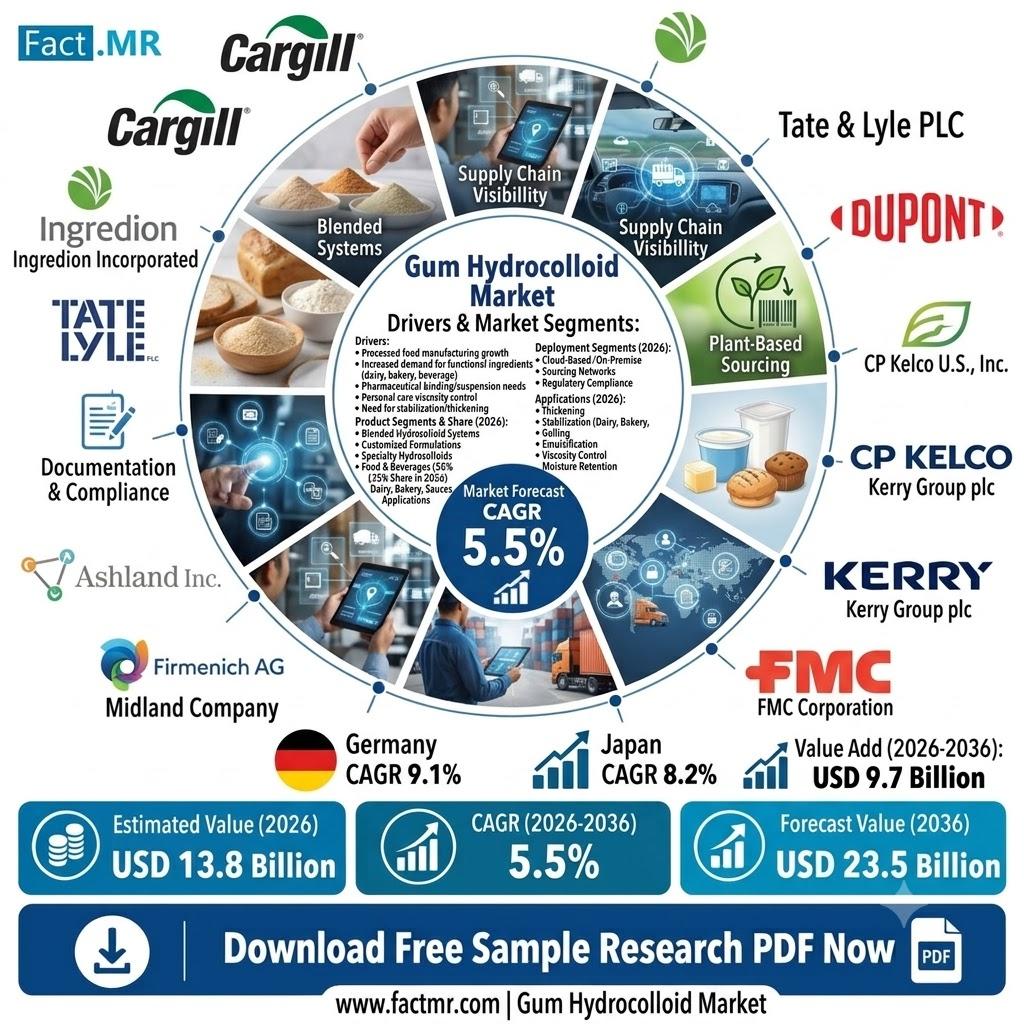
The Gum Hydrocolloid Market is projected to grow from USD 13.8 billion in 2026 to USD 23.5 billion by 2036 at a 5.5% CAGR, according to Fact.MR.
ROCKVILLE, MD — October 5, 2026 — The Gum Hydrocolloid Market is projected to reach USD 23.5 billion by 2036, rising from an estimated USD 13.8 billion in 2026 at a 5.5% CAGR, according to Fact.MR analysis. The market was valued at USD 13.1 billion in 2025. Demand is being supported by food processing, pharmaceutical formulations, and personal care applications where hydrocolloids are used for thickening, stabilization, gelling, emulsification, viscosity control, and moisture retention.
The market is expected to add USD 9.7 billion between 2026 and 2036. Food and beverages are expected to account for 55% of market share in 2026, while plant-based sources are projected to hold 35%. The figures indicate where current demand is concentrated and why formulation performance remains central to purchasing decisions.
Get detailed market forecasts, competitive benchmarking, and pricing trends: https://www.factmr.com/connectus/sample?flag=S&rep_id=14549
Fact.MR is a market research company that provides industry analysis, forecasting, and strategic market intelligence based on primary research, desk research, and proprietary forecasting models. The Gum Hydrocolloid Market report combines interviews with hydrocolloid producers, food ingredient formulators, application scientists, and supply chain specialists with industry publications, trade statistics, and chemical industry association reports.
Food and Beverage Applications Lead Demand
Food and beverages are expected to capture 55% of the Gum Hydrocolloid Market in 2026. Hydrocolloids are used in dairy products, beverages, sauces, bakery products, and processed foods to control texture, viscosity, moisture retention, and stability.
The market's expansion is closely linked to processed food manufacturing. Fact.MR identifies increasing demand for functional ingredients in dairy, bakery, and beverage formulations as a key demand driver. Pharmaceutical manufacturers also use hydrocolloids as binding and suspension agents, while personal care formulations require viscosity control and stabilization systems.
The shift toward customized formulations is also changing supplier priorities. Traditional commodity gums face price pressure linked to agricultural feedstock volatility, including variability affecting guar and locust bean gum. Food manufacturers are increasingly using blended hydrocolloid systems to achieve specific texture profiles and formulation performance.
This shift creates opportunities for suppliers with application-specific formulation capabilities. Fact.MR identifies customized hydrocolloid blends, stronger agricultural sourcing networks, application laboratories, specialty hydrocolloids, and regulatory compliance as strategic areas for market participants.
Germany Records Fastest Country Growth
Germany is projected to record the highest CAGR among the countries assessed, at 9.1% from 2026 to 2036. Japan follows at 8.2%, while Australia is projected to grow at 7.8%. India records a 6.3% CAGR, followed by the United States at 4.7% and China at 3.4%.
Germany's demand is supported by food ingredient manufacturing, pharmaceutical applications, and specialty chemical production. Japan's market is supported by food formulation research and specialty ingredient production. In India, growth is linked to processed food production, dairy demand, pharmaceutical manufacturing, and expanding ingredient supply networks.
In the United States, Fact.MR identifies food processing, pharmaceuticals, and personal care manufacturing as important demand areas. Cargill, Incorporated, Ingredion Incorporated, and Archer Daniels Midland Company are among the companies identified in the regional analysis.
Competition Centers on Functionality and Supply
The Gum Hydrocolloid Market is moderately concentrated. Major suppliers include Cargill, Incorporated, Ingredion Incorporated, Tate & Lyle PLC, DuPont de Nemours, Inc., CP Kelco U.S., Inc., Kerry Group plc, FMC Corporation, DSM Firmenich AG, Archer Daniels Midland Company, and Ashland Inc.
Large food and beverage manufacturers remain primary buyers. These buyers commonly qualify multiple suppliers and negotiate long-term agreements linked to performance specifications and price stability. Supplier competition therefore extends beyond price to viscosity performance, formulation compatibility, technical application support, and supply continuity.
Analyst Perspective
Shambhu Nath Jha, Principal Consultant, Fact MR, said, “In this updated edition of the Gum Hydrocolloid Market report, industry participants will observe that value creation is shifting from commodity hydrocolloid ingredients toward customized stabilizer systems used in modern food and pharmaceutical formulations.”
Jha added that manufacturers increasingly require precise viscosity control, moisture retention, and texture consistency, while suppliers investing in application expertise, agricultural supply chains, and specialty ingredient development are positioned to strengthen their market position.
About Fact.MR
Fact.MR is a market research and consulting company providing market intelligence, forecasts, and industry analysis across global markets. The Gum Hydrocolloid Market study covers product types, source categories, applications, regional markets, competitive structures, and a forecast period from 2026 to 2036. The study uses a hybrid top-down and bottom-up approach validated through primary research, production data, trade flows, and industry performance indicators.

 English
 Arabic
 French
 Spanish
 Portuguese
 Deutsch
 Turkish
 Dutch
Dutch
 Italiano
 Russian
 Romaian
 Portuguese (Brazil)