


Medical Device Packaging Market Gains From Expanding Class II Device Manufacturing Requirements
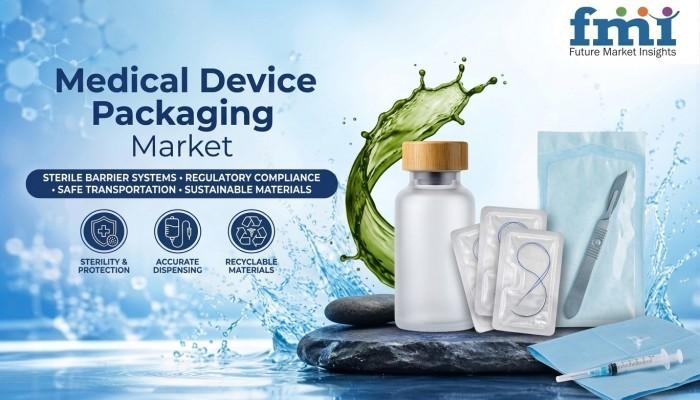
The global Medical Device Packaging Market is projected to reach USD 68.4 billion by 2036, rising from USD 45.2 billion in 2026 at a 4.2% CAGR, according to Future Market Insights (FMI). The market was valued at USD 43.2 billion in 2025.
The shift is being driven by a change in how medical device manufacturers evaluate packaging. Packaging is increasingly treated as part of the product release process rather than a basic protective layer. Sterile barrier validation, seal integrity, sterilization compatibility, aging studies, and documentation are becoming central to supplier qualification.
For packaging converters, this creates opportunities beyond material supply. Suppliers able to support cleanroom production, validated sealing processes, sterilization compatibility, and technical documentation can address a wider share of device manufacturers' requirements.
Get detailed market forecasts, competitive benchmarking, and pricing trends:
https://www.futuremarketinsights.com/reports/sample/rep-gb-5679
Medical Device Packaging Demand Is Increasing With Single-Use Devices
The expansion of single-use surgical devices and diagnostic kits is creating additional demand for individual protective packaging. Pouches, trays, films, and other device-specific formats must maintain product integrity and, where required, sterility through storage, transportation, and clinical opening.
Bags and pouches are projected to account for 21.5% of packaging format demand in 2026, making them the leading format in the supplied market outlook. Flexible structures remain useful across different device sizes and can reduce material weight compared with some rigid alternatives.
Plastic is expected to lead the material segment with a 42.7% share in 2026. Medical-grade polyethylene, polypropylene, and polyester structures support applications where sealing control, puncture resistance, and production efficiency are important.
Sterilization Controls Are Changing Packaging Decisions
Ethylene oxide remains important for devices that cannot tolerate high heat or radiation. However, tighter emissions requirements are increasing the technical burden associated with ethylene oxide-compatible packaging.
The United States Environmental Protection Agency stated in March 2024 that commercial ethylene oxide sterilizers must reduce emissions by more than 90%. The rule affects nearly 90 commercial sterilization facilities operated by about 50 companies.
For packaging suppliers, sterilization route selection therefore needs to be considered earlier during pack development. Porosity, gas penetration, microbial barrier performance, and cycle efficiency can all affect whether a packaging structure is suitable.
ISO 11607-2:2019 also places emphasis on validation of forming, sealing, and assembly processes for sterile barrier systems. This supports demand for suppliers that can provide repeatable process records and evidence covering seal integrity and aging performance.
Class II and Sterile Packaging Represent Major Demand Pools
Class II devices are estimated to account for 52.0% of device-class demand in 2026. These moderate-risk products create substantial packaging volumes because many require validated protective packaging without the lower-volume profile associated with highly complex devices.
Sterile packaging is projected to account for 58.0% of application demand in 2026. Instruments, implants, catheters, and other products requiring protected release continue to depend on packaging systems that preserve sterility until point of use.
The opportunity is also expanding around recyclable sterile barriers. Medical packaging suppliers are exploring mono-material structures where plastic reduction can be achieved without compromising seal performance or sterile barrier requirements.
China and India Lead Country Growth
China is projected to record the fastest country growth at 6.2% CAGR through 2036, supported by domestic medical device manufacturing and evolving standards. India follows with a 6.0% CAGR, supported by expanding medical device production programs.
Brazil is forecast to grow at 5.3% CAGR, while the United States is projected to advance at 4.1% CAGR. Germany, the United Kingdom, and Japan are expected to record CAGRs of 3.9%, 3.8%, and 3.5%, respectively.
China's manufacturing base is creating demand for pouches, thermoformed trays, compact diagnostic packaging, and compliant labeling systems. In India, medical device production incentives are creating additional requirements for validated sterile packaging and technical documentation.
Supplier Capability Is Becoming a Competitive Differentiator
FMI's competitive assessment identifies Amcor plc, DuPont de Nemours, Inc., Nelipak Corporation, Oliver Healthcare Packaging Company, Klöckner Pentaplast Group, PAXXUS, Wipak Group, Sterimed Group, Tekni-Plex, Inc., Huhtamaki Oyj, and UFlex Limited among the companies active across the market.
Competition is centered on sterile barrier expertise, cleanroom converting, medical-grade materials, and validation documentation. Amcor, DuPont, Nelipak, and Oliver Healthcare Packaging have established positions across different parts of the sterile barrier and medical packaging value chain.
FMI's analyst Nandini Roy Choudhury, Principal Consultant for Packaging, says:
“Medical device packaging is becoming a risk-control system. Device makers now ask whether a supplier can prove sterility/sealing discipline and change control before they ask for the lowest unit price. The practical opportunity sits with converters that combine cleanroom capacity, sterilization compatibility and documentation support. Suppliers that reduce audit friction for device manufacturers will gain repeat contracts in Class II and Class III products.”
Market Snapshot
- 2025 market value: USD 43.2 billion
- 2026 market value: USD 45.2 billion
- 2036 forecast: USD 68.4 billion
- 2026–2036 CAGR: 4.2%
- Incremental opportunity: USD 23.2 billion
- Leading material: Plastic, 42.7% share in 2026
- Leading format: Bags and pouches, 21.5% share in 2026
- Leading application: Sterile packaging, 58.0% share in 2026
- Leading device class: Class II, 52.0% share in 2026
- Leading sterilization route: Ethylene oxide, 50.0% share in 2026
- Fastest-growing country: China, 6.2% CAGR
- Second-fastest-growing country: India, 6.0% CAGR
About the Medical Device Packaging Market Report
The FMI study covers medical device packaging materials and formats used to protect devices during sterilization, storage, transportation, and clinical opening. The study examines plastic, Tyvek, aluminum, glass, paperboard, fabric, and silicone across Class I, Class II, and Class III devices.
Applications include sterile packaging, non-sterile packaging, implantable device packaging, and diagnostic and monitoring device packaging. Packaging formats include bags and pouches, films and wraps, lids, rollstock, containers, trays, stick packs, clamshells, blister packs, boxes, and flow wraps.
The report covers North America, Latin America, Western Europe, Eastern Europe, East Asia, South Asia and Pacific, and the Middle East & Africa, including the United States, China, India, Germany, Japan, the United Kingdom, Brazil, and 40+ countries.
Related Report Links:
https://www.openpr.com/news/4651493/fiber-based-jar-shipping-inserts-market-set-to-reach-usd-1-197-7
https://www.openpr.com/news/4651496/beauty-cosmetic-packaging-market-is-expected-to-reach-usd-57-9
https://www.openpr.com/news/4651499/fiber-based-closures-caps-market-is-anticipated-to-grow-usd
FMI Custom Research: Strategic Intelligence for Confident Decision-Making
In today’s rapidly evolving business environment, leadership teams need more than market data—they need clear, actionable intelligence tailored to their strategic objectives. FMI’s Custom Research solutions are designed around the specific business questions organizations need answered, enabling executives to evaluate growth opportunities, validate investments, assess competitive dynamics, and reduce uncertainty before making critical decisions. By combining deep industry expertise, primary research, and proprietary market intelligence, FMI delivers insights that help organizations move from assumptions to evidence-based strategies with greater speed and confidence.
Business Impact
FMI helps organizations transform market complexity into strategic clarity, enabling leadership teams to identify growth opportunities faster, optimize resource allocation, strengthen competitive positioning, and make high-stakes business decisions with confidence.
To explore how FMI Custom Research can support your strategic priorities, please connect with our team at – sales@futuremarketinsights.com
About Future Market Insights (FMI)
Future Market Insights, Inc. (FMI) is an ESOMAR-certified, ISO 9001:2015 market research and consulting organization, trusted by Fortune 500 clients and global enterprises. With operations in the U.S., UK, India, and Dubai, FMI provides data-backed insights and strategic intelligence across 30+ industries and 1200 markets worldwide.

 English
 Arabic
 French
 Spanish
 Portuguese
 Deutsch
 Dutch
Dutch
 Italiano
 Russian
 Romaian
 Portuguese (Brazil)
 Greek
Greek