


Building Robust Speech Datasets Through Professional Audio Annotation
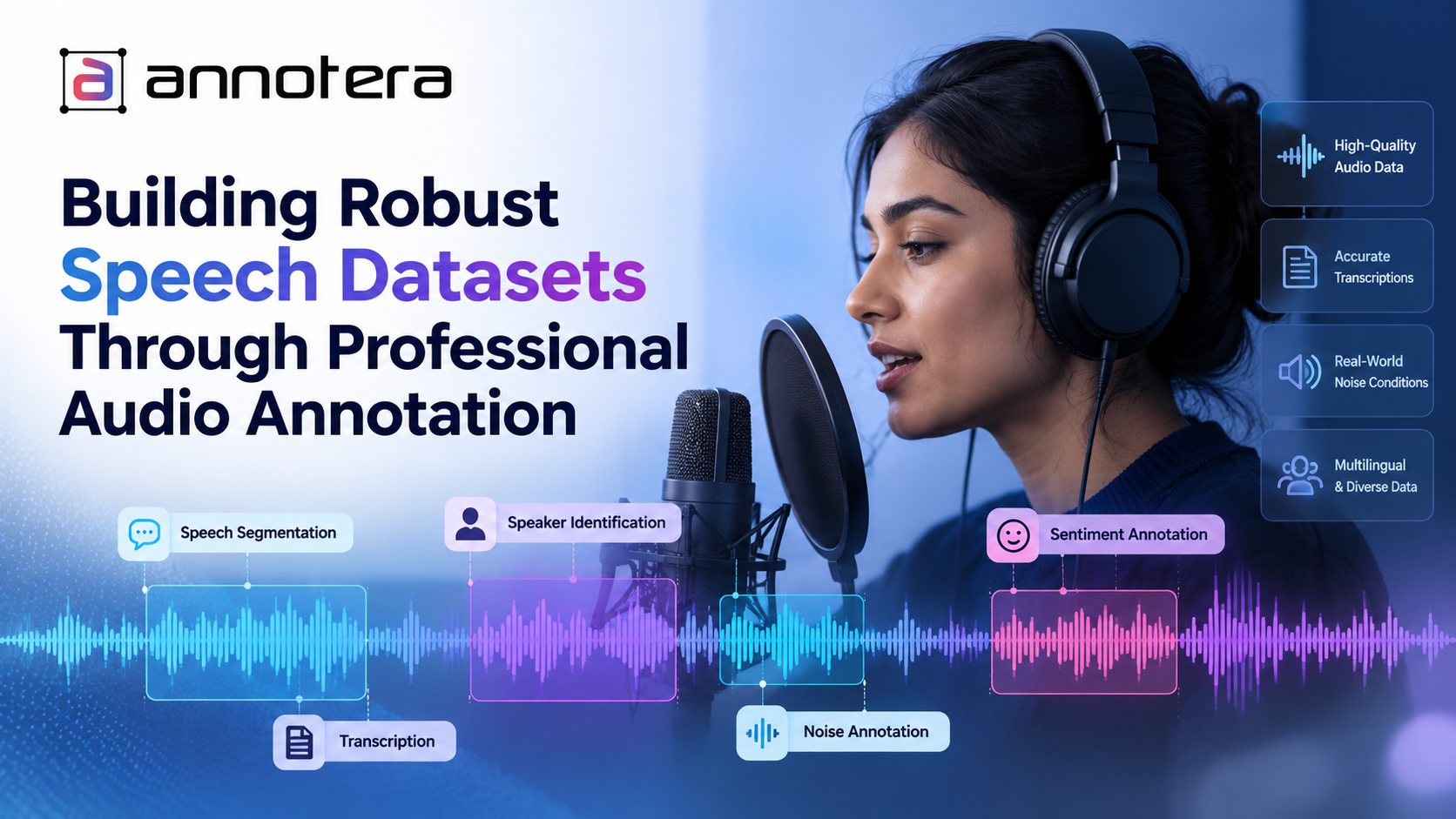
Speech AI is moving rapidly from controlled laboratory environments into real-world applications. Voice assistants, conversational AI, automated transcription, call analytics, accessibility tools, healthcare applications, and automotive systems all depend on one critical resource: high-quality speech data.
Yet collecting large volumes of audio is only the beginning. For a speech dataset to support reliable machine learning, raw recordings must be carefully structured, segmented, transcribed, classified, and enriched with meaningful metadata. This is where professional audio annotation becomes essential.
A well-annotated speech dataset helps AI models understand not only what is being said, but also who is speaking, when speech occurs, and what acoustic conditions surround it. For businesses developing speech technologies at scale, working with an experienced audio annotation company can provide the expertise and quality controls needed to transform raw recordings into training-ready datasets.
Why Speech Dataset Quality Matters
Speech data is inherently complex. People speak at different speeds, use regional accents, pause, overlap with other speakers, and express meaning through tone and emotion. Recordings may also contain traffic, music, machinery, household sounds, or conversations in the background.
Research on in-the-wild speech data has highlighted problems such as background noise, overlapping speech, incomplete transcriptions, missing speaker information, and inadequate segmentation. These issues can significantly limit the usefulness of otherwise valuable audio collections.
For AI developers, simply increasing dataset volume does not necessarily solve these problems. The dataset must represent the acoustic conditions and speech characteristics that the model will encounter after deployment.
Professional annotation provides the structure required to make that data useful.
What Does Professional Audio Annotation Involve?
Audio annotation converts unstructured recordings into machine-readable information. Depending on the project's objective, annotation teams may apply several layers of labeling.
1. Speech Segmentation
Annotators identify the precise portions of an audio recording containing speech. Start and end timestamps can help models distinguish spoken content from silence, music, or environmental sounds.
Accurate segmentation is particularly valuable for automatic speech recognition (ASR), voice activity detection, and speech-processing systems.
2. Transcription
Speech is converted into written text while following project-specific transcription guidelines. Depending on the application, annotations may capture words, punctuation, filler words, disfluencies, or other speech characteristics.
Domain-specific vocabulary also deserves attention. Medical terminology, financial language, product names, technical expressions, and industry-specific jargon can be difficult for generic speech models to recognize.
3. Speaker Identification and Diarization
In conversations involving multiple people, annotators can identify speaker changes and associate speech segments with individual speakers.
This is particularly important for:
-
Contact-center analytics
-
Meeting transcription
-
Interview datasets
-
Conversational AI
-
Multi-speaker ASR
-
Voice analytics
Speaker-aware datasets can help models distinguish between participants rather than treating an entire conversation as one continuous voice.
4. Background Noise Annotation
Real-world speech rarely occurs in perfect acoustic conditions. Annotation can identify background sounds such as traffic, machinery, music, appliances, alarms, animals, or other human speech.
Recent research on the VAANI Noise Event Timestamp Dataset demonstrates the value of timestamped noise labels layered onto spontaneous, real-world speech. Its annotations cover multiple categories of environmental noise and are designed to support tasks including noise-robust ASR and speech enhancement.
This type of labeling helps developers understand the conditions under which a speech model performs well—or struggles.
5. Emotion and Sentiment Annotation
For conversational AI, recognizing words alone may not be enough. Models may also need to understand whether a speaker sounds satisfied, frustrated, excited, concerned, neutral, or angry.
Emotion and sentiment labels can therefore support applications such as customer-service analytics, voice assistants, virtual agents, and human-computer interaction.
6. Language, Accent, and Pronunciation Labels
Speech datasets may also be enriched with language, dialect, accent, pronunciation, and phonetic information.
This becomes increasingly important as voice AI expands across multilingual and geographically diverse populations. A model trained primarily on one accent or speaking style may struggle when exposed to unfamiliar pronunciation patterns.
Why Background Conditions Should Not Be Ignored
One common mistake in speech dataset development is treating noise as something that should always be removed.
For many applications, realistic noise is actually valuable training information.
A voice assistant deployed in a kitchen, for example, may encounter appliance sounds. An automotive voice system may operate alongside road and engine noise. A customer-service model may encounter overlapping speakers and imperfect telephone audio.
IBM's speech technology guidance similarly emphasizes that training audio should reflect the acoustic conditions of the environment in which the system will ultimately operate.
Professional annotation can therefore help teams distinguish useful acoustic variation from unusable recordings.
How Professional Annotation Improves Dataset Robustness
A robust speech dataset should represent the diversity of real-world inputs rather than an artificially narrow recording environment.
Professional annotation contributes to this objective through:
Consistency: Standardized annotation guidelines help ensure that similar audio events receive similar labels.
Granularity: Precise timestamps and detailed labels provide models with more useful training signals.
Coverage: Annotators can classify different speakers, accents, languages, noise types, and conversational conditions.
Quality assurance: Multi-stage review, sampling, adjudication, and agreement checks can identify annotation inconsistencies.
Domain expertise: Specialized annotators can better handle terminology and contextual requirements in industries such as healthcare, finance, retail, automotive, and telecommunications.
Why Outsource Audio Annotation?
Building an internal annotation operation can become difficult when datasets grow rapidly. Organizations may need to recruit annotators, develop detailed guidelines, manage quality control, maintain annotation platforms, and coordinate multilingual or domain-specific teams.
Using audio annotation outsourcing services can provide a more scalable alternative.
An experienced provider can support the complete annotation workflow—from dataset preparation and segmentation to transcription, labeling, quality review, and delivery.
Outsourcing can also help AI teams focus their internal resources on model development while specialized annotation professionals manage the data-labeling workload.
Choosing the Right Audio Annotation Company
Not every annotation provider offers the same capabilities. When evaluating an audio annotation company, organizations should consider:
-
Experience with speech and conversational datasets
-
Multilingual and accent coverage
-
Speaker diarization capabilities
-
Noise and sound-event labeling
-
Transcription expertise
-
Domain-specific annotation
-
Multi-level quality assurance
-
Data security and confidentiality
-
Scalability for large datasets
-
Compatibility with required annotation formats
The right partner should be capable of adapting its annotation methodology to the model's intended application rather than applying a generic labeling process.
Build Better Speech AI With Annotera
High-performing speech AI starts with representative, structured, and accurately labeled data. Professional audio annotation transforms raw recordings into datasets that can support ASR, voice assistants, conversational AI, speech analytics, emotion recognition, and other intelligent voice applications.
At Annotera, we help organizations turn complex audio collections into high-quality, AI-ready datasets through scalable annotation workflows and rigorous quality processes. From transcription and speaker labeling to segmentation, noise classification, sentiment, and other specialized audio labels, our approach is designed around the requirements of each AI project.
As speech technology continues to evolve, dataset quality will remain a decisive factor in model performance. Investing in professional annotation today can help organizations build speech systems that are more accurate, adaptable, and reliable in the real world.
Looking to build a robust speech dataset? Partner with Annotera for professional audio annotation solutions tailored to your AI requirements.

 English
 French
 Spanish
 Portuguese
 Deutsch
 Turkish
 Dutch
Dutch
 Italiano
 Russian
 Romaian
 Portuguese (Brazil)
 Greek
Greek