


AMRs for Cold Chain Warehousing Market Growth, Analysis with Impact of COVID-19 top Companies, Trends, Future Opportunity Analysis By Fact.MR
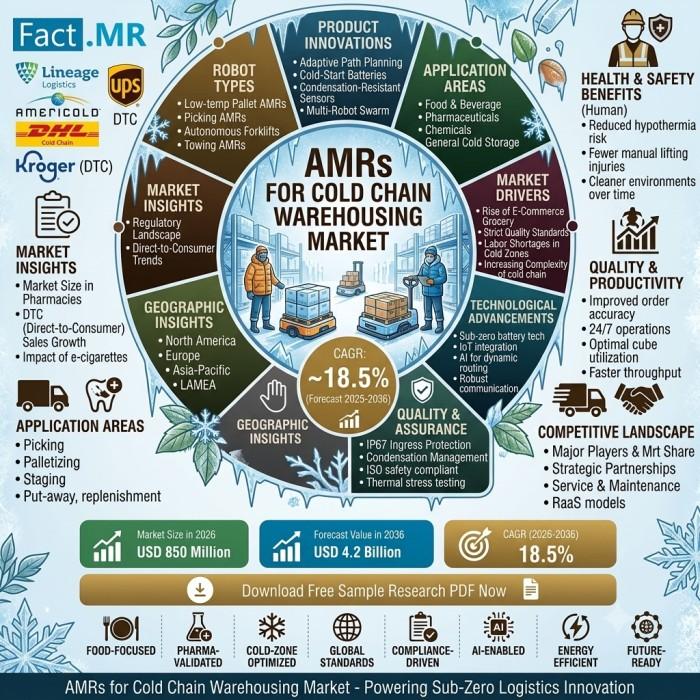
Rockville, Maryland — October 5, 2026 : The AMRs for cold chain warehousing market is entering a high-growth phase, with global sales valued at USD 585.7 million in 2026 and forecast to reach USD 2,018.6 million by 2036, advancing at a 13.2% CAGR over the period. Fact.MR attributes this expansion to increasing automation across temperature-controlled logistics, where warehouse operators are seeking consistent material movement, higher throughput, and lower worker exposure to extreme cold.
Get detailed market forecasts, competitive benchmarking, and pricing trends:
Demand is being strengthened by the need to automate pallet transport, picking, sorting, inventory movement, and packaging support inside refrigerated and frozen facilities. Autonomous mobile robots can operate continuously while reducing manual handling in low-temperature environments. Pharmaceutical cold chain infrastructure is another important contributor, as precise movement of vaccines, biologics, and other temperature-sensitive products requires dependable internal logistics and inventory accuracy.
Pharma cold chain is projected to account for 38% of the market in 2026, making it the leading end-use industry. Adoption is supported by the need for controlled product movement between storage racks, staging areas, and packaging stations while maintaining operational continuity. By payload capacity, AMRs handling up to 100 kg hold a 36% share, reflecting their suitability for cartons, insulated containers, and smaller pallet loads in compact warehouse layouts.
China is projected to record the fastest country growth among the markets assessed, expanding at a 14.4% CAGR through 2036. Its growth is linked to expanding pharmaceutical distribution infrastructure and automated cold storage deployment. India follows at 13.9%, supported by investment in cold-chain logistics and increasing integration of robotic material handling. In Europe, the United Kingdom is expected to grow at 13.6%, while Germany records a 13.4% CAGR as structured pharmaceutical logistics and advanced warehouse automation support adoption. The United States is forecast to expand at 13.2%, with demand tied more closely to upgrades and replacement cycles within an established automation ecosystem.
Across the competitive landscape, ABB Ltd., KUKA AG, FANUC Corporation, Omron Corporation, Geekplus Technology Co. Ltd., Locus Robotics Corporation, Daifuku Co. Ltd., and SSI Schaefer AG are among the companies profiled by Fact.MR. Competition is shaped by navigation accuracy, fleet scalability, cold-temperature operating capability, system reliability, and integration with warehouse management systems. Suppliers with established automation portfolios can address the technical and service requirements of pharmaceutical and food logistics operators.
The market also presents opportunities for developers that can optimize AMRs for low-temperature operation, narrow-aisle maneuverability, durable hardware, and real-time inventory visibility. Modular fleet configurations can help warehouse operators scale automation as storage capacity expands, while stronger integration with warehouse management systems can support coordinated movement and workflow optimization. At the same time, capital expenditure requirements, retrofitting complexity, and technology integration costs remain considerations for facilities evaluating automation investments.
Asia Pacific remains a key deployment region as China, India, and other markets expand refrigerated logistics infrastructure. Europe continues to offer opportunities through established pharmaceutical distribution networks and advanced automation capabilities, while North America benefits from mature warehouse robotics adoption and ongoing efficiency upgrades. Together, these regional dynamics create an opportunity for AMR suppliers serving temperature-sensitive logistics.
The shift toward autonomous handling is relevant where facilities must balance labor availability with stringent temperature requirements. Traditional manual processes can become less efficient in chilled and frozen settings, making automation attractive for repetitive internal transport tasks. AMRs also support flexible workflows because navigation systems can be configured for changing warehouse routes rather than relying exclusively on fixed infrastructure. This flexibility is relevant to operators managing multiple product categories, variable order volumes, and different storage zones within the same facility.
For procurement teams, the choice of AMR extends beyond the robot itself. Battery reliability, sensor stability, navigation performance, software integration, maintenance support, and long-term fleet management can influence the economics of deployment. As pharmaceutical, food, biotechnology, and chemical cold-chain networks modernize, automation providers are positioned to address a wider range of warehouse material-handling requirements. Continued investment in temperature-controlled infrastructure is likely to keep autonomous movement technologies relevant to capacity expansion and operational improvement.
Unlock 360° insights for strategic decision making and investment planning:
Fact.MR’s AMRs for Cold Chain Warehousing Market report provides forecasts from 2026 to 2036, covering applications, payload capacities, end-use industries, regions, country-level demand, competitive positioning, and market dynamics. The report can help robotics manufacturers, warehouse operators, logistics providers, pharmaceutical supply-chain stakeholders, and investors assess deployment opportunities and plan automation strategies through 2036.
Explore More Related Studies Published by Fact.MR Research
Cell and Gene Therapy Clinical Trials Market
Examination and Surgical Gloves Market
Dermatophytic Onychomycosis Therapeutic Market
About Fact.MR
Fact.MR is a global market research and consulting firm, trusted by Fortune 500 companies and emerging businesses for reliable insights and strategic intelligence. With a presence across the U.S., UK, India, and Dubai, we deliver data-driven research and tailored consulting solutions across 30+ industries and 1,000+ markets. Backed by deep expertise and advanced analytics, Fact.MR helps organizations uncover opportunities, reduce risks, and make informed decisions for sustainable growth.
- Contact Us -
11140 Rockville Pike, Suite 400, Rockville,
MD 20852, United States
Tel: +1 (628) 251-1583 | sales@factmr.com

 English
 Arabic
 French
 Spanish
 Portuguese
 Deutsch
 Turkish
 Dutch
Dutch
 Russian
 Romaian
 Portuguese (Brazil)
 Greek
Greek