


Managed NOC Services: 24/7 Monitoring & IT Support
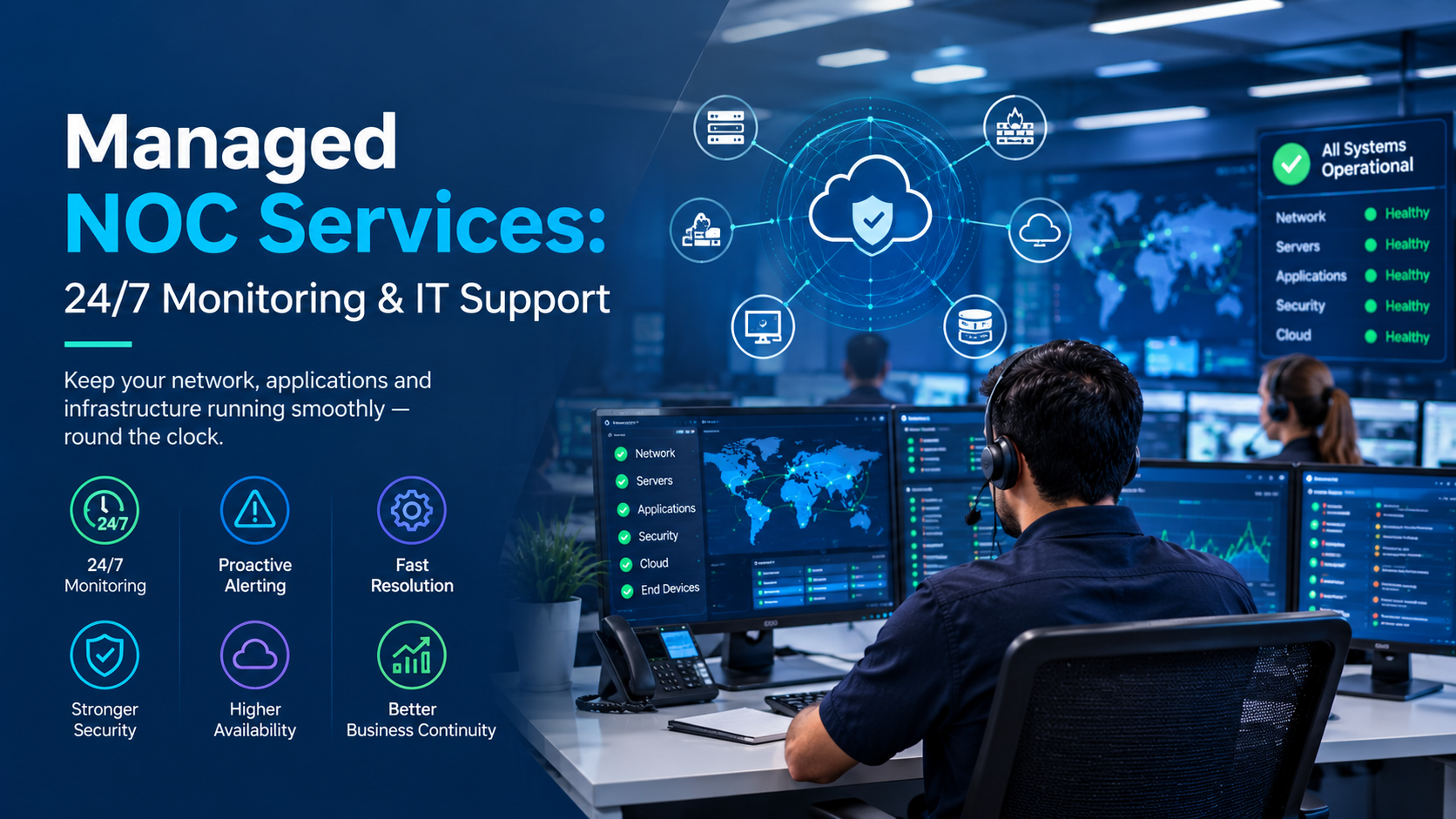
Managed NOC services give businesses a dedicated team that provides 24/7 monitoring and IT support for their entire technology environment. Instead of reacting after a server crashes or a network slows down, the team spots warning signs early and fixes them before users notice. For companies that cannot afford downtime, this is the difference between a quiet fix at 2 a.m. and a costly outage during business hours.
What Are Managed NOC Services?
A Network Operations Center (NOC) is a central team and toolset that tracks the health, performance, and availability of your IT infrastructure. With managed NOC services, a specialist provider runs this function for you. Engineers watch your networks, servers, cloud platforms, and applications, respond to alerts, and escalate issues based on agreed service levels. You get the capability of an enterprise operations center without building one yourself. For a deeper primer, read our guide on what a NOC is and how it works.
How 24/7 Monitoring Works
Monitoring is the foundation of the service. Tools collect data from devices and systems continuously, and engineers review it against set thresholds and normal behavior patterns.
Detect
Agents and probes track bandwidth, latency, CPU, memory, disk space, and application response times. Anything outside the normal range raises an alert straight away.
Diagnose
Engineers check whether an alert is a real fault, a symptom of a bigger problem, or a false alarm. Correlation tools group related events so the root cause is easier to find.
Resolve
Common issues are fixed under documented runbooks. Complex ones move to senior engineers or your internal team with full context, so nobody starts from zero.
IT Support Beyond Monitoring
Watching systems is only half the value. A good NOC also acts on what it sees.
-
Incident management: logging, prioritizing, and closing issues against clear response times
-
Patch management: scheduling updates to close security gaps without disrupting work
-
Configuration management: tracking changes so unplanned edits do not cause outages
-
Capacity planning: spotting growth trends before systems run out of room
-
Vendor coordination: working with ISPs and hardware vendors to speed up repairs
-
Reporting: regular summaries of uptime, incidents, and areas to improve
Key Benefits of Managed NOC Services
-
Less downtime: problems are caught early, often before users notice
-
Lower cost: no need to hire for three shifts or buy enterprise monitoring tools (see our breakdown of managed NOC vs. in-house NOC)
-
Predictable budgets: fixed monthly pricing replaces unpredictable emergency spending
-
Focused internal teams: your IT staff work on projects instead of overnight firefighting
-
Scalability: coverage grows with new offices, cloud workloads, and users
-
Better compliance: continuous logs and records support audits
NOC and Security Working Together
Availability and security are closely linked. A sudden traffic surge may be a failing device or an attack. When NOC and security teams share data, they spot patterns faster and react with better context. Our comparison of NOC vs SOC explains how the two functions differ and where they overlap. Regulated sectors also benefit from continuous monitoring that supports standards such as PCI DSS.
What to Look for in a Provider
Not every provider delivers the same quality. Check these points before you sign:
-
Defined SLAs for both response and resolution time
-
Genuine 24/7 staffing with experienced engineers, not just on-call cover
-
Coverage across network, server, cloud, and application layers
-
Transparent dashboards and regular service reviews
-
Clear escalation paths and communication
-
Pricing that scales without hidden fees
Our guide on how to choose a managed NOC provider includes a full evaluation checklist, and our overview of managed NOC pricing models explains what drives cost.
Metrics That Show It Is Working
Good providers report on numbers, not promises. Review these every month:
-
Uptime percentage: overall availability of key services
-
MTTD (Mean Time to Detect): how fast issues are spotted
-
MTTR (Mean Time to Resolve): how fast they are fixed
-
Ticket trends: whether recurring problems are shrinking
See key NOC metrics explained for benchmarks and targets.
Conclusion
Reliable IT is not about avoiding every problem. It is about catching problems early and fixing them fast. With managed NOC services, you get round-the-clock visibility, expert IT support, and a calmer operations team, without the cost of building a center in-house. If your business depends on uptime, a managed NOC is one of the most practical investments you can make.

 English
 Arabic
 Spanish
 Portuguese
 Deutsch
 Turkish
 Dutch
Dutch
 Italiano
 Russian
 Romaian
 Portuguese (Brazil)
 Greek
Greek