


Field Service Management in 2026: Emerging Trends, Leading Vendors, and Buyer Insights
A technician arrives at a customer site and discovers they brought the wrong part. The job is rescheduled, the customer is frustrated, and the cost of a second visit lands on the service team. Multiply that by hundreds of jobs a week and the damage to margins and loyalty becomes clear.
That is why Field Service Management (FSM) has become a priority for organizations that depend on technicians, engineers, and mobile workforces. Customers expect fast, accurate, and transparent service, while operations teams face tight budgets and growing complexity. This article explains what FSM software does, the challenges and trends shaping the market, and how buyers can evaluate vendors using QKS Group's SPARK Matrix™ research.
Market Overview: What Is Field Service Management?
According to QKS Group, FSM software is used to handle an organization's field operations by streamlining scheduling, dispatch, contract management, and reporting while integrating advanced technologies for improved service delivery.
Most platforms bring together these capabilities:
- Scheduling and dispatch to match the right technician to the right job
- Contract management to track service agreements and entitlements
- Asset work history summaries so technicians can see past maintenance records before they arrive
- Reporting on performance, completion, and service quality
- Generative AI chatbots that assist with troubleshooting and automate work order creation
- Customer self-service portals for booking appointments and tracking requests
- AR-based remote assistance and training for real-time expert guidance and interactive learning
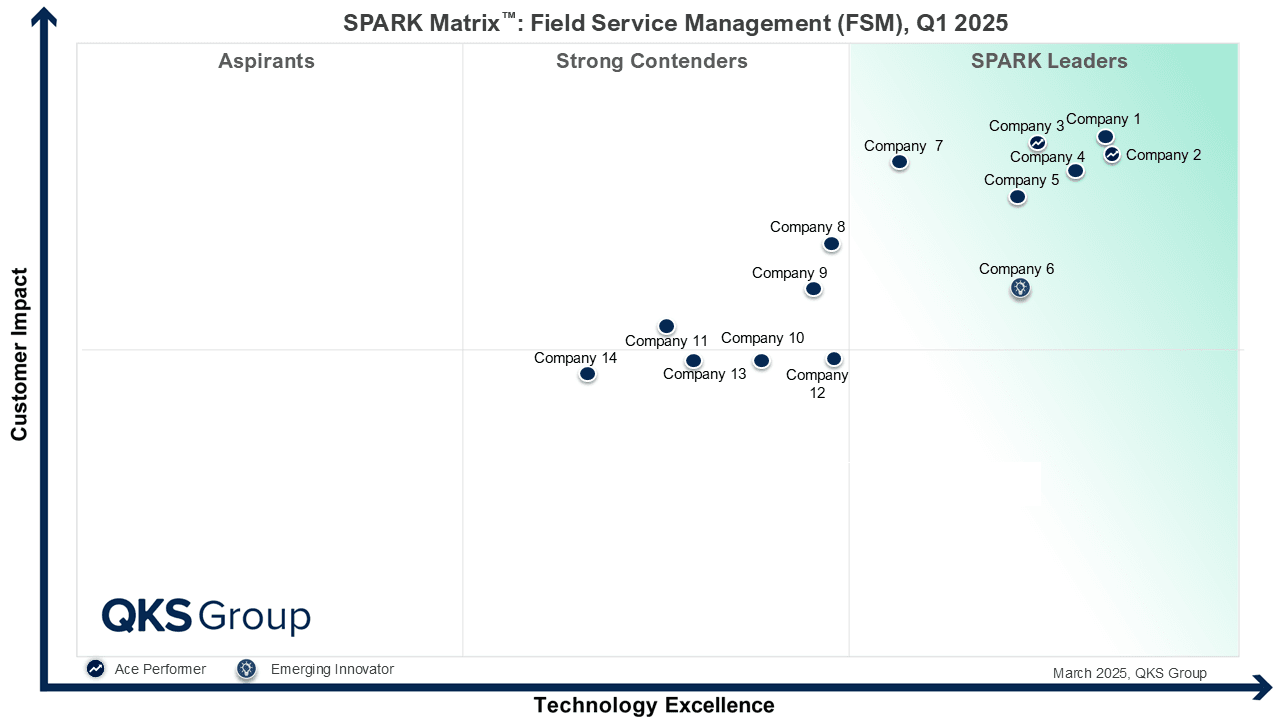
QKS Group's SPARK Matrix™ analysis includes vendors such as IFS, KloudGin, Microsoft, Nomadia, Nuvolo, Oracle, OverIT, Praxedo, PTC, Salesforce, SAP, ServiceNow, ServicePower, and Syncron. They come from different origins, including enterprise applications, CRM, asset management, and specialist service platforms, so a structured comparison is essential.
Key Challenges Businesses Face
- Inefficient scheduling. Manual planning leads to idle time, long travel, and missed appointment windows.
- Low first-time fix rates. Technicians without the right information, parts, or skills need repeat visits.
- Disconnected systems. CRM, ERP, inventory, and asset data often sit apart, limiting visibility.
- Skills shortages. Experienced technicians are retiring, and new hires need faster onboarding.
- Rising customer expectations. Customers want live updates, narrow arrival windows, and self-service options.
- Limited performance visibility. Without clear reporting, leaders struggle to measure productivity and service quality.
Key Trends and Innovations
Generative AI assistance. Chatbots help technicians troubleshoot issues and create work orders faster. Buyers should test accuracy and use of trusted knowledge sources, not just demo appeal.
AR-based remote assistance. Remote experts can guide on-site staff in real time, reducing travel and resolving complex issues sooner.
AR-driven training. Interactive modules help new technicians build skills faster and with less supervision.
Customer self-service. Portals let customers book appointments and track requests, reducing call volume and improving transparency.
Asset history at the point of work. Technicians who can see prior maintenance records make better decisions on site.
Connected and predictive service. Linking FSM with asset and IoT data supports proactive visits before failures occur.
Benefits and Business Impact
When implemented well, Field Service Management can deliver:
- Higher first-time fix rates through better information and preparation
- Improved technician productivity with optimized routes and schedules
- Lower operating costs by reducing repeat visits and travel time
- Better customer experience through transparency and self-service
- Faster onboarding with AR-based training and guided support
- Stronger service revenue through better contract and entitlement management
Use Cases and Real-World Examples
These are illustrative scenarios of typical applications:
- Equipment manufacturers. A manufacturer uses asset history so technicians arrive knowing past repairs and likely parts.
- Utilities and energy. A provider dispatches crews by skill and location to restore service faster.
- Healthcare and facilities. A facilities team tracks service requests and maintenance across buildings and devices.
- Telecom and technology. A provider offers customers self-service booking and live tracking of technician arrival.
- Remote expert support. A junior technician resolves a complex repair with live AR guidance from a senior engineer.
How Organizations Can Choose the Right Solution
Start with your biggest service pain points, such as repeat visits, slow response, or poor visibility. Then evaluate vendors on:
- Scheduling and dispatch strength for your workforce size and complexity
- Integration with CRM, ERP, asset management, and inventory systems
- Mobile experience for technicians, including offline use
- AI and AR capabilities that are practical, not just promotional
- Customer self-service options
- Reporting and analytics for service performance
- Scalability across regions, teams, and service types
- Time to value, including implementation effort and cost
- Vendor viability, including roadmap, ecosystem, and support
QKS Group's SPARK Matrix™ for Field Service Management ranks and positions leading vendors with global impact, offering buyers an independent shortlisting reference and giving vendors a benchmark for strategy.
Future Outlook: 2026–2029
Expect these shifts in the coming years:
- Wider use of generative AI for troubleshooting, work order creation, and knowledge access
- Growth in AR for remote assistance and technician training
- Closer links between FSM, asset management, and IoT data
- More customer-facing self-service and real-time transparency
- Service moving from a cost center to a measurable revenue and loyalty driver
Vendors that combine intelligent scheduling, practical AI, and strong integration are likely to stand out.
Conclusion
Service quality is now part of the product. Field Service Management platforms help organizations send the right technician, with the right information, at the right time, and keep customers informed along the way. The right choice depends on your service model, systems landscape, and customer expectations.
QKS Group's SPARK Matrix™ research provides a vendor-neutral view of the market to support that decision.
1. What is Field Service Management (FSM)?
FSM software handles an organization's field operations by streamlining scheduling, dispatch, contract management, and reporting while integrating advanced technologies to improve service delivery.
2. What features do FSM platforms typically offer?
They commonly offer scheduling and dispatch, contract management, asset work history summaries, reporting, generative AI chatbots, customer self-service portals, and AR-based remote assistance and training.
3. How does AI help field service teams?
Generative AI-powered chatbots assist technicians with troubleshooting and automate work order creation, helping teams resolve issues faster and reduce administrative effort.
4. How does AR improve field service?
AR-based remote assistance gives customers and on-site staff real-time expert guidance, while AR-driven training modules offer technicians interactive learning experiences.
5. Which vendors does QKS Group's FSM SPARK Matrix™ include?
The analysis includes vendors such as IFS, KloudGin, Microsoft, Nomadia, Nuvolo, Oracle, OverIT, Praxedo, PTC, Salesforce, SAP, ServiceNow, ServicePower, and Syncron.

 English
 Arabic
 French
 Spanish
 Portuguese
 Turkish
 Dutch
Dutch
 Italiano
 Russian
 Romaian
 Portuguese (Brazil)
 Greek
Greek