


Inside Techemer’s Advanced Composite Materials: The Science Behind High-Performance Hydro Turbine Bearings
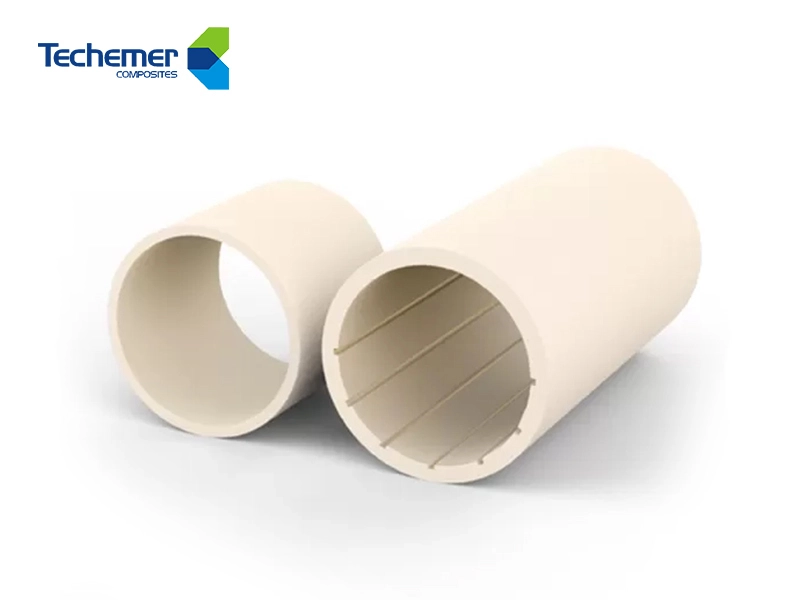
At first glance, a turbine bearing looks like a simple sleeve or set of pads. The real sophistication is hidden inside the material. Water-lubricated bearings must carry heavy loads, run on a thin film of water, resist abrasion, and survive years of wet service without swelling or losing shape. Meeting these demands takes careful materials science. Techemer works with advanced composite and polymer formulations designed for exactly this environment. Understanding what goes into these materials helps engineers and plant managers appreciate why modern polymer bearings have become a serious option in hydropower.
What Makes a Composite Different
A composite combines two or more materials so the result performs better than any single ingredient alone. In bearing applications, a polymer matrix may be combined with reinforcing fibers or fillers that increase strength, stability, and wear resistance. The matrix provides toughness and the ability to absorb shock, while the reinforcement helps the material hold its shape under load. By adjusting the mixture, engineers can fine-tune properties such as hardness, stiffness, and friction behavior. This flexibility is a major advantage, because different turbines and operating conditions call for slightly different characteristics, and a tunable material can be matched to the job more precisely.
Friction, Heat, and the Water Film
In a water-lubricated bearing, the shaft rides on a thin film of water that separates it from the bearing surface. When the film is stable, friction is very low and wear is minimal. When the film breaks down, such as at very low speed, contact occurs and heat builds up. Material design plays a key role here. Surface properties that encourage water to spread evenly help form and maintain the film, while low-friction characteristics reduce heat during contact. Good hydro turbine bearings balance these factors so that the bearing performs well not just at rated speed but also during starting, stopping, and transient conditions.
Dimensional Stability in Wet Service
Many polymers absorb water and swell, which can change clearances and cause the bearing to bind or lose its intended fit. Stability in wet service is therefore essential. Material formulations are chosen to minimize water absorption and to remain consistent across temperature changes. Even small dimensional changes can matter, because bearing clearances in turbines are tight. Engineers also account for thermal expansion when selecting dimensions and tolerances. By paying attention to how the material behaves after long exposure to water, Techemer aims to deliver bearings that keep their fit and performance throughout years of continuous operation in a plant.

Resistance to Abrasion and Shock
Hydropower environments introduce sand, silt, and occasional debris, along with vibration and sudden load changes. Composite materials can be tailored to respond to these challenges. A slightly elastic surface lets hard particles embed rather than scratch the shaft, while a tough body resists cracking when shocks occur. The balance is delicate, since a material that is too soft wears quickly and one that is too hard can damage mating parts. Careful testing helps identify the best combination for each application. This research effort, though invisible to plant visitors, is a major reason some bearings outlast others in demanding rivers.
From Laboratory Testing to Field Experience
Laboratory tests measure friction, wear rate, load capacity, and water absorption under controlled conditions. They provide valuable comparisons, but they cannot capture every real-world variable. Field experience in working power plants completes the picture, revealing how materials behave through seasons, floods, and long operating cycles. Techemer combines both sources of knowledge to refine its materials. Buyers evaluating any bearing should ask for this evidence, including operating hours and wear measurements from comparable installations. When science and experience agree, engineers can specify with confidence, knowing the material has been proven in conditions that resemble their own.

 English
 Arabic
 French
 Spanish
 Portuguese
 Deutsch
 Turkish
 Dutch
Dutch
 Italiano
 Russian
 Portuguese (Brazil)
 Greek
Greek