


Specialty Paper Market Growth Reflects Rising Adoption Across Packaging Foodservice And Industrial Applications
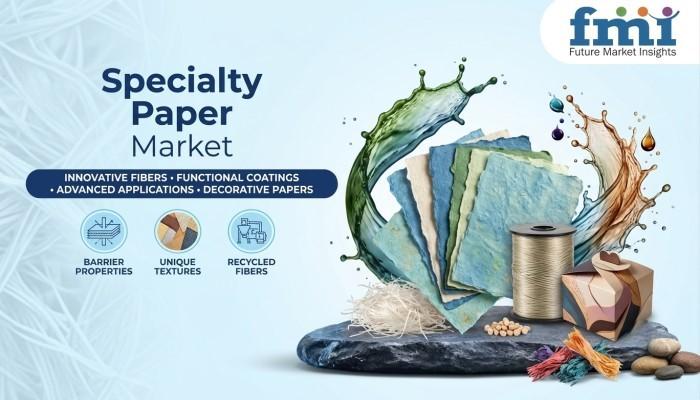
The global specialty paper market is entering a period of sustained expansion as brands, converters, and manufacturers look for fiber-based alternatives to single-use plastics without giving up performance. According to Future Market Insights (FMI), the market is valued at USD 18.9 billion in 2026 and is projected to reach USD 31.1 billion by 2036, advancing at a 5.1% CAGR during the forecast period.
The shift is being supported by rising demand for high-performance cellulose substrates across food service, packaging, industrial applications, and other commercial uses. Manufacturers are also investing in biodegradable barrier coatings and advanced chemical treatments to improve the functional performance of paper while addressing environmental requirements.
Get detailed market forecasts, competitive benchmarking, and pricing trends:
https://www.futuremarketinsights.com/reports/sample/rep-gb-683
Packaging Remains the Largest End-use Application
Packaging represents 39.7% of the specialty paper market in 2026, making it the leading end-use segment. The position reflects growing requirements for protective packaging as e-commerce expands and brands reassess material choices.
Converters are increasingly using specialty grades for applications where strength, barrier performance, printability, and handling properties need to work together. Greaseproof paper sheets, thermal grades, and other engineered substrates are gaining relevance in food service and logistics applications.
The market is also responding to the need for lighter packaging. Packaging engineers are emphasizing lightweight kraft and thermal grades to improve shipping efficiency while retaining required material performance.
Kraft Paper Leads the Product Landscape
Kraft paper accounts for 31.6% of the market in 2026, making it the leading product type. Its tensile strength and printability support demand across packaging and industrial applications.
Refining improvements are also helping producers pursue downgauging without compromising structural integrity. The growing preference for unbleached and renewable-looking packaging is adding to the relevance of kraft grades as companies seek alternatives to fossil-fuel-based packaging.
Coatings and Fiber Engineering Create New Opportunities
Technology development is increasingly focused on improving the performance of cellulose fibers. Manufacturers are combining specialty pulp and paper chemicals with bio-based polymers to create water-resistant barriers.
Flexible packaging paper is also being developed with heat-sealability comparable to polymer films. Synthetic paper innovations are supporting weather-resistant sheets while retaining printability.
These developments point to a wider shift in the specialty paper industry. Sustainability is no longer being considered separately from performance. Procurement teams and packaging engineers increasingly need materials that can meet both requirements.
Regional Growth Varies Across Major Markets
China is projected to record the fastest growth among the countries highlighted in the FMI assessment, with a 7.1% CAGR from 2026 to 2036. Green packaging initiatives, investment in high-speed paper machines, and demand for premium packaging are supporting expansion.
Germany follows with a 6.0% CAGR, supported by technical applications, circular economy priorities, recycled fiber use, and bio-based coating adoption.
The United States specialty paper market is forecast to grow at 5.1% CAGR, supported by food service, e-commerce logistics, sustainable packaging adoption, and demand for fluorochemical-free papers.
Japan is projected to grow at 4.8% CAGR, while India is expected to expand at 2.6% CAGR over the assessment period.
Competitive Landscape
Competition is increasingly centered on higher-value specialty grades rather than commodity paper alone. Key participants identified by FMI include International Paper, Mondi Group, Stora Enso, UPM-Kymmene, Sappi Limited, Domtar Corporation, Nippon Paper, Fedrigoni, Glatfelter, and ITC Paperboards.
International Paper holds an 18% share, according to the supplied FMI assessment. The competitive landscape also includes investment in barrier coating lines, development of recyclable plastic-free cups and trays, strategic collaborations with FMCG companies, and exploration of alternative fibers such as bamboo and bagasse.
For manufacturers, profitability and operational efficiency remain important considerations. Specialty grades typically command gross margins of 18% to 24%, compared with around 10% for commodity papers. The report also highlights packaging-sector inventory turnover averaging 4.0x to 5.0x annually and EBITDA margins of 15% to 19% for top specialty performers.
Report Scope
FMI's Specialty Paper Market analysis covers the market by product type, end-use application, raw material, and region.
Product types include Kraft paper, Décor paper, Thermal paper, Carbonless paper, and Others. End-use applications include Packaging, Printing & writing, Building & construction, Industrial, and Other commercial end use.
The raw material analysis covers Virgin fiber, Recycled fiber, and Synthetic/hybrid compositions. The regional assessment covers North America, Europe, East Asia, South Asia, Latin America, and MEA.
Related Report Links:
https://www.openpr.com/news/4653423/box-filling-machine-market-to-reach-usd-171-0-million-by-2036
https://www.openpr.com/news/4653425/industrial-chemical-packaging-market-to-reach-usd-102-97
https://www.openpr.com/news/4653426/corrugated-automotive-packaging-market-set-to-reach-usd-34-5
FMI Custom Research: Strategic Intelligence for Confident Decision-Making
In today’s rapidly evolving business environment, leadership teams need more than market data—they need clear, actionable intelligence tailored to their strategic objectives. FMI’s Custom Research solutions are designed around the specific business questions organizations need answered, enabling executives to evaluate growth opportunities, validate investments, assess competitive dynamics, and reduce uncertainty before making critical decisions. By combining deep industry expertise, primary research, and proprietary market intelligence, FMI delivers insights that help organizations move from assumptions to evidence-based strategies with greater speed and confidence.
Business Impact
FMI helps organizations transform market complexity into strategic clarity, enabling leadership teams to identify growth opportunities faster, optimize resource allocation, strengthen competitive positioning, and make high-stakes business decisions with confidence.
To explore how FMI Custom Research can support your strategic priorities, please connect with our team at – sales@futuremarketinsights.com
About Future Market Insights (FMI)
Future Market Insights, Inc. (FMI) is an ESOMAR-certified, ISO 9001:2015 market research and consulting organization, trusted by Fortune 500 clients and global enterprises. With operations in the U.S., UK, India, and Dubai, FMI provides data-backed insights and strategic intelligence across 30+ industries and 1200 markets worldwide.

 English
 Arabic
 French
 Spanish
 Portuguese
 Deutsch
 Turkish
 Italiano
 Russian
 Romaian
 Portuguese (Brazil)
 Greek
Greek