


Understanding 7-Hydroxymitragynine in Modern 7-OH Products
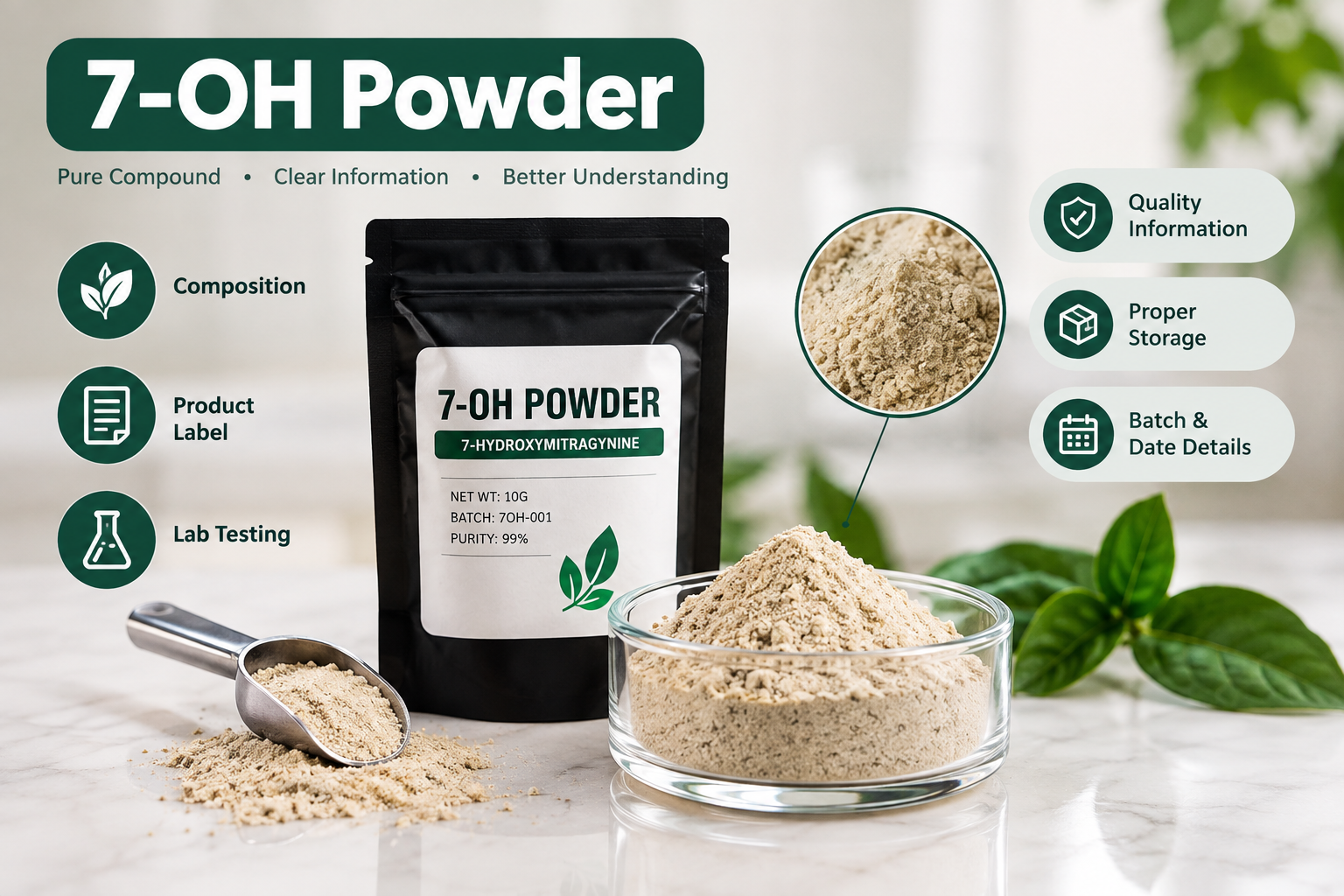
7-hydroxymitragynine, commonly shortened to 7-OH, is an alkaloid associated with Mitragyna speciosa, commonly known as kratom. Today, products identified with 7-OH can appear in several different formats, including powders, tablets, capsules, and vape formulations.
Although these products may share the same named compound, their formulations, physical characteristics, packaging, and product specifications can be very different. Understanding the role of 7-hydroxymitragynine provides useful context when reading product labels and comparing different formats.
What Is 7-Hydroxymitragynine?
7-hydroxymitragynine is one of the alkaloids associated with Mitragyna speciosa. It is chemically distinct from other compounds found in the plant and can be present naturally at relatively low levels.
The term 7-OH is generally used as a shortened reference to 7-hydroxymitragynine. However, the presence of the term on a product label does not independently confirm the identity, concentration, or purity of the material.
For that reason, product documentation and appropriate laboratory analysis are more informative than appearance or product naming alone.
7-OH in Different Product Formats
One of the notable characteristics of modern 7-OH products is the range of available formats.
Powder products contain the material in a dry, solid form. Product information may focus on net weight, stated composition, batch identification, and laboratory testing.
Tablets or tabs use a compressed solid format. Their labels may provide information about the number of tablets, stated amount per tablet, total contents, ingredients, and manufacturing details.
Capsules contain a measured solid formulation inside an outer capsule. Packaging can include capsule count, stated contents, batch information, and other specifications.
Vape products use an electronic device containing a liquid formulation. These products introduce additional specifications such as liquid volume, battery configuration, heating elements, airflow, and device capacity.
These formats should not be treated as interchangeable simply because they reference the same compound.
Reading 7-OH Product Labels
Product labels are an important source of basic information. Depending on the format, a label may identify the product name, ingredients, stated 7-OH amount, net contents, batch number, manufacturing information, and storage instructions.
The measurement used for the stated amount is particularly important. A total amount, concentration, and amount per unit represent different measurements.
For example, a tablet label may state an amount per tablet, while a vape may describe a concentration or total amount associated with the liquid. Comparing these numbers without considering their measurement basis can lead to confusion.
The Importance of Batch Numbers
A batch or lot number can connect a product to a specific manufacturing run. This information becomes particularly useful when laboratory documentation is available.
A matching batch number can help determine whether a certificate of analysis relates to the product being evaluated. Without corresponding identification information, a generic laboratory report may provide limited information about a particular product.
Manufacturing dates can also help establish when a product was produced and provide context for its storage history.
What Can Laboratory Testing Tell You?
Laboratory testing can provide information that is not available from appearance or packaging alone. A certificate of analysis, commonly called a COA, may report analytical results for a tested sample.
Depending on the laboratory and testing scope, a report can include the sample identification, testing date, analytical method, and measured concentration of selected compounds.
A COA should be interpreted within the limits of the tests performed. Testing for 7-hydroxymitragynine does not automatically verify every ingredient in a product, and results from one production batch should not automatically be applied to another.
Laboratory results also should not be interpreted as proof that a product is safe for human consumption or inhalation.
Product Stability and Storage
Storage can influence the condition of 7-OH products. Temperature, moisture, light, and exposure to air may affect certain formulations and packaging materials over time.
Dry products may require protection from moisture, while liquid formulations may have additional storage considerations related to temperature and container integrity.
Following manufacturer-provided storage information and keeping packaging properly sealed can help maintain the product within its intended storage conditions.
Why Product Documentation Matters
Modern 7-OH products can vary considerably even when they use similar terminology. A product's actual specifications are better understood by reviewing multiple sources of information.
Ingredient declarations explain what the manufacturer reports using. Product specifications provide details about quantity and format. Batch numbers connect products with production records, while laboratory reports can provide analytical information about tested samples.
Considering these details together provides a more complete picture than relying on a product name or marketing description alone.
Final Thoughts
7-hydroxymitragynine is an alkaloid associated with Mitragyna speciosa and is now referenced across several different product formats. Powders, tablets, capsules, and vape products can all have different formulations and specifications despite identifying the same compound.
When evaluating a 7-OH product, pay attention to the stated amount, measurement units, ingredient information, batch identification, manufacturing details, storage instructions, and available laboratory documentation.
The health effects and risks associated with concentrated 7-OH products, particularly through different routes of administration, are not sufficiently established. Product specifications and laboratory results should therefore be understood as information about composition and testing—not as evidence that a product is safe.

 English
 French
 Spanish
 Portuguese
 Deutsch
 Turkish
 Dutch
Dutch
 Italiano
 Russian
 Romaian
 Portuguese (Brazil)
 Greek
Greek